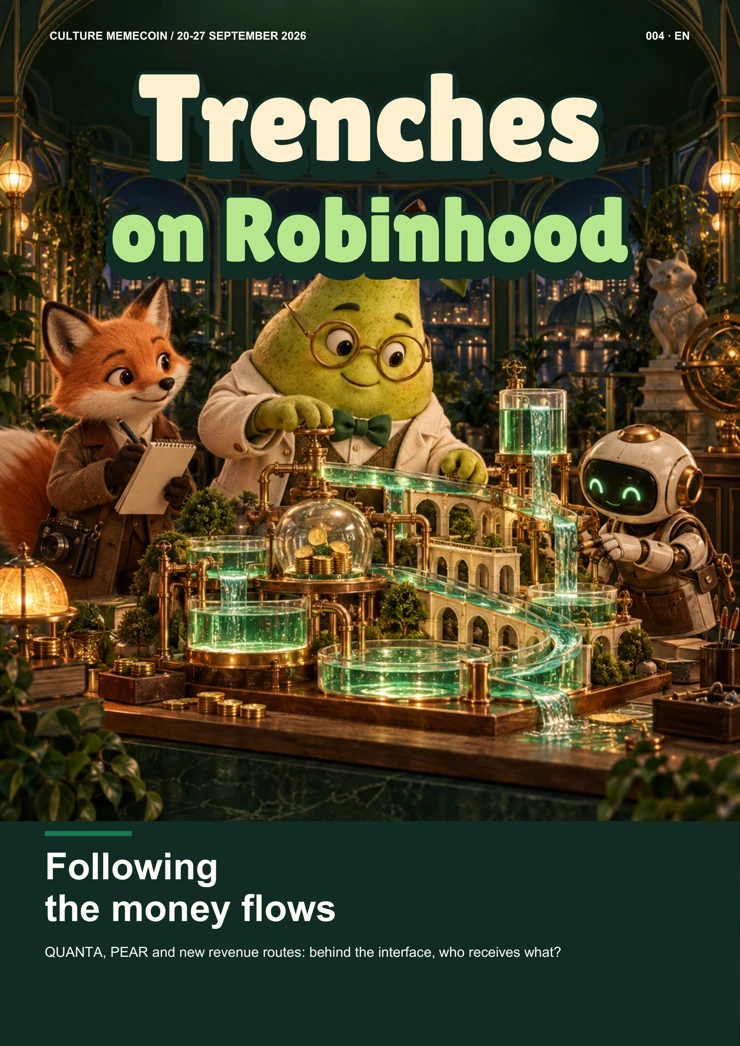
After the nickname, the evidence
Tools are being built, and users are beginning to question them.
“The Meteora of Robinhood”: fifteen minutes is enough to create a shorthand. A pear can also stand for an entire platform. These images make a product approachable; the exchanges that follow reveal expectations.
This week QUANTA had to explain its token’s role, then show operations. PEAR separated distributions for its launched coins from those for its own holders. Our September 27 follow-up adds announcements and counters to those opening scenes, without turning a dashboard into an audit.
The accompanying feature examines that shift: attention to price is joined by questions about flows. Describing these routes means keeping their recipients, conditions and the actual scope of available evidence in view.
 Written by Jérôme L.
QUANTA: beyond the nickname, the product

An electric-green interface, liquidity pools and public answers about the token’s role: Quanta Pools brings an infrastructure narrative to Robinhood Chain. Its reported ATH reached a $1.38 million market cap on September 24 at 02:15 Paris time, during a night of demonstrations and questions.
By 21:17, the shorthand has already landed
Under the Quanta Pools announcement, PopeCalls sums up the project in a few words: “Basically meteora of RH”. It is 21:17 in Paris on September 23. Fifteen minutes after the official post announcing mainnet availability, a reader has already supplied its most shareable comparison. There is no animal to recognise or catchphrase to remix: a familiar platform has been transplanted into the imagination of another blockchain. [2] [3]
The comparison begins with Quanta itself, which describes the project as its version of Meteora for Robinhood Chain. That gives traders a reference point; it establishes neither a partnership with Meteora nor equivalence between the products. The distance between an appealing comparison and a service that still needs to prove itself is what makes QUANTA’s first hours interesting. [2]
At 02:15 on September 24, the peak reported to the editorial team reaches a $1.38 million market capitalisation. That figure and time are this article’s reference point; the exact peak has not been independently verified. Subsequent announcements belong to the next part of the story and cannot retrospectively explain its initial trigger.
Green waves instead of a mascot
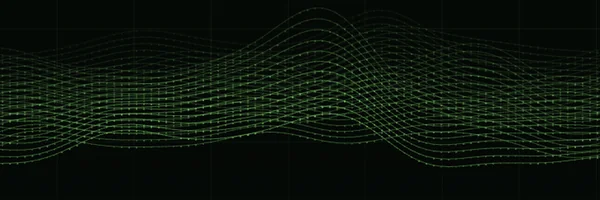
The website welcomes visitors into an almost entirely black setting. Green dots form undulating sheets; a grid and technical labels surround a promise of liquidity for Robinhood Chain. The token’s banner repeats those waves. The eye is directed towards flows, connections and markets rather than a character. [1] [12]
This identity accompanies a project presenting itself as independent infrastructure. The contract supplied to the editorial team appears on the website, in the X announcement and in DexScreener’s listed markets: 0x1da81ca017949efbe07972776580d04592ba9b63. That cross-check ties these sources to the same QUANTA. The site also states that the project is not affiliated with, sponsored by or endorsed by Robinhood. [1] [2] [12]
Our reading is that the narrative shifts attention: after the tokens people trade come the tools intended to make those trades possible. For participants, backing QUANTA becomes a bet on its place in the ecosystem. That is an interpretation of its positioning, not a measurement of adoption.
How liquidity providers change the story
The intended audience extends beyond people buying a token. Quanta addresses liquidity providers, or LPs: people depositing assets into pools used for swaps. Its announcement brings together DLMM, DAMM, position management and dynamic fees. Meteora’s documentation helps explain the reference: its terminal offers functions including creating and tracking positions, claiming fees and rebalancing liquidity. It does not validate Quanta’s implementation. [2] [13]
On its own website, Quanta describes a router intended to compare several liquidity sources: internal pools, Pons markets and external Uniswap v4 liquidity. Its stated ambition is to bring those paths into one interface, with slippage, deadline and Pons token-lifecycle checks. For users, the promise is less movement between separate tools. [1]
The project also distinguishes volatile launch tokens, tokenised stocks and future approved real-world assets. The last category is presented as a future extension. Including these assets in an architecture does not mean a corresponding catalogue of markets is already available. The difference between the proposed scope and the observable offering runs throughout the presentation. [1]
Readers start looking behind the interface
The conversation is not entirely enthusiastic. At 21:08, gootshed claims the counters then displayed do not match the API responses he is examining. That is a participant’s published criticism, not a finding we reproduced at that time. It nevertheless shows that some readers are already looking behind the presentation. [5]
During our September 24 visit, the application initially displays an unavailable indexer before synchronising and showing two discovered pools and three registered assets. That loading sequence matters: a temporary zero would have produced a misleading snapshot. The depth chart is described as illustrative, so we do not treat it as evidence of millions of dollars deposited. [4]
These observations neither settle the earlier discussion nor constitute an audit. They provide a more precise picture of the visible development stage: an accessible interface, data that loads and functions whose operation needs to be assessed separately. A technical badge or an attractive curve cannot, by itself, answer every user question.
At 02:51, the next worksite is Telegram
After the reported peak, Quanta says its Telegram liquidity terminal is approximately 40% built. The proposed functions describe a practical routine: discovering pools, comparing DLMM and DAMM, tracking fees, finding positions, adjusting ranges and rebalancing deposits. The account explicitly describes a product still under construction. [6]
The appeal of this format lies in an existing habit: discussions and alerts already circulate in messaging apps. The developer wants position monitoring and management closer to those conversations. Our interpretation is that this promise concerns user convenience as much as technology. The completion percentage remains the developer’s statement; it cannot establish that the terminal is a finished service.
“What’s the role of the token?” changes the conversation
SpeedRacer asks what QUANTA does: buybacks, burns, an airdrop? He wants a post explaining the tokenomics. At 04:26, the account replies that 95% of protocol fees will be used for QUANTA buybacks and burns. The reader thanks the account and expresses interest. In this short exchange, the discussion moves from the product to how its token might benefit. [7]
The subsequent answers matter just as much. Asked whether the mechanism is automatic or manual, Quanta says at 04:31 that automation is still being worked on. When Daniel.HL asks which wallet will perform the operations, the account replies at 04:48 that it is setting up the system and promises an update. [8] [9]
This is therefore an announced allocation of protocol fees, not 95% of trading volume, nor evidence in those posts of buybacks already executed. These details also arrive more than two hours after the reported ATH. They add to the project’s economic narrative without establishing the cause of that earlier peak.
A demonstration with a trace to follow
At 06:11, Quanta publishes a DAMM v2 swap demonstration through its SmartRouter and supplies a transaction link. This time, readers can leave the X thread to check a specific record: Blockscout marks the transaction successful on September 24 at 05:52:42 Paris time. It originates from the address presented as the deployer and interacts with the contract identified by the website as SmartRouter. [1] [10] [11]
The visible transfers show WETH passing into USDG through contracts on the announced route. That is a specific execution trace, more informative than a demonstration button alone. Its significance remains that of one operation: it does not measure protocol traffic, the depth of all its pools or the reliability of every promised feature. [11]
The next chapter will be written through use
QUANTA enters the Runners section with a story different from a mascot going viral. Its raw material combines a familiar comparison, product images, questions addressed to a developer and early evidence readers can inspect. The community is not merely repeating a name: it asks what revenue might reach the token and what already works.
The reported $1.38 million peak brings that sequence into view. The next meaningful developments will be repeated usage, positions actually managed and verifiable implementation of the announced mechanisms. The nickname “Meteora of Robinhood” offered an opening in the conversation. What follows depends on what users can do with the product, then tell one another about.
September 27 follow-up — Jérôme L.
The promised next chapter has begun taking shape. At 12:42 Paris time on September 27, Quanta says it has deployed its automated buyback and burn system: 95% of eligible fee revenue should buy and burn QUANTA, with 5% going to the treasury. A separate post supplies addresses for system components. These are developments since the September 24 replies, rather than evidence that every future flow will execute as intended. [23] [25]
That day the team also publishes a video showing an LP position withdrawal: selecting the position and amount, previewing returned assets, then confirming in a wallet. Moving from a swap to a withdrawal broadens what the project shows. This is Quanta’s demonstration; we committed no funds to reproduce it. It documents a product step without establishing adoption at scale. [24]
Written by Emma C.
PEAR: one pear, two reward routes

On Robinhood, PEAR combines coin launches with stock-token distributions. Behind the fruit sit two reward routes and a community discovering the mechanism. Reported ATH: $991K on September 25 at 08:56 Paris time.

A pear that wants to grow stocks
A pixelated green pear for a logo, a green gradient and the name PearOnPons across its banner: PEAR arrives with an identity simple enough to fit inside a token list. Its accompanying story extends beyond the fruit. On Robinhood, the project proposes linking memecoins to stock tokens, then using trading fees to deliver assets to holders’ wallets. The pear/pair wordplay becomes a description of the product. [14] [16]
The peak supplied to the editorial team is a market capitalisation of $991,000 on September 25, 2026 at 08:56 Paris time. This reference concerns PEAR at 0x383562778894760d53a247c97686284931bb28cc. It should not be confused with coins created through its platform, even when their names reuse the same pear. Understanding this runner requires following two layers: a launch tool and a token intended to benefit from its activity.
From 02:34 to the first relays
The launch post’s version reviewed here shows a last edit at 02:34 on September 25. It provides the exact contract and describes an engine intended to scan coins every fifteen minutes, convert their fees on Uniswap and automatically distribute stock tokens. The main PEAR/ETH pair returned by DexScreener also carries a creation timestamp of 02:34. These markers document the observed start, without establishing when the project was conceived. [15] [16]
At 02:56, @Alpha_Untold asks whether there is room for a community. At 03:44, @treyerl shares the contract with an immediately understandable argument: passive stock payouts. He also says the developer’s identity is unknown, while attributing the launch to the Pons circle. That attribution is his; the PearOnPons account name alone does not establish membership of the Pons team. [17] [19]
Five minutes later, @bajieChina quotes that message and invites his audience to look at the pear. The shift into Chinese commentary shows the same proposition travelling between audiences. At 07:21, @RobinhoodAlphah expresses a favourable impression beneath the announcement. X labels this account a fan account: its reaction is not an endorsement by Robinhood. [18] [20]
Choosing a basket before launching a coin
The interface foregrounds a selection of tokens associated with names such as Nvidia, Tesla, Apple and Microsoft, alongside references including SPY, QQQ and GLD. Creators choose the assets they want to associate with their coin. That choice gives the story substance: behind a humorous name, holders are invited to follow a recognisable basket. The catalogue displayed 61 choices when reviewed. [14]
The advertised journey begins on a Pons bonding curve, with trading in ETH. The website sets graduation at 4.2 ETH, followed by migration to Uniswap v4, and describes liquidity as permanently locked. These are the project’s displayed terms, rather than the findings of an audit by us. The narrative attraction is nevertheless clear: launching a meme and selecting financial assets are brought together in one interface. [14]
The word stocks needs a substantive distinction here. The website refers to Robinhood stock tokens, subject to issuer terms and availability. Its own footer says holding a PEAR coin does not mean ownership of the associated companies. The stock-portfolio language used in its communications therefore compresses a more indirect mechanism. [14] [15]
Two separate reward routes
Under the displayed split, 80% of trading fees buy the selected stock tokens for holders of the relevant coin. The remaining 20% feeds a pool intended for PEAR holders. Once that pool reaches its threshold, the site advertises a distribution of stock tokens from a rotating selection, proportional to the PEAR balance held at that moment. A PEAR holder and a PEARCAT holder therefore do not participate in exactly the same reward route. [14]
For the associated coins, the initial announcement describes allocation across the chosen stocks, weighted by both the amount held and holding duration. It advertises neither staking nor manual reward claims. The promise attempts to give people a reason to retain a coin beyond the next price move: watching what it distributes. It describes the claimed operation, without establishing that it will continue indefinitely. [15]
PEARCAT and MANGO make the idea tangible
The first names visible on the platform give the concept a concrete form. PEARCAT, presented as pear cat, links its feline identity to a basket of 60 stock tokens. MANGO takes a different approach: its expanded name, MicrosoftAppleNvidiaGoogleOpenAI, announces its theme, while its listing shows four associated assets. Fruit becomes a naming convention around which several projects can develop. [14]
In the September 25 snapshot, the site displayed 67 launched coins, 18 payout rounds, 3,982 payouts and $6,945.86 of stock tokens bought for holders. A PEARCAT row listed $248.76 for 283 holders; a MANGO row showed $108.32 for 148 holders. These figures come from the project’s dashboard and are not an independent reconstruction of all its transactions. [14]
Crucially, the counters specifically for PEAR holders still showed zero rounds and zero payouts in the same snapshot, with a pool approaching its threshold. The thousands of payouts displayed for the platform as a whole cannot therefore be attributed to PEAR holders. That distinction is essential to reading the claimed traction correctly.
Demonstrations to share, a team to document
In another post, the account announces a $79 payment to one wallet in a single round across PEARCAT’s 60 assets. It also reports an average gas cost equivalent to 0.67% of a round’s fees. These are two demonstration arguments: an individual example that is easy to retell and an efficiency figure. Both remain project statements; the first concerns PEARCAT, and the second does not mean purchases and trades have no costs. [21] [22]
The question raised early by treyerl remains useful: who develops and maintains this engine? The pages and posts reviewed do not supply a verifiable biography of its creator. The article can document an interface, advertised rules and public exchanges, but cannot turn them into a guarantee about the team. The initial conversation thus combines enthusiasm for the mechanism with limited visibility into the people operating it. [14] [17]
$991,000 and a test just beginning
Six hours and twenty-two minutes separate the 02:34 reference point and the reported ATH at 08:56. The relays observed fall within that interval, without allowing the rise to be attributed to any one of them. The peak remains the figure supplied to the editorial team; we have not reconstructed it transaction by transaction.
PEAR offers a distinctive story: making a memecoin the starting point for distributions tied to other assets. Its continuation will depend on measurable facts: coins continuing to generate fees, distributions actually received and documentation of how the system operates. The fruit already has an image, an interface and early relays. The next chapter will show whether those first uses become sustained activity.
September 27 follow-up — Jérôme L.
The September 27 dashboard shows 78 coins, 42 rounds and 9,237 payouts, representing roughly $11,000 in purchased tokens. The PEAR subset is no longer zero: it reports five rounds, 1,806 payouts and $900.76. Round 42 lists $147.28 for 282 holders, with transaction links. These remain interface figures, without an independent recount of all payments. [27]
The offering has also expanded. The menu now includes Pear Memes, Solana and Fees to X. The team claims mixed baskets and cross-chain pairing. That expansion matters for the product but does not change the network of the PEAR contract covered here: Robinhood Chain. One platform name can now lead to several workflows; the address remains necessary to identify the asset. [26] [27]
Written by Jérôme L.
Fees, buybacks, distributions: following the right number
QUANTA and PEAR offer two answers to the same expectation: connecting a token to activity. What their comparison reveals.
Two questions beneath green interfaces
On September 24, a reader asks Quanta what its token does. The next day, a PEAR visitor has to understand why some payments concern PEARCAT and others concern PEAR holders. Both scenes ask something more precise than whether the price rises: what connects product activity to the token being watched? The answers describe different systems despite a shared vocabulary of fees and rewards. [7] [14]
Quanta puts liquidity providers at the centre of its interface. PEAR begins with launching a coin and choosing associated assets. Depositing in a pool, buying a protocol token and holding a coin launched by someone else are not interchangeable actions. They involve distinct mechanisms and assets. The ease with which stories bring them together explains why the public questions matter.
An open network does not provide an endorsement
Robinhood officially describes its chain as open and Ethereum-compatible, independent of brokerage accounts in its main application. Its technical documentation separates mainnet 4663 from testnet 46630, with ETH used for fees. These details establish where projects deploy. They do not endorse tokens appearing there. [28] [29]
The chain’s name nevertheless supplies powerful cultural shorthand. Quanta introduces itself through a comparison with Meteora; PEAR borrows the imagery of a stock portfolio. In both cases readers recognise vocabulary before examining the product. Our interpretation is that this familiarity opens the conversation while making the boundaries between infrastructure, an issuer and an independent team less visible. [1] [2] [14]
A percentage does not describe the whole route
Quanta’s announced 95% refers to eligible protocol fee revenue. It does not mean 95% of trading volume or a payment of that proportion to holders’ wallets. The stated destination is buying QUANTA and destroying it. PEAR advertises a different split: 80% for assets distributed to a coin’s holders, 20% towards a pool for PEAR holders. The same word, fees, therefore leads to different outcomes. [23] [14]
That distinction changes how results can be followed. A buyback and burn should leave evidence of a purchase and removal from circulation. A distribution should identify an asset, an amount and a recipient. None of these events alone determines a holder’s eventual return: entry price and the value of retained assets remain separate information. This is a basic accounting distinction, yet launch conversations often compress it into a promise of income.
From the initial zero to the first rounds
PEAR supplies a dated comparison. Our September 25 snapshot showed thousands of platform payments while counters reserved for PEAR holders remained at zero. On September 27, the latter show five rounds and $900.76. What the interface presents for this category has therefore changed. Describing that change requires preserving the original scope: the platform total was never the PEAR token’s total. [14] [27]
Round 42 adds useful detail: 282 holders and four named assets, NVDA, AAPL, MSFT and GOOGL, representing a displayed $147.28. Such detail enables verification without replacing the work of reconstructing transfers. Another misleading addition should be avoided: a cumulative payout count does not necessarily represent that many different people. One wallet can receive several assets across several rounds. [27]
A demonstration answers one question, not every question
Quanta’s progression takes another form. On September 24, buyback automation was still described as work in progress. On September 27, the account presents deployment and supplies addresses. It also publishes an LP withdrawal workflow. The change goes beyond a fresh image: the operations shown move closer to actions users would need to repeat. The account remains the source of these announcements; publication is not an independent audit. [8] [23] [24]
A demonstrated withdrawal answers a question about that particular workflow. It does not measure how many people can exit simultaneously, market depth or persistent revenue. Conversely, an imperfect loading sequence cannot by itself disqualify every operation. Reporting benefits from keeping those scales separate: an observation, a function, a system, then repeated use.
The next story will be about repetition
These projects add a service promise to the meme. That gives them more possible episodes: a usable feature, a received transfer, a corrected rule or a resolved question. Conversation no longer has to depend entirely on a new image or price target. The richer story also demands greater precision from those describing it.
This week’s comparison does not name a winner. It shows two paths: Quanta attempts to connect liquidity infrastructure to a buyback policy; PEAR connects fees from launched coins to several distribution routes. The next appointment will be less spectacular than a successful nickname: observing what users can still do and receive after the opening demonstrations.
Written by Jérôme L.
The sources, a click away.
Numbered references in the articles point to this list. External links open in a new tab.
- Quanta Pools — website, architecture and contract
- Quanta Pools — mainnet launch, 23 September, 21:02 Paris time
- PopeCalls — Meteora comparison, 23 September, 21:17
- Quanta Pools — public application, 24 September snapshot
- gootshed — interface data question, 23 September, 21:08
- Quanta Pools — Telegram terminal 40% claim, 24 September, 02:51
- Quanta Pools — protocol fees reply to SpeedRacer, 04:26
- Quanta Pools — automation still in development, 04:31
- Quanta Pools — buyback wallet reply to Daniel.HL, 04:48
- Quanta Pools — DAMM v2 and SmartRouter demo, 06:11
- Blockscout — successful demonstration transaction, 05:52:42
- DEX Screener — QUANTA markets and images, 24 September
- Meteora — official DLMM terminal documentation
- PEAR — interface, rules and counters, 25 September
- PearOnPons — pinned announcement edited at 02:34 on 25 September
- DEX Screener — exact contract, pairs and images
- treyerl — payouts and developer question, 03:44 Paris time
- bajieChina — treyerl post shared, 03:49
- Alpha — community question, 02:56
- Robinhood Alpha — fan account reaction, 07:21
- PearOnPons — claimed PEARCAT distribution example
- PearOnPons — claimed gas cost of distributions
- Quanta Pools — buyback and burn, 27 September
- Quanta Pools — LP withdrawal demonstration, 27 September
- Quanta Pools — implementation addresses, 27 September
- PearOnPons — product expansion, 27 September
- PEAR — dashboard and rewards, 27 September
- Robinhood — chain and account separation, 27 September
- Robinhood — mainnet and testnet configuration
Make this issue yours.
The same edition, wherever you want to read.