Who receives the attention?
From fees promised to creators to images borrowed from the news.
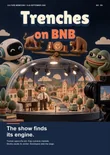
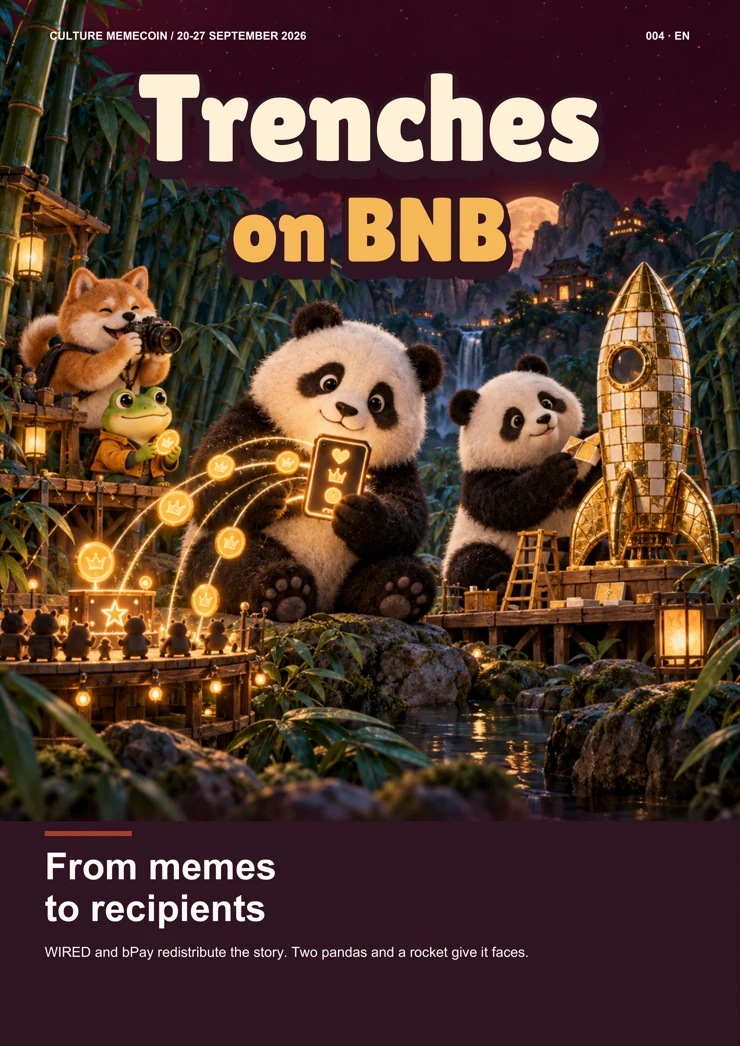
A developer, a Binance Square participant, two pandas expected at a zoo: the characters in this issue occupy different positions. Some are meant to receive fees. Others become images around which traders gather.
WIRED and bPay describe two ways to redistribute part of that activity. The former designates social accounts; the latter asks participants to submit an application. Questions about verification, waiting and changing rules give those promises a much more concrete meaning.
The pandas and “Chinese people can fly” take a different route. A diplomatic phrase or a chorus becomes connected to a contract address. We trace those connections without confusing the creators of the cultural story with those behind the token inspired by it.
 Written by Emma C.
WIRED: creators at the other end
A social account becomes the recipient of fees from a token launched by its community. On BNB, WIRED builds its story around that connection and a 70/30 split. Its reported ATH reached $2.22 million on September 27, 2026 at 01:43 Paris time.
At 01:08, a question about a wallet
Why do all the fees arrive in the same place? At 01:08 on September 27, @wiredupbnb repeats that question and publishes a BscScan address. Its answer describes a collection wallet, called a worker, that retains the social accounts’ share pending verification. The remainder is meant to buy and burn WIRED. Thirty-five minutes before the reported peak, the conversation is already about the route taken by the money. All times here are Paris time. [7]
That is the central subject of WIRED, short for Wired fees to socials. A community can launch a token around a person, an image or an idea and designate the social account that should receive creator fees. That person need not have initiated the launch. The official account explicitly says they may not even know the token exists. [18]
A yellow plug makes the idea readable
At 22:22 on September 26, WIRED announces BNB launches through Flap and invites readers to suggest additional social platforms. The message emphasises the possible breadth of the connections: if an integration is missing, the account says, the team is probably already working on it. That is an expansion promise, rather than proof that every destination operates at the same level. [1]
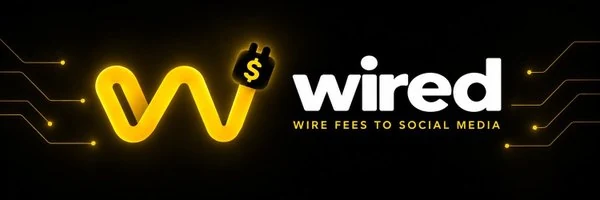
The artwork compresses this proposition. A yellow cable draws a W and ends in a plug bearing a dollar sign. White lettering stands out against black, surrounded by circuit lines. The word wired suggests both a connection and a transfer. It supplies an easily repeated image for a mechanism that actually involves accounts, proofs and transactions.
On the website, this ambition is placed alongside USEPAID, CASHED, TIPPED and SQUAREPAID in a comparison table produced by WIRED itself. The comparison locates its territory: capturing part of the speculative activity generated around creators and assigning them the fees. The table remains a project argument, rather than an independent assessment of its competitors. [3]
70% for the recipient, 30% for WIRED
The announced split applies to creator fees actually reconciled by the service: 70% for the verified social recipient and 30% for a reserve that buys and burns the WIRED platform token. It means neither 70% of market capitalisation nor 70% of every amount traded. At 00:40, the official account explicitly reminds readers that a displayed value does not create a claimable balance. [2] [17]
The process starts with a Flap launch specifying the token information and beneficiary account. Fees become available once the underlying platform exposes or settles them and the supporting on-chain evidence has been reconciled. Both the documentation and the form identify Flap as available and Four.meme as forthcoming. Both names appear in the marketing, but only one launch route is active at that point. [2]
This distinction also creates two different objects: tokens launched for social accounts, and WIRED, the platform token. Named creators receive their fee allocation; WIRED holders are exposed to the buyback narrative funded by platform activity. The mechanism does not promise them an individual payment. [2] [5]
Proving control without handing over account access
At 22:55, an explanation specifically addresses Instagram. WIRED says it avoided OAuth sign-in so participants would not have to connect their social account to the service. The recipient publishes a unique code, supplies the proof link and associates a wallet. The documentation further specifies a separate signed message to bind the BNB address. [4] [2]
Methods vary by platform: a public X post, an Instagram image or Reel, a TikTok video or photo, or a public GitHub Gist. For GitHub, the project says it stores the stable numeric user ID so a username change cannot redirect the fees. Fomo is another case: its wallet is resolved through FomoScan and payments are described as automatic. Several other integrations, including YouTube and Binance Square, remain labelled beta. [2]
The distinction matters: naming a recipient does not prove participation. Demonstration posts featuring Elon Musk, Cristiano Ronaldo or Taylor Swift are explicitly illustrative. The footer says they establish neither endorsement nor participation nor an existing balance. The numbers in those mock-ups therefore do not describe those people’s income. [3]
New destinations, and a more fundamental objection
Replies quickly broaden the discussion. STRUGZ suggests GoFundMe; Zib addresses ChillTRD and Kdotcheta with the exact contract, presenting the service as already working across social platforms. These interventions show how the product circulates: one person proposes a use, another seeks an influential reader who might spread it. They do not demonstrate adoption by the accounts addressed. [12] [13]
After the peak, interpretations diverge. At 02:20, Iven compares WIRED to Bags and critically asks why buyers would want to give money to rich people. At 02:31, 大表哥 instead compares the project to PAID, highlights its range of platforms and notes that Four.meme is not yet connected. One questions who benefits from redistribution; the other focuses on the product’s reach. [14] [15]
At 02:48, Lejzer imagines a much higher valuation if CZ interacts. That conditional is crucial: the post documents promotional anticipation, not an intervention by CZ. Part of the appeal is the possibility that a famous creator might discover a token reserving fees for them. That possibility does not establish their consent. [16]
What the first traces show
At 00:42, WIRED announces that 645,727 tokens have been bought back and burned. Its pinned demonstration video appears at 02:22, after the supplied 01:43 ATH. It explains the process to newcomers but cannot be presented as having triggered that earlier peak. [6] [8]
At approximately 09:57 on September 27, the site explorer displays 100 launches and one active launchpad. It marks @unipcs as a verified recipient for BONKGUY, while entries associated with @cz_binance and @heyibinance await verification. These are WIRED’s displayed statuses; a visible allocation does not by itself prove that the recipient has received the funds. [9]
The register then reports approximately 5.04 million WIRED burned against 8.0086 BNB spent. One transaction opened from that register is confirmed on BscScan: at 09:57, the collection wallet transfers 169.397 WIRED from the contract studied here to the burn address. This verifies a specific operation, without independently auditing the register’s total or every creator payment. [10] [11]
WIRED has therefore quickly produced more than a slogan: a process, explanations and inspectable traces. Its next chapter depends on the passage from allocation to receipt. Connecting a famous name to a token creates a story; seeing that person verify their identity and receive the fees would give it a concrete continuation.
On September 27, two use cases become clearer
Later that day, WIRED describes a GitHub maintainer as a possible recipient: a community can designate one, with a public Gist containing a one-time challenge used to verify the account. Another post describes a Spotify artist placing a code in a biography or Artist Pick. These scenarios make the multi-platform promise more concrete. They establish neither partnerships with those platforms nor verified payments to these recipient categories. [61] [62]
Written by Jérôme L.
bPay: redistribution meets the queue
On BNB, bPay turns participation on Binance Square and social platforms into a promise of BNB rewards. The reported peak reached $2.32 million on September 26 at 16:51 Paris time. Behind the slogan lies a first day of announced payments, a surge in applications and revised rules.
Waiting for a reward, looking for a code
On the morning of September 27, Paula Sheroy asks a practical question beneath a bPay post. After submitting her application and closing the page, she returns to a form offering a new registration and a new code. How can she recover her existing application? She also mentions a seven-day restriction on changing her biography. Her account does not establish a general malfunction. It does capture the moment when a promise of a few dollars meets a procedure that participants need to understand. [31]
A few hours earlier, andre had also asked what exactly he needed to do. These users bring bPay’s story into focus: distributing BNB to ordinary people willing to publish, verify an account and take part in an on-chain process. The project wants their presence to become a rewarded contribution. [32] [19]
Sending money back to the trenches
On September 25 at 14:25, @usebPay calls for liquidity to return to BNB Chain. The following day at 14:28, its Chinese manifesto develops a more personal proposition. In crypto, it argues, money readily flows towards celebrities, large influencers and people who already have plenty. bPay instead places the ordinary Square reader at the centre: someone hunting memecoins and returning to the charts after a bad trading day. All times in this article are Paris time. [20] [19]
The text promises usable BNB rather than accumulating points or endlessly deferred rewards. Several programmes sit beneath this idea: welcoming participants, rewarding creators and offering symbolic help after losses. That last strand is called Boys Don’t Cry. Its language seeks familiarity with traders; it does not amount to insurance or reimbursement of their losses. [19]
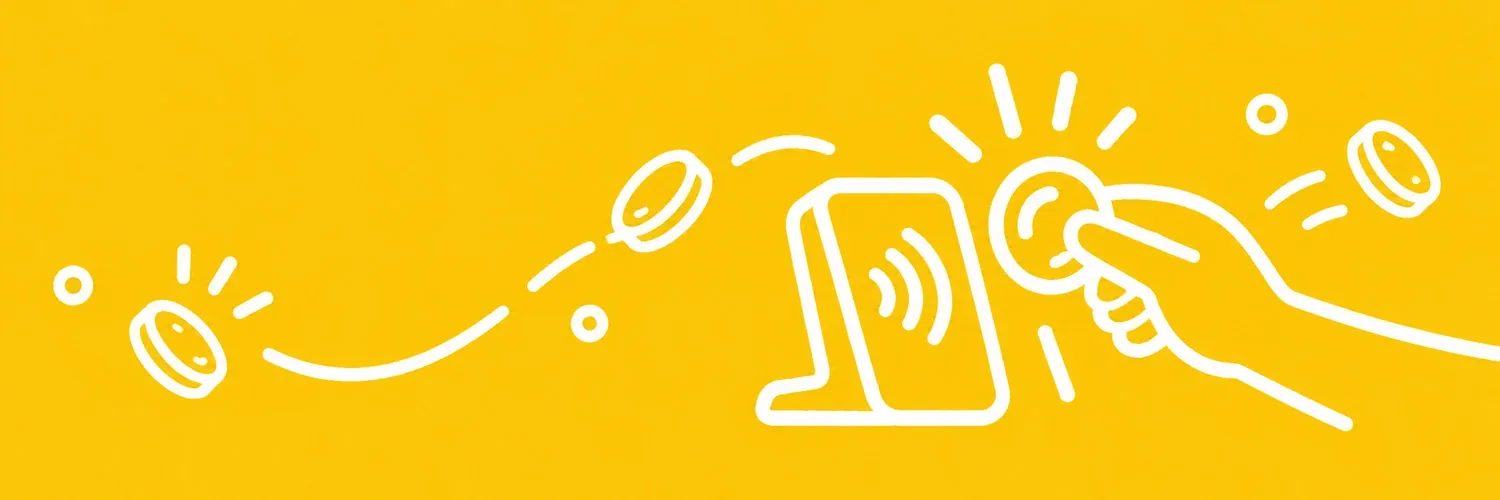
At 15:28, @usebPay publishes the exact token address alongside bpays.fun. Its yellow banner shows a payment terminal, coins and a contactless gesture. The visual identity immediately conveys the act of paying. The peak reported to the newsroom arrives at 16:51, meaning attention around the token precedes much of the evening’s operational adjustment. [21]
What participants actually have to do
The process displayed on September 27 begins with a Binance Square account, a public BSC address and a verification code placed in the account biography. This establishes control of the account. The FAQ explains that it is neither Binance KYC nor a guarantee that each person operates only one account. [24] [25]
The terms reviewed offer $20 for an approved Square post plus three additional approved tasks across TikTok, Douyin, X and Instagram. Completing all five platforms qualifies for another $10. Posts must include the full contract and a personal code. Participants already approved or paid are excluded from the new campaign. [23]
Amounts are expressed in dollars, but the proposed payment is native BNB, converted at approval and subject to the available budget. The website explicitly describes an independent BSC community project, without official affiliation to Binance or Onboard. Using Binance Square should therefore not be mistaken for participation in a Binance-run programme. [25] [22]
Participation becomes advertising too
The mechanism leaves visible traces on X. At 21:26 on September 26, UFAS publishes a message praising simpler digital payments, accompanied by the contract and a BP code. At 21:34, NaPastoro repeats the same wording with a different code. These posts match the requested participation format. They do not establish that either author received a payment. [26] [27]
They do, however, illuminate how the story travels. A favourable message may be an application requirement as well as a spontaneous opinion. The manifesto itself describes a loop in which rewards encourage contributions, which bring in new participants. Its proposed creator programme would also weight audience size, contribution history and approved posts. The stated ambition was to recognise influence without allowing the largest accounts to absorb the entire budget. [19]
The evening the rules changed
At 19:56, the official account claims to have distributed $18,930 and approved 939 Square accounts, while saying payments remain ongoing. It reports a combined audience exceeding 100,000 followers and identifies the largest approved account as having 20,105 followers. These are project-reported figures, not an independent reconciliation of transfers or unique people. [28]
Twenty minutes later, the emphasis shifts towards operations. bPay reports more than 20,000 applications and says tax receipts cannot sustain the previous payment rate. Reviews, described as being performed by multiple automated agents, should follow submission order. Applications not yet approved must be submitted again, and the creator programme is paused. [29]
A discrepancy remains visible between that announcement, which mentions two additional platforms, and the subsequently reviewed website terms, which require three. Instructions therefore need a date rather than being presented as a permanent schedule. At 00:32 on September 27, @usebPay announces that approvals have resumed under the new rules. The questions from andre and then Paula appear after that restart. [29] [23] [30]
Taxes, buybacks and a verifiable trace
The documentation describes a 3% buy tax and a separate 3% sell tax at launch, routed through a Flap vault into the reward vault. At 20:23 on September 26, bPay says 20% of total taxes will fund daily buybacks and burns despite the creator programme’s pause. These parameters describe the announced funding model; they do not guarantee a steady income stream. [33] [34]
There is nevertheless a more tangible trace than a promise. At the time of our review, BscScan displays approximately 43.45 million bPay at the burn address, equivalent to 4.345% of a maximum one-billion-token supply. One referenced transaction alone transfers approximately 13.39 million tokens from the reward vault to that address. This documents tokens sent out of circulation without certifying every payment to participants. [35] [36]
The next chapter happens inside the applications
Boys Don’t Cry is announced for September 27 at 14:00 Paris time. During the morning review, the feature is still marked as forthcoming and creator registrations remain closed. The story consequently combines an already accessible application process, recently changed rules and programmes that have yet to open. [29] [22] [37]
bPay’s first peak measures the intensity of interest in that redistribution promise. What follows also depends on quieter actions: recovering an application, understanding a rule and receiving an approved amount. In a campaign that asks participants to tell the project’s story, the way they experience the wait becomes part of that story itself.
Written by Emma C.
Ping Ping and Fu Shuang: pandas and a phrase
Awaited in Atlanta for months, two pandas become the characters of a BNB runner after a speech by Xi Jinping. Under the name 友谊使者, participants bet on the circulation of a phrase: “envoy of friendship”. Reported ATH: $1.70M on September 24 at 23:57 Paris time.
Two pandas awaited before the first trade
On Instagram, a panda peeks out from the bottom of a blue poster. Above its ears are the words “COMING SOON!”. Zoo Atlanta’s pinned post dates from April 23, 2026. In the comments, lun_yang_panda asks when the animals will arrive; discoveratlanta looks forward to welcoming them. When checked on September 25, the post displayed approximately 10,500 likes. That anticipation already had an audience and a history before it had a BNB contract. [40]
Five months later, traders adopt the names Ping Ping and Fu Shuang under another label: 友谊使者, meaning “envoy of friendship”. According to the ATH supplied to our editorial team, the runner reaches a $1.70 million market capitalisation on September 24 at 23:57 Paris time. Between the animal photograph and that peak, a diplomatic phrase has become a name participants hope to see in headlines everywhere.
In Atlanta, a story of return
The April announcement presents a new research and conservation agreement between Zoo Atlanta and the China Wildlife Conservation Association. President Raymond B. King emphasises the responsibility of caring for the animals and the shared scientific work. The original framework is a zoological programme, rather than a financial launch. [38]
The FAQ gives the two names precise identities: Ping Ping is a male born on March 17, 2020; Fu Shuang is a female born on October 18 that year. Both were born at the Chengdu Research Base of Giant Panda Breeding. The page does not yet set an arrival date. [39]
For Atlanta, the story also renews an existing connection. The programme’s legacy page recalls Lun Lun and Yang Yang arriving in 1999 and the seven cubs born to the pair. It now introduces Ping Ping and Fu Shuang as the next chapter. That continuity helps explain why two new names can already attract attentive readers, without inventing a sudden rise to fame for them. [48]
A presidential phrase becomes a ticker
On September 24, during his welcome remarks at the White House, Xi Jinping describes pandas as envoys of friendship between the Chinese and American peoples. He announces that Ping Ping and Fu Shuang will reach Zoo Atlanta in a few days. The text published by China’s foreign ministry confirms both the names and the wording traders are invoking. [41]
The shift is subtle. The token’s English name preserves the two animals; its Chinese symbol preserves their role in the speech. The same identity can travel as a panda story or as a political phrase. Our reading is that this dual entry makes it easier to share: the pictures supply the characters, while the words supply the slogan.
That does not make the memecoin an initiative of the zoo or the authorities. The institutional communications reviewed do not mention its contract. What is documented is market participants appropriating a public news event. The project borrows an existing story; that story does not, on its own, confer official recognition.
17:53: participants trace the phrase back to the speech
At 17:53 on September 24, @0xPenguinx posts the exact token address and links to a broadcast, pointing to a moment around the thirty-third minute. Quoting a post from Mario Nawfal, he stresses that the expression comes from the Chinese leader’s remarks. The contract connects this reference to the specific runner, beyond a general interest in pandas. [42]
Four minutes later, @0xGGbond66 shares the same address and a market link. His comment is less unanimous than a promotional slogan: he finds this second identity less compelling than the panda-centred narrative. Yet he still describes the connection with the White House scene and the two animals. Participants are already debating what deserves attention: the character, its name or the phrase attached to it. [43]
At 18:05, Penguin quotes Polymarket and anticipates major news outlets repeating the English expression “envoy of friendship”. He is no longer merely recalling the name’s origin; he is imagining its next exposure. That expectation belongs to his argument. It establishes neither the scale of future coverage nor its effect on market capitalisation. [44]
Together, these posts form a readable sequence: locate the original wording, debate its appeal and then hope for repetition. The token’s narrative develops through that selection process. People looking at the same pandas do not necessarily choose the same words to tell their story.
Green, black and white, rather than an invented mascot
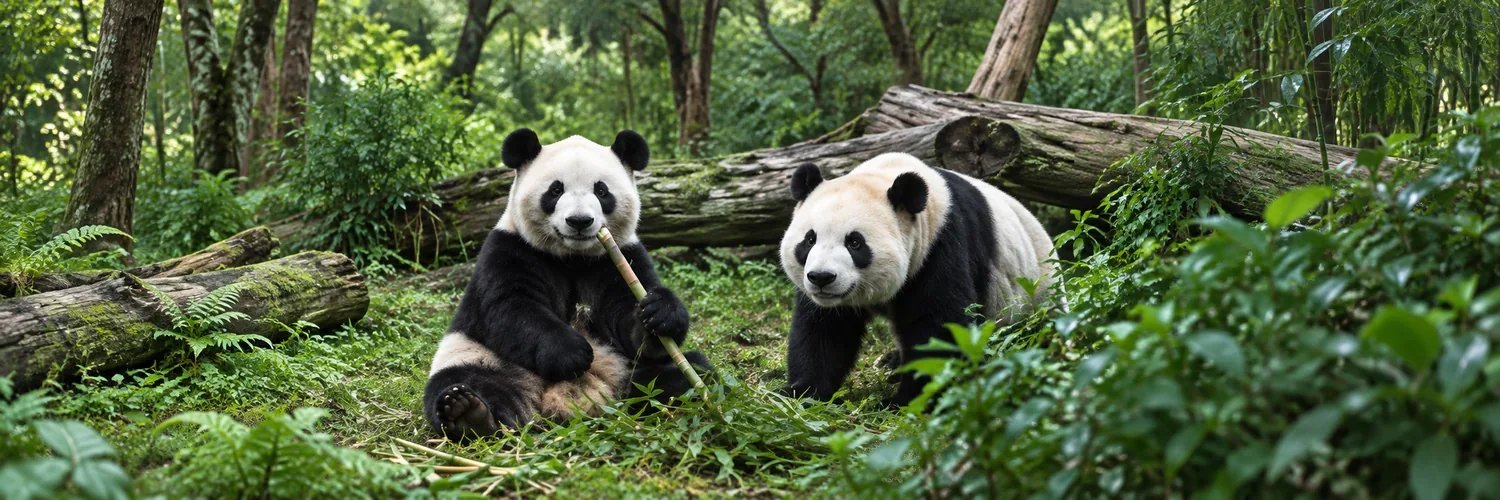
The artwork attached to the contract on DexScreener shows two pandas surrounded by dense vegetation. One sits with a stem near its face; the other is beside it, in front of logs. We present it as the token’s artwork: the metadata reviewed does not establish that the photographed animals are specifically Ping Ping and Fu Shuang. [47]
That simplicity matters to how the subject travels. There is no hybrid character, armour or unfamiliar illustrated world to decipher. Readers recognise pandas and connect the picture to the news. The choice makes the first encounter immediate, but leaves the posts to explain why this pair should be associated with this contract rather than another one.
The listing does identify Ping Ping and Fu Shuang, symbol 友谊使者, on BNB. It also returns separate assets named 平平福双 in other pairs, where the token studied here serves as the quote asset. This detail is a reason to distinguish a similar translation, an identical name and an identical address. No official social account or website was included in this listing’s metadata when checked. [47]
After the peak, the promise of another audience
At 04:10 on September 25, after the reported ATH, @ShawnThread circulates the contract again. He says a contact working in official media told him the news had aired on CCTV, and predicts further broadcasts. He provides a replay link and a time. We treat this post as evidence of a promotional argument about television exposure, without presenting either his contact or every predicted broadcast as independently verified. [45]
On September 25, 清扬大叔, @ansim_l, also pairs the contract with Mid-Autumn Festival wishes and a wish for friendship to endure. The vocabulary moves beyond diplomatic commentary into a greeting participants can exchange. It adds no new information about the animals; it gives people another way to keep the name in conversation. [46]
The story’s interest lies in this movement between audiences: people awaiting the pandas, people discussing the visit and people looking for a market narrative. The sources show connections between their words and images. They cannot measure how many zoo visitors become token buyers, or attribute the rise to a particular post.
$1.70 million, then two stories continue
The reference remains a peak market capitalisation of $1.70M on September 24, 2026 at 23:57 Paris time, supplied to the editorial team and not independently reconstructed to the minute. The posts at 17:53, 17:57 and 18:05 precede that peak; the overnight publications document the narrative continuing afterwards.
For Atlanta’s visitors, the next chapter will involve an arrival, a habitat and first encounters with the animals. For 友谊使者, it depends on what participants do with the name when the phrase leaves the headlines. The memecoin has found two immediately recognisable characters. It still has to build a conversation of its own around them.
Written by Emma C.
Chinese people can fly: from chorus to rocket
“Chinese people can fly” already has a song, a history of remixes and now a proposed photo mosaic on a rocket. On BNB, traders connect those stories to one contract. On September 21, 2026, its reported peak reaches $4.24 million in market capitalization.
Five characters, several ways to take off
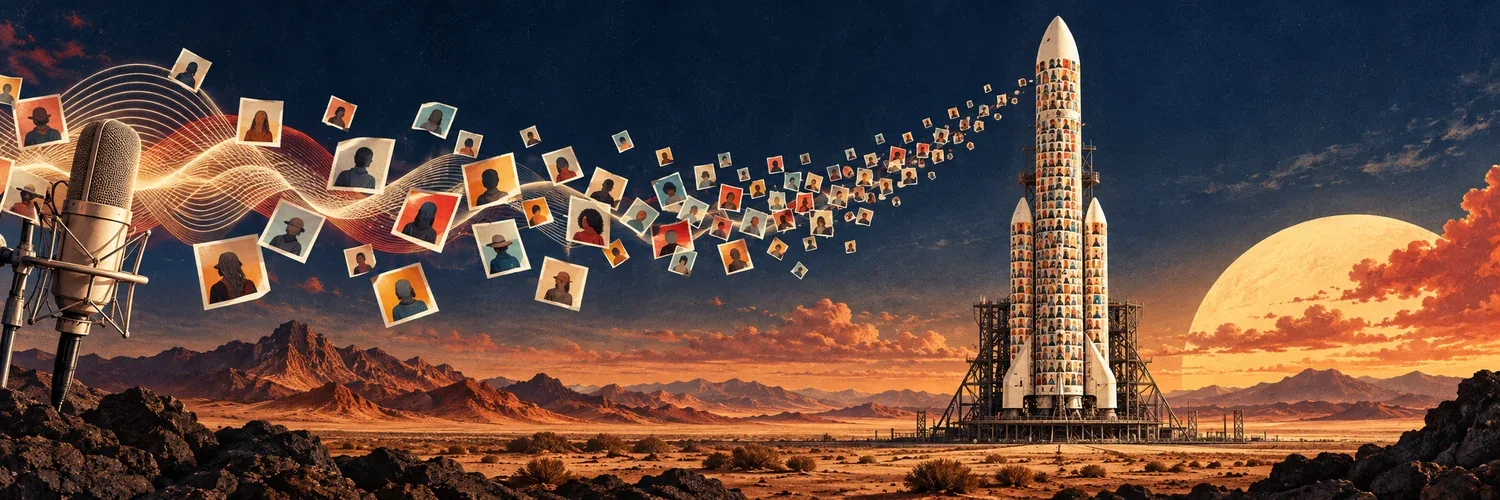
At 09:40 on September 21, the X account 顶尖 BNB describes a rocket decorated with ordinary people’s faces. From a distance, five characters: 中国人能飞. Up close, photographs. In the replies, web3池掌柜 immediately challenges the connection: to this participant, the meme refers to qinggong, the supernatural lightness of martial-arts fiction, rather than rockets. The exchange captures the issue: a phrase is circulating, but people do not give it precisely the same meaning. [53]
Hours later, the peak supplied to the editorial team for the BNB token is $4.24 million, recorded at 20:24 Paris time. Between those reference points, the rocket has become a market argument. Understanding the move means following three overlapping stories: a rap track, a participatory project and an asset traders connect to both.
Before the contract, a refrain already in circulation
中国人能飞 means “Chinese people can fly.” The phrase did not begin with this contract. The official On The Radar Radio channel publishes a freestyle by SKAI ISYOURGOD, known as 揽佬, on July 17, 2026. The following day, MEROS posts an excerpt on Douyin naming SKAI ISYOURGOD and Chalky Wong. Two months before this Runner, the words already have a stage and identifiable performers. [49] [50]
One detail helps keep the story straight: YouTube’s music panel lists 中国人会飞 alongside “The Chinese Can Fly” and Chalky Wong, while the slogan and token use 中国人能飞. The characters 会 and 能 differ; the usages converge as the meme circulates. Treating every title variant as a separate project would be misleading, as would inferring ownership of a token from the title of a song. [49]
The premise travels easily: a short phrase, an impossible ability taken literally, and a verb that can also suggest ascent. Martial-arts imagery, performance and spaceflight can take turns without removing the original expression. Our reading is that this flexibility allows people to change the setting while retaining the same point of recognition.
MediaStorm gives the slogan a physical surface
On September 21, MediaStorm, or 影视飓风, invites its audience to help decorate a rocket. According to the project presentation reported by STNN, selected photographs will form a mosaic: the five characters will be readable from a distance, the people visible on closer inspection. The announced submission window runs from September 21 to October 12. That deadline concerns contributions; it is not a launch date. [51] [52]
The connection to the song is explicit. In the comments on its Douyin post, the author account tags SKAI ISYOURGOD and Chalky Wong and says it wants to take their phrase into space. The proposal turns a refrain into something people can participate in: choosing a photograph, submitting it and imagining its place in a collective composition. [51]
The image attached to the token on DEX Screener narrows the idea further. It shows a vertical portion of a white rocket, with the characters stacked one beneath another against a desert landscape. There is no animal mascot or rapper portrait: the displayed identity already foregrounds the spacecraft. The image connects the token visually to the story; it does not establish an agreement with the people behind the project. [59]
On X, the rocket becomes a market proposition
The post from 顶尖 BNB provides a visible crossing point between the participatory project and crypto conversations. Paurojay then shares it in English, describes the rocket artwork and includes the exact contract examined here. He accompanies the connection with a $10 million target. The target is promotional; what the post documents is the translation and linking of a Chinese publication, a story accessible in English and a BNB address. [53] [54]
Crypto北斗 offers another interpretation. In his 17:51 thread, he quotes an earlier message timestamped 13:17 that paired 牛来 with 中国人能飞 and mentioned a range of $1 million to $1.3 million. This records what the account was writing at the time. It establishes neither an executed purchase at that valuation nor the entry point of the very first KOLs. [55]
His argument concerns BSC’s ability to generate Chinese memes after 牛来. The song, derivative creations and easily repeated name become ingredients in a potential narrative successor. In the replies, 金石 stresses precisely the rough but memorable quality of the name. These participants are interested in more than a rocket: they see an expression capable of continuing to circulate across communities. [55] [60]
The same story does not produce the same decisions
Reactions do not amount to uniform enthusiasm. At 13:18, Greek says he is taking profits on the exact contract. He cites numerous snipers and says he does not expect much further upside. The message establishes his stated position, not a verified analysis of wallet distribution. One reply reminds him that profit is profit: this conversation is already about exiting while others are still looking for an entry. [56]
Leslie, meanwhile, says he chooses to bid on the token, connecting market conditions to ordinary people’s dreams of space. In this interpretation, participation in the mosaic becomes a story strong enough to sustain a trader’s interest. The coexistence is revealing: people can look at the same characters and see a collective project, an opportunity for continuation or a move to leave behind. [58]
What the Gate announcement actually establishes
At 16:35, Gate Trenches announces several new assets available through its onchain trading aggregator, including 中国人能飞. The BSC link contains exactly 0x108876c3df3d893350e9b780563b3697aa3e7777. This is an identifiable distribution and visibility channel; the post should not be presented as a conventional spot-listing announcement for Gate’s centralized exchange. [57]
DEX Screener also connects the contract to BNB Smart Chain under the full name 中国人能飞火箭, with a PancakeSwap pair against FXIon. The contract provides continuity between the publications. The sources reviewed do not, however, identify its creator with certainty or establish a partnership with MediaStorm, SKAI ISYOURGOD or Chalky Wong. Their role in the cultural story does not constitute endorsement of the memecoin. [59]
$4.24 million: a reference point in an unfinished story
The figure retained is the peak supplied by the publisher: $4.24 million in market capitalization on September 21, 2026, at 20:24 Paris time. It is a dated snapshot, not a live value or a peak independently reconstructed to the exact minute. Targets posted on X are not additional recorded highs.
The narrative draws strength from its changes of scale: a few sung words, a community remixing them, photographs intended to form a mural, then an address that becomes tradable. Its vulnerable point lies in the same transitions: moving from one stage to the next establishes no official connection. What follows will depend on whether participants can create conversations and material specific to the token, beyond the announcement whose momentum they borrowed.
A new reference on September 22
A subsequent observation supplied to the editorial team raises the maximum to $4,707,650 on September 22 at 09:04:33 Paris time. The $4.24 million peak in the chronology remains the September 21 reference; the later observation documents the continuation.
Written by Jérôme L.
The sources, a click away.
Numbered references in the articles point to this list. External links open in a new tab.
- WIRED — Flap launch, 26 September, 22:22 Paris time
- WIRED — assignment, social verification and fees documentation
- WIRED — website and illustrative examples
- WIRED — Instagram verification, 26 September, 22:55
- WIRED — 70/30 allocation, 27 September, 00:07
- WIRED — claimed 645,727 token burn, 00:42
- WIRED — collection wallet role, 01:08
- WIRED — demonstration video, 02:22
- WIRED — launch explorer, morning of 27 September
- WIRED — buyback and burn register
- BscScan — 169.397 WIRED burn, 27 September, 09:57
- STRUGZ — GoFundMe integration proposal
- Zib — message to ChillTRD and Kdotcheta
- Iven — model criticism and Bags comparison
- holdonyourrope — PAID comparison and Four.meme limitation
- Lejzer — conditional CZ scenario
- WIRED — displayed value versus claimable fees
- WIRED — recipient may not know about token, 27 September
- bPay — manifesto, 26 September 2026
- bPay — BNB liquidity narrative, 25 September
- bPay — launch and contract, 26 September, 15:28 Paris time
- bPay — campaign and project identity
- bPay — participation terms
- bPay — account verification and post submission
- bPay — rewards FAQ
- UFAS — contract and BP code post
- NaPastoro — contract and BP code post
- bPay — claimed $18,930 distributed, 26 September, 19:56
- bPay — revised rules and application queue, 20:16
- bPay — approvals resume, 27 September, 00:32
- Paula Sheroy — code and application tracking question
- andre — task clarification request
- bPay — funding, taxes and rewards vault
- bPay — buyback and burn announcement
- BscScan — bPay burn address balance
- BscScan — 13.39 million bPay sent to burn address
- bPay — creator area, morning of 27 September
- Zoo Atlanta — new agreement, 23 April 2026
- Zoo Atlanta — panda identities and programme FAQ
- Zoo Atlanta — Instagram announcement and replies, 25 September snapshot
- Xi Jinping — White House address, 24 September 2026
- 0xPenguinx — speech and exact contract, 24 September, 17:53
- 0xGGbond — name and imagery discussion, 17:57
- 0xPenguinx — anticipated media coverage, 18:05
- 0xShawn — television coverage claim, 25 September, 04:10
- ansim_l — festival wishes and contract, 25 September
- DEX Screener — contract, pairs and images, 25 September
- Zoo Atlanta — Panda Legacy and programme history
- On The Radar Radio — Skai Isyourgod freestyle, 17 July 2026
- MEROS — SKAI ISYOURGOD and Chalky Wong excerpt, 18 July 2026
- MediaStorm — space project invitation and replies, 21 September
- STNN — mosaic concept and photo submission dates, 21 September
- Dingjian BNB — rocket project and meme discussion, 21 September, 09:40
- Paurojay — rocket project and exact contract, 21 September
- Crypto Beidou — BNB story and earlier quoted post, 21 September, 17:51
- Greek — declared profit-taking, 21 September, 13:18
- Gate Trenches — onchain announcement and exact BSC contract, 16:35
- Leslie — space project interpretation and declared purchase, 21 September
- DEX Screener — Chinese people can fly / FXIon, BNB contract
- Jinshi — name recognition and circulation discussion
- WIRED — GitHub verification, 27 September
- WIRED — Spotify verification, 27 September
Make this issue yours.
The same edition, wherever you want to read.