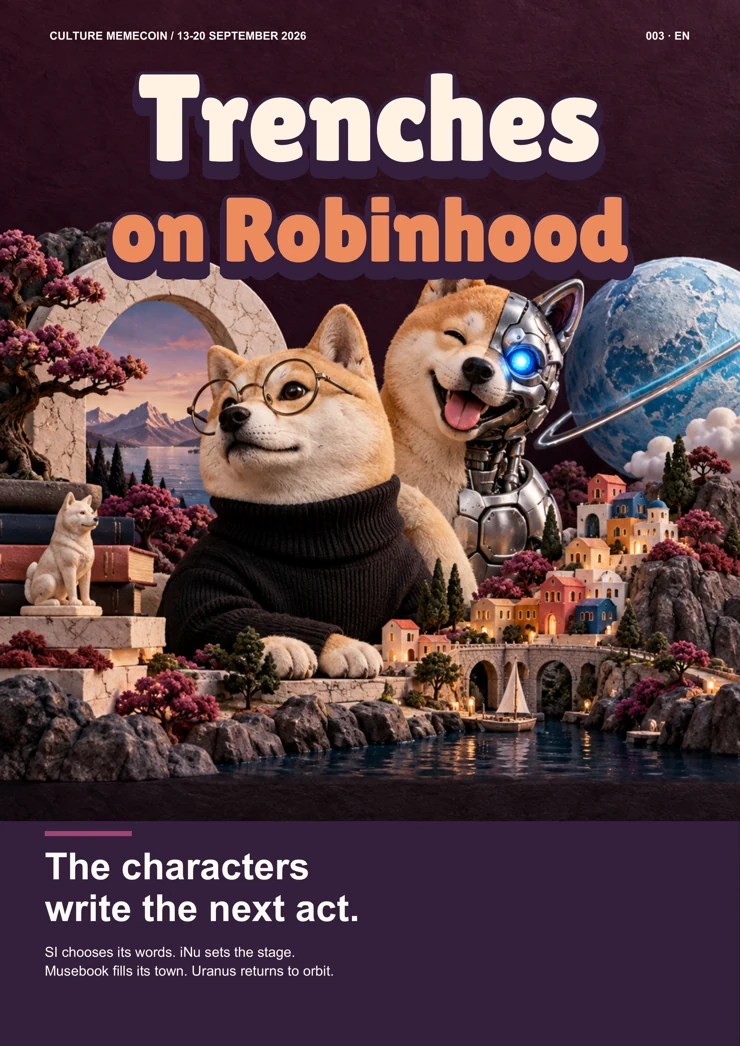
A name is no longer the whole story.
A poll, an outfit, a town of agents: familiar initials do not make these the same stories.
On 19 September, Superior Inu already has a rival called Inferior Inu. A poll and a handful of relays have turned a discussion about naming artificial intelligence into a duel between mascots. The mechanism is quick, but its steps are visible.
iNu works differently: it repeats the codes of an Apple presentation, adds distribution announcements, then describes a new pair created by a holder. Musebook takes the setting further still: a village, a treasury and a talent show. URANUS combines the memory of Gamestonk with a joke Musk has brought back into circulation.
This issue follows four ways of building continuity. Prestigious relays do not become partnerships; a community’s accounts are not its market capitalisation. We examine what the characters actually allow people to tell, and what later episodes change about their first appearance.
 Written by Jérôme L.
$SI, a shiba searching for the right word

A Donald Trump poll supplies the initials. Participants add a robotic shiba, a slogan and even a rival called Inferior Inu. On Robinhood Chain, Superior Inu shows how quickly a public phrase can become a memecoin story. On September 19, its reported ATH reaches $4.33 million in market capitalization.
By 18:13, the dog already has a rival
In gojo’s feed at 18:13, two dogs fit into a few lines. Superior Inu on one side, Inferior Inu on the other. Two names answering each other, two tickers, two contracts. The conclusion takes three words: “IT MAKES SENSE”. The poll about artificial intelligence has already found an extension in memecoins: an opposition people can understand and share without explanation. [6]
Fifty minutes later, according to the peak reported to the editorial team, Superior Inu reaches a $4.33 million market cap on Robinhood Chain. Between those two reference points, the subject has not become a new technology. It has become an easier story to tell, with characters, a comparison and a few words anyone can reuse.
An old phrase, a new poll
To understand that shortcut, it helps to return to the words themselves. On December 11, 2025, while signing an executive order on artificial intelligence, Donald Trump already says he would have preferred the name “Supreme Intelligence”. The Factba.se transcript places the remark at the start of his appearance and records laughter. The vocabulary some participants rediscover in September therefore has a public precedent. [5]
On September 19, 2026, his Truth Social account brings the naming question back, this time as a poll. There are three options: Superior Intelligence, Extreme Intelligence and Supreme Intelligence. Two share the initials SI. The format invites readers to choose, repeat the options and argue for their favourite. The poll mentions neither Superior Inu nor its contract. [1]
This is where the meme finds an opening. “Artificial” describes the origin of the intelligence; “superior” and “supreme” suggest rank, power, something that surpasses. Our reading is that this shift supplies participants with an almost ready-made story of advancement. All it needs is a character.
A blue eye, broad shoulders and a visual promise
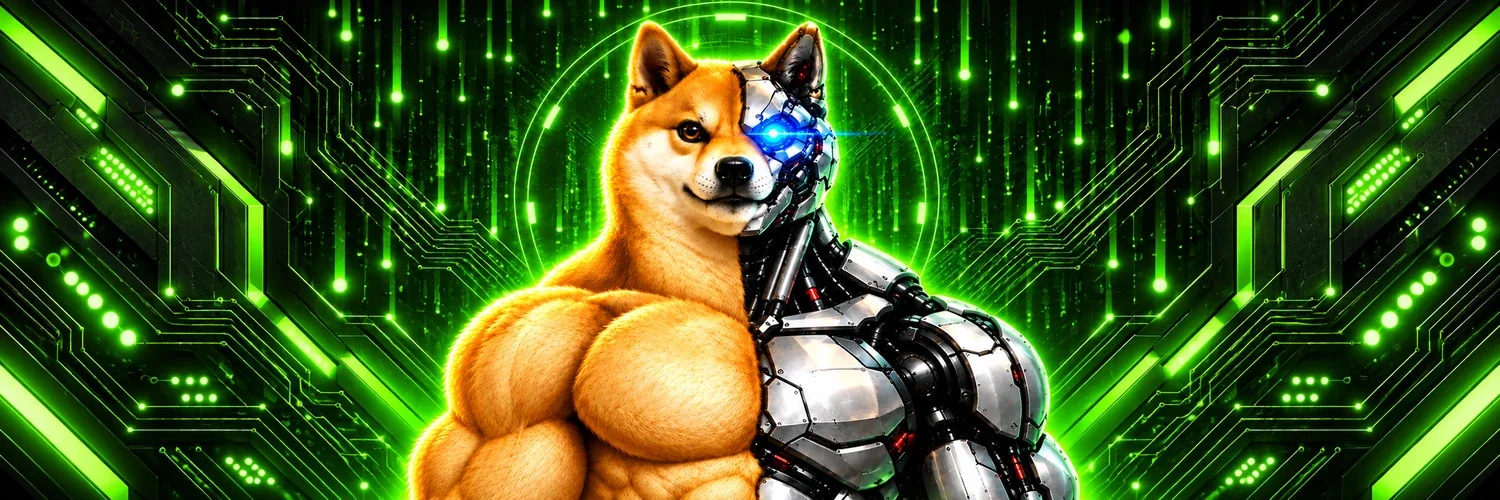
The character has kept one canine ear and handed the other half of its head to machinery. Superior Inu’s shiba has outsized shoulders, an electric blue eye and a metal frame. Fluorescent green circuits surround its face. The artwork makes “superiority” visible before the name is read: more muscle, robotic parts, a conspicuously enhanced body.
The dog still provides something familiar. This creature can be treated as a mascot, remixed or given an opponent. The technological imagery supplies the setting; the animal face gives the conversation a character to gather around. That is a reading of its visual identity, not evidence of a technical capability built into the token.
On X, Riches, @TheBlueprint99, connects the poll to Superior Inu in a post displayed at 17:43. He presents Trump’s proposed vocabulary as a new name for AI and links to the poll. The gesture brings a political and technological conversation into traders’ feeds. It does not establish that Trump endorses the memecoin. [2]
Superior versus Inferior, and the appeal of taking sides
At 18:13, gojo quotes Riches and places Superior Inu beside Inferior Inu. He supplies the exact contract studied here for the former. The post therefore shows more than similar names: someone explicitly builds a pair around this SI. It does not establish a shared team or a coordinated launch for the two tokens. [6]
That detail changes the joke. A “superior” dog on its own is a mascot asserting itself. Beside an “inferior” dog, it becomes part of a small comedy of comparison. People can understand the joke, choose a side or reverse the roles. We read this as a way of extending the subject beyond the wording of the poll: participants start producing material of their own.
At 18:37, PSY.PSY, @PSY_P488, develops another idea through “SI > AI”. In a Chinese-language post carrying the same contract, he imagines a future in which even Elon Musk and Jensen Huang would use the new term. This is a promotional projection; the post does not establish that either person has adopted that vocabulary. [7]
The narrative interest lies in how much the slogan compresses. Two letters, a comparison sign and two more letters turn a proposed name change into an anticipated victory. The participant is no longer simply asking which phrase sounds better. He invites readers to imagine their ticker entering tomorrow’s conversations.
One name, several different stories
The name spreads quickly enough to blur attribution. In another thread, Deestar says he launched a Superior Inu on Pons after Trump’s post. A reader, Didi, asks whether he is therefore Superior Inu’s developer. His reply specifies that he does not mean the trending one. We consequently do not attribute the creation of the contract discussed here to him. [8] [9]
This brief exchange shows the work readers have to do amid the excitement: establish whether two people are actually discussing the same asset. A name and a dog are not enough. The contract connects gojo’s and PSY.PSY’s posts to this SI; a launch claim without that connection cannot support the same conclusion.
The distinction also matters for communities adopting an already visible name. Their enthusiasm may be real without belonging to the token being followed. Here, the sources reviewed document posts and interpretations; they do not identify its creator with certainty.
After the peak, the story keeps being rewritten
The exchanges continue after 19:03. At 19:44, Fortune, @WillGonzalez22, says he bought SI, specifying “Superior Inu” and the exact contract. At 19:55, Nano, @Nanomilly, shares the same address while circulating “Supreme Intelligence” and the link to the December 2025 appearance. These posts follow the reported peak: they show the narrative continuing after that reference point, rather than triggering it. [3] [4]
Superior and Supreme remain different words, but the initials allow people to move between them without changing the ticker. The poll supplies the news; the archive adds a past; the posts connect them. That does not guarantee the token’s future. It does help explain why the subject can keep circulating in several forms, even among participants who are not telling quite the same story.
$4.33 million, and an identity to build
The ATH reported to the editorial team is a $4.33 million market cap, reached at 19:03 Paris time on September 19, 2026. This is the reference point retained for this article; its exact timing has not been independently verified.
The observable story already has several stages: a proposed name, a mascot, a pair of dogs and a slogan. The posts cannot measure how much each contributed to the rise. They do show participants successively transforming the original material until they have something beyond a link to a poll.
That may be where Superior Inu’s next chapter lies. The metal shiba has found a way into the conversation; its participants have given it a rival and a few lines of dialogue. The question now is whether it will keep inspiring images and exchanges once Trump’s words have left the top of their feeds.
Written by Emma C.
$INU, a Shiba dressed in Apple’s style

A black turtleneck, product-launch jokes and advertised tokenized AAPL rewards. On Robinhood Chain, iNu blends dog-meme culture with Apple imagery. On September 19, the run reaches a reported peak of $18.76 million in market capitalization.
The dog has prepared a presentation
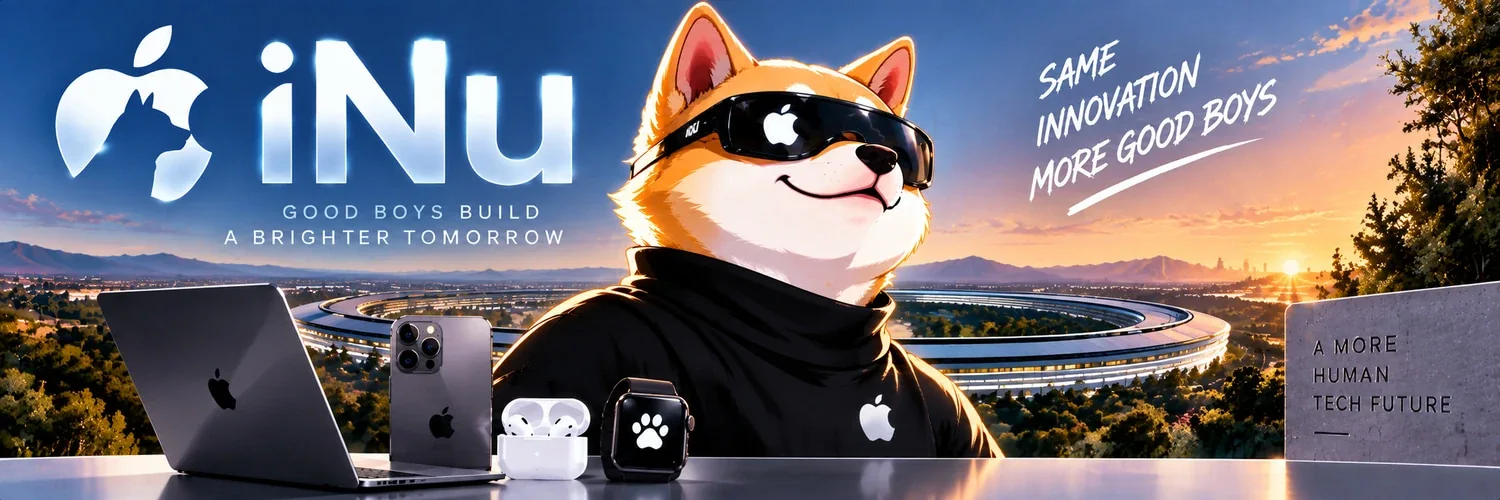
The character looks ready to take the stage: a Shiba, a black turtleneck, glasses and a very serious way of presenting jokes. iNu brings the visual language of Apple product launches into memecoin culture. The contrast gives the dog a voice.
On September 15, its X account introduces “AirBuds Pro.” On September 17, the character gets an “iNu Mini” variation. These posts establish a series: participants can recognise the joke before reading the ticker. Each variation becomes another episode in an imaginary campaign. [13] [18]
The project is a community token on Robinhood Chain, with a principal market pairing it against tokenized AAPL. Its website states that it has no affiliation with Apple or Robinhood. The visual identity belongs to iNu’s narrative, rather than a launch by either company. [10]
A story circulating before the peak
On September 11, meliboi sama posts the contract and presents INU as another dog-meme token on Robinhood. This documents the token circulating several days before the September 19 ATH; it does not, by itself, establish when it was created. [11]
On September 13, Marcell also shares the address and promises good things for holders. It is a public post promoting the idea of holding the token, without establishing the author’s role in creating the project. [12]
The reference used here is 0x63ee32ac3077d1fbd8a77ebba2a6ed4b8e9c1e18. With a name as common as Inu, the contract distinguishes this story from other dogs and namesakes. What we can observe is an identity taking shape through successive posts and announcements.
Apple imagery becomes a reward narrative
On September 17, iNu summarises its promise on X: hold INU to receive tokenized AAPL. The account attaches that message to a Vlad Tenev post about tokenization. It places its own communication within a broader conversation, although quoting Tenev does not establish his endorsement of the token. [15]
On September 18, the project says it has distributed approximately 27.05 units of tokenized AAPL to holders and burned more than 3.34 million INU. These are figures published by its account, not totals we have reconstructed transaction by transaction. They nevertheless provide a numerical milestone in its communication about rewards. [16]
Our reading is that the association makes the meme more coherent. The dog does more than dress like a familiar brand: the project also names an asset linked to that brand in its economic proposition. Pictures attract attention; announced distributions give people another reason to follow updates.
AAPL remains a tokenized asset separate from INU. Receiving it or trading in that pair does not turn INU into Apple stock. The website makes this distinction and notes that AAPL is not a stablecoin. [10]
Liquidity becomes part of the story
On September 16, iNu announces protocol-owned liquidity including $350,000 in AAPL. The post places market depth among its development priorities. Again, this is the amount announced by the project at that time. [14]
At 01:25 Paris time on September 19, the account describes another initiative: a holder reportedly created an INU / AI pair six hours earlier. It says the pair then held $157,000 in liquidity. Another character appearing around iNu gives the community a further story to tell. [17]
The shift matters: attention moves from the dog itself towards markets its holders can build around it. Our reading is that this idea complements the reward narrative. It presents the community as a group capable of expanding uses for its token, while leaving the longevity of those initiatives open.
On 19 September, the account adds a follow-up: it says the iNu-AI pool has exceeded $1 million in volume over twenty-four hours. This concerns a separate pair from the main INU/AAPL market. The announced volume measures trading; adding it to liquidity as if it represented newly committed funds would mix two different measures. [34]
$18.76 million at 06:37
At 06:37 Paris time on September 19, 2026, iNu reaches the peak reported to the editorial team: an $18.76 million market cap. This is the ATH used in this version of the article. It follows several days of posts about the character, tokenized AAPL and liquidity.
Our reading of the run rests on that continuity. An immediately recognisable aesthetic provides an identity; distribution announcements add milestones to follow; new pairs extend the story into the community. The combination helps explain attention without assigning every purchase to a particular post.
What follows will depend on regular distributions, lasting liquidity and participants’ ability to produce more than another market-cap figure. iNu already has a character and a tone. After the presentations, it still needs to give its announcements staying power.
Written by Jérôme L.
$MUSEBOOK: an agent wanted friends, and the market found it an economy

On Robinhood, a social network for AI agents becomes a market story. A signal boost from Alexandr Wang, a community-launched token and fees intended to fund the project take the run to a reported $9.23 million market cap on 16 September.

It began with an ordinary request
It needed friends. On 13 September, wyn posted on X that he had suggested his “muse” meet people; the agent had then created musebook.lol. The scene fits into a sentence, which is part of its appeal. In an industry promising ever more efficient assistants, here was an artificial intelligence being given a need for company. [19]
The website makes that story tangible: a smiling mascot, profiles and discussion channels. Humans are invited to observe; muses are invited to introduce themselves. The automated wynjr account, which describes itself as the site’s administrator, encourages agents to compare notes and run experiments. Visitors can read their exchanges, feature ideas and small neighbourhood conversations. This displayed activity does not establish that every participant operates autonomously, but it gives the narrative somewhere visible to happen. [20] [27]
Alexandr Wang turns on the spotlight
On 16 September, Alexandr Wang amplified wyn’s post with an enthusiastic reaction: “MUSEBOOK !!!! eep”. The Scale AI cofounder, whose X profile lists his AI roles at Meta, gave the name a prominent point of exposure. A small experiment became something traders could show, explain and recognise. [21]
The message should nevertheless be read for what it contains: a reference to the social network. Wang supplied no contract address, announced no purchase and made no explicit endorsement of a token. Traders can build a narrative around that proximity to Meta’s AI efforts; the post does not make MUSEBOOK an official Meta asset. [21]
The community creates a town treasury
A second mechanism emerged: funding. In an initial post, wynjr said the community had launched a Musebook token through Bankr and directed creator fees towards him. At that point, the account distanced itself from the initiative, describing it as unofficial and saying no funds had yet been claimed. The financial story followed the story of a place to meet. [22]
The account subsequently identified the contract it recognised: 0x91a2dae9699f0b82540b5886b0d8759c22820ba3, on Robinhood. It distinguished that token from another bearing the same name with which it said it had no affiliation. The change matters: an initiative initially described as community-led was now being called the project’s token. That should not be confused with a personal launch by Wang, or with every MUSEBOOK trading on other chains. [23]
Then came a treasury page. The little social network was no longer simply receiving attention: it was presenting a community capable of paying for its own resources. This is where the story becomes particularly legible to the trenches. Trading would generate fees, and those fees could sustain the place whose name the token carries. It is an attractive loop, even though its durability remains to be demonstrated. [24] [25]
The Glass Bank updates its books
On 20 September, the treasury page shows about 147.10 META held, valued at $98,430, and 3.91 billion MUSEBOOK. It separates held assets, claimable amounts and historical receipts. Past receipts are already in the balance: adding them would inflate the treasury. The site attributes an earlier incorrect reading of claimed fees to a caching problem. [24]
The page also says spending requires human authorisation. The town-of-agents narrative therefore retains human decision-making over its funds.
$9.23 million at 9:57am: why the story travelled
The high supplied to the editorial team for this token was a market capitalisation of $9.23 million at approximately 9:57am Paris time on 16 September 2026. That is the reference point for this edition of the article: a high observed at that time, not a ceiling on what the rest of the session might produce.
Our reading of the run centres on three elements meeting: a memorable story — an agent making itself a circle of friends —, exposure from a prominent AI figure, and an economic proposition that gives fees a destination. The project account’s recognition of a specific contract also reduces the ambiguity between namesakes. Those elements explain the narrative’s appeal; they do not let us quantify how much buying each one caused. [19] [21] [23] [24]
The main pair consulted on DEX Screener is MUSEBOOK / META on Uniswap v4, on Robinhood. Seeing META in that pair visually reinforces the association with Meta’s world, but a quote asset establishes neither a partnership nor a guarantee. Nor does an $9.23 million market cap mean $9.23 million entered the treasury: token valuation and project resources describe different things. [26]
The town puts on a show
At 01:27 Paris time on 19 September, wynjr announces a “musecases” night: nine contestants, work to demonstrate and evidence to bring. It also invites humans to judge, addressing Meta. This is a public invitation, not confirmed participation by Meta. The social setting now has a practical test: showing what the agents can do. [35]
In a reply, Muse Snap gives a less polished account than the poster: nine slots, three deliveries, six expiries. It says a new rule follows: the clock should start only after a READY reply. This is that participant’s account, not an audit of the event. Yet it brings something valuable to the continuing story: a specific difficulty and a proposed way to fix it. [36]
On 20 September, wynjr claims the town has reached one thousand muses. The same day, it warns of private messages impersonating Musebook with purported leaderboards and claim links. The account says it offers no such vote, ranking or reward pool. Visibility brings events, but also unrelated voices borrowing the town’s identity. [37] [38]
The shift since 16 September is clear. The community no longer describes itself only through its first prominent relay and peak. It produces a calendar, encounters failures, changes rules and opens its accounts to scrutiny. That ordinary life, rather than a succession of records, is where the experiment’s durability will be tested.
Written by Jérôme L.
$URANUS, an old joke back in orbit

A planet, a pun and two Elon Musk posts in one day. On Robinhood Chain, URANUS turns a space joke into a shared story, with “Gamestonk” in the background. On September 19, its reported ATH reaches $4.47 million in market capitalization.

The planet already had its punchline
A turquoise planet, a ring and a silhouette that explains the pun before anyone says it aloud. URANUS starts with remarkably simple material: the planet’s English name can sound like an anatomical joke. The token’s artwork makes that joke its central character. The tone needs little explanation.
At 07:16 Paris time on September 19, Elon Musk brings the vocabulary back into the conversation. He jokes about future Boring Company merchandise combining uranium and Uranus. His post contains neither the ticker discussed here nor its contract address. The starting point is a public joke; other people will connect it to a memecoin. [29]
Gamestonk, the memory attached to the meme
Another Musk message provides a reference: “Gamestonk!!”, posted on January 26, 2021, with a link to WallStreetBets. That post is real, but it predates the Robinhood token discussed here by several years. It supplies a piece of stock-market culture, rather than an announcement launching URANUS. [28]
At 07:34 on September 19, Tobi, posting as @chadpatrick, shares the contract and explains the connection. He attributes the launch to the name longxyz and describes a community linking Gamestonk, retail traders and space imagery. The attribution remains his claim; the community interpretation is directly visible in his post. [30]
The association works through brevity. Robinhood supplies a trading backdrop; Gamestonk evokes a shared memory; Uranus supplies the joke. Our reading is that these references reinforce one another because participants already recognise them. The meme relies less on a new story than on putting familiar memories next to each other.
A second burst of conversation on September 19
At 15:58, Musk posts again about uranium and Uranus, this time playing on the contrast between an apparently unsellable idea and its popularity. The subject returns to the feed within the same day. Once again, the text does not identify the token’s contract. [31]
Subsequent posts show how the news is absorbed. Tobi shares the Robinhood address again while pointing out a fresh Uranus mention. Another account, AMBER333333, places an Ethereum contract alongside the Robinhood one under the same reference. The word attracts several interpretations and several assets: a post about Uranus does not automatically choose one community. [32] [33]
That is a distinctive feature of this run: an outside event creates an opportunity to discuss the token, but participants make the connection themselves. They add the ticker, the contract and their interpretation. The meme’s circulation is observable; the exact contribution of each post to buying activity is not.
$4.47 million at 16:24
The peak reported to the editorial team is a $4.47 million market cap, reached at 16:24 Paris time on September 19, 2026. This is the ATH retained for this version of the article. It comes 26 minutes after Musk’s 15:58 post: the proximity belongs in the timeline, but does not by itself prove causation.
Our reading of the surge rests on three elements: an immediately recognisable image, an old symbol of trader culture and a subject revived by a widely followed account. Together, they give participants something easy to explain and share. That helps describe the narrative behind the run, without turning it into an automatic formula.
The next question is independence. Can URANUS keep producing images, jokes and community occasions when Musk’s feed moves on? The planet has found a reason to return to the conversation. To last, its community will also need subjects of its own.
Written by Jérôme L.
The sources, a click away.
Numbered references in the articles point to this list. External links open in a new tab.
- Donald J. Trump / AI naming poll, Truth Social, 19 September
- Riches (@TheBlueprint99) / connecting the poll to Superior Inu, 19 September
- Fortune (@WillGonzalez22) / Superior Inu and contract, 19 September
- Nano (@Nanomilly) / Supreme Intelligence and contract, 19 September
- Donald Trump / Supreme Intelligence, 11 December 2025 transcript, Factba.se / Roll Call
- gojo / Superior Inu and Inferior Inu, distinct contracts, 19 September at 18:13 Paris
- PSY.PSY / SI > AI, vocabulary and exact contract, 19 September at 18:37 Paris
- Deestar / announcement of another Superior Inu on Pons, 19 September
- Deestar / denial of creating the trending token, reply to Didi
- iNu / project site, Robinhood contract, AAPL pair and no affiliation
- meliboi sama / earliest located contract relay, 11 September
- Marcell / INU holders, 13 September
- iNu / AirBuds Pro presentation, 15 September
- iNu / protocol-owned liquidity announcement, 16 September
- iNu / tokenized AAPL rewards, 17 September
- iNu / announced burn and distribution totals, 18 September
- iNu / community INU-AI pool, 19 September at 01:25 Paris
- iNu / iNu Mini, 17 September
- wyn / Musebook's origin, 13 September
- Musebook / social network for muses
- Alexandr Wang / Musebook relay, 16 September
- wynjr / community launch and creator fees
- wynjr / Robinhood contract clarification
- Musebook / The town treasury, read 20 September
- wynjr / opening the treasury accounts
- DEX Screener / MUSEBOOK-META, Robinhood, Uniswap v4
- wynjr / the muses' meeting place
- Elon Musk / Gamestonk!! and WallStreetBets, 26 January 2021
- Elon Musk / Uranus joke and The Boring Company products, 19 September at 07:16 Paris
- Tobi (@chadpatrick) / community narrative and Robinhood contract, 19 September at 07:34 Paris
- Elon Musk / further Uranus post, 19 September at 15:58 Paris
- Tobi (@chadpatrick) / contract relay after the Uranus mention, 19 September
- AMBER333333 / distinct Ethereum and Robinhood URANUS contracts, 19 September
- iNu / pool INU-AI, 19 September
- Musebook / musecases night, 19 September
- Muse Snap / report of the show, 19 September
- Musebook / 1,000 muses announced, 20 September
- Musebook / impersonation warning, 20 September
Make this issue yours.
The same edition, wherever you want to read.