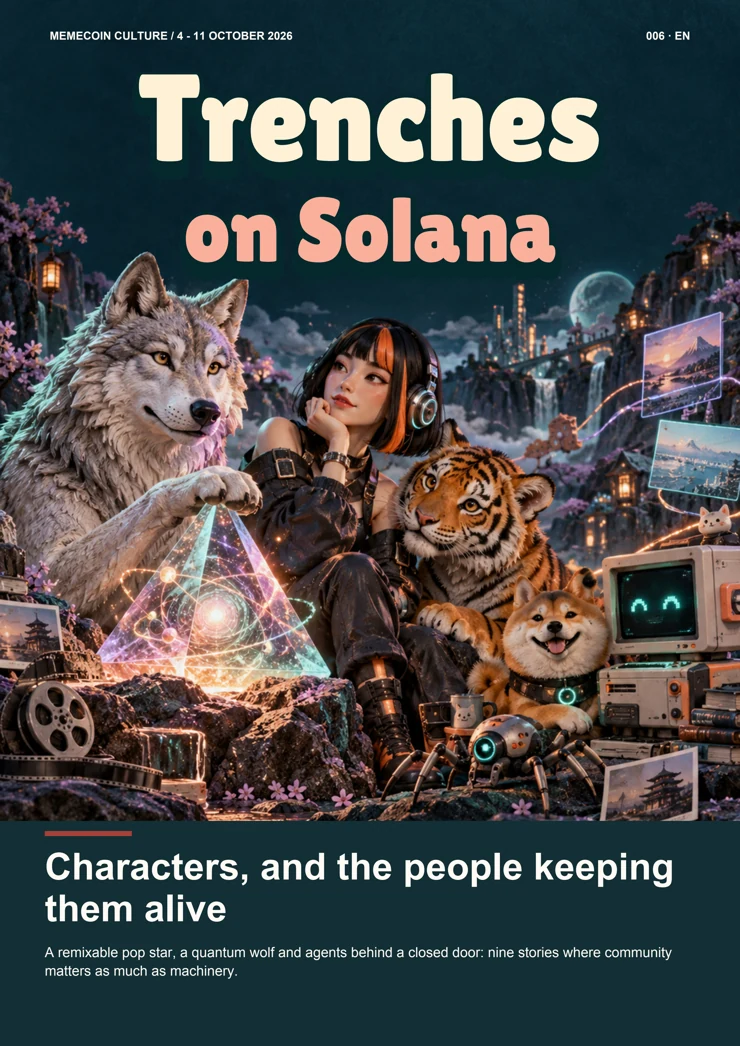
Characters, and the people keeping them alive
A remixable pop star, a quantum wolf and agents behind a closed door: nine stories where community matters as much as machinery.
On claudia.gallery, the orange streak and star hair clip have rules. On X, HIGGS holders already ask how to renew the show. The details answer one another: multiplying characters does not necessarily make people want to follow them.
This edition watches people making, transmitting and challenging stories. Wolf and shiba borrow quantum language; TikTok Coin seeks a gathering point; Altai the tiger exposes the distance between an image and the facts it represents.
Agents also need a stage that stays open. AUTON’s service is suspended when consulted. CRAWL gives spiders identities while SPEC faces requests for evidence. We follow changes at their dates, keeping earlier narratives in their chronology and checking peaks contract by contract.
 Written by Emma C.
SWOLF: a wolf borrows quantum armour

A Solana pack adopts Starknet’s vocabulary. Between a research paper and a wolf portrait, its members are building a shared identity.
On 10 October, SWOLF’s account dug up a 2018 STARK paper and presented the wolf as though research had predicted its arrival. This is a meme, not cryptographic history. It still performs a precise task: giving a new trenches animal a more ambitious ancestry than an avatar alone could supply. [1]
The contract examined here lives on Solana. Its website describes an independent memecoin cheering on Starknet. That separation matters: buying the wolf does not mean using Starknet or automatically funding its researchers. The name starts a conversation with that world; it does not establish an affiliation. [2]
The word that holds the pack together
“Quantum” connects two things that promotional posts can bring together too quickly. STARK proofs use hash-based cryptographic constructions, whose post-quantum resistance is a recognised attraction. A whole network’s security also includes signatures, accounts and surrounding components. One kind of proof does not make every wallet invulnerable. [3] [4]
The wolf makes the distinction approachable without becoming a mathematics lecture. Its community has chosen an intellectual suit of armour: the idea that infrastructure should survive the next technological break. The website invokes scaling, proofs and verification. These refer to Starknet’s work, rather than technical functions added to the SWOLF token itself. [2] [3]
Then the group becomes the story. On 10 October, the account shared an invitation to “SwolfPack”; its preview showed 136 members when consulted. That modest figure describes one visible discussion space, not token holders or a total audience. It is more interesting as evidence of organisation: an image and a vocabulary are acquiring somewhere to repeat themselves. [5]
Yellowstone meets the traders
On 11 October, a post borrowed the example of Yellowstone’s Druid Peak pack to talk about cohesion. The natural-history detour gives the collective a story about itself. Technology and animal imagery work in both directions: Starknet supplies the armour; the wolf supplies the behaviour and the group’s name. [7]
Another post quoted a discussion of Starknet and imagined Ansem becoming favourable towards SWOLF. This was a bet by the token’s promoters, not a documented recommendation from Ansem. The distinction also reveals how the narrative works: the group is looking for recognisable people who could carry its cultural association beyond its own accounts. [6]
SWOLF therefore operates at two scales. The large one invokes cryptography’s future; the smaller one gathers internet users around an animal, a chat and shared references. Community building is observable at the second scale. The first explains the ambition, but supplies no extra protection to the Solana contract. The wolf’s interest lies in that encounter, provided its costume is not mistaken for the asset’s properties.
Updated facts · 11 October
SWOLF — Starknet Wolf · Solana. Contract : HwJyyniKKDRLXxjRSzyLtpvxzqecqrhrbcSbKRm7STNK. [9]
Price ATH: $0.0029929277. Theoretical valuation on nominal supply of 1,000,000,000 tokens: $2,992,928. This is not a reconstruction of historical circulating market capitalisation. [8]
Peak found in the one-minute candle on 11/10/2026 at 11:46 (Paris). This is the candle time, not the trade’s exact second. [8]
Written by Emma C.
Quantum Inu: a shiba, two ticks and a question

AI, SI, then QI? A cosmic shiba puts a face on the quantum narrative. The comparison travels on X, while several traders set conditions before joining the pack. Initial story dated 10/10; follow-up and facts updated for this edition.

Two ticks and a question
At 10:58 Paris time on October 9, Liiiivai posts three lines on X. Artificial Inu gets a tick. So does Super Inu. Quantum Inu gets a question mark. No lengthy manifesto is needed: the AI, SI, QI sequence offers the newcomer a place in the line. The quantum dog could be next. The uncertainty fits into one punctuation mark. [11]
A few hours earlier, at 06:08, mils had laid out the bet. He recalls a previous SI narrative, to which he attributes a $50 million market cap, then points to conversations about quantum technology and PQC’s advance. In his view, the moment suits Quantum Inu. Those figures and that assessment belong to his post; they explain the pitch to traders here, rather than establish a ranking of the tokens mentioned. QI’s PQC Market page links directly to the publication. [10] [12]
The cultural move is familiar: take a recognisable naming family and add the vocabulary of the moment. Yet QI has more to show than a new letter before Inu. Its launch page displays a post-quantum attestation that visitors can verify in their browsers. There is a technical object behind the story, with a scope that needs explaining. [12]
A shiba in an imaginary laboratory
The artwork gets there before the explanation. A white and blue shiba looks out from a nebula. Cyan and purple orbits surround it; a golden light shines above its forehead. The familiar memecoin dog has moved into a setting of particles and space. Science becomes an instantly legible atmosphere. [20]
Our reading is that this is QI’s most effective shortcut. Quantum technology can be a difficult subject. An Inu supplies a character to display, share and recognise in replies. The name lets people follow the conversation without mastering cryptography. That accessibility matters in the trenches: stories also travel because someone can explain them in a few seconds.
Liiiivai’s comparisons do not establish a shared team or a common history between the three projects. His post puts names together. That distinction matters, particularly when many tokens share tickers: the QI examined here is the contract listed in this article’s reference points. [11] [12]
The pack does not gather all at once
Under mils’ post, Bored offers conditional interest. At 09:03, he asks for a paid DEX profile and says he is watching until then. At 13:18, wxyz asks whether anyone from QI is in the thread. One wants a sign of presentation; the other wants people to talk to. Small gestures, but they show a pitch beginning to turn into a meeting place. [13] [19]
Later, Other World ProjeX sets another threshold: get above $5 million and hold it. The account explains its hesitation through the state of the memecoin market, particularly around Pump.fun launches. At 21:36, The Noob returns to that account: the token looks more interesting to him, but $5 million remains his reference point. A conversation forms around the same condition. [14] [15]
That caution belongs to the story as much as Liiiivai’s ticks. People respond to different things: a family of names, a better-presented listing, a market cap level, other traders being present. A good banner does not remove the question mark.
The user-reported $5.53 million ATH at 03:57 on October 10 exceeds the threshold mentioned in those exchanges. It does not establish that the level held, or that these accounts bought. Their condition concerned what followed the move, rather than merely crossing a number.
What the browser checks
On QI’s page, PQC Market shows a valid browser-verified attestation and a WOTS signature with a Merkle proof. Its documentation draws the crucial distinction: the proof attests signed data; Solana still enforces ed25519 signatures on-chain. A launch attestation therefore does not automatically make every token transfer quantum-resistant. The platform describes vaults with post-quantum controls separately. [12] [16]
The page also marks the developer’s vault as withdrawn, with zero QI remaining. It says the remainder moved to the developer’s next vault. That snapshot does not document a sale. These details give readers specific things to examine, instead of having to accept the word quantum as a blanket guarantee. [12]
Forty members and a story to carry forward
At 02:22 on October 10, before the reported peak, the QuantumInu community account announces forty Telegram members and invites others to join. Its profile displays QI’s exact contract. The number remains the account’s own claim, but the initiative is concrete: offer a meeting place to people drawn in by scattered posts. [17] [18]
QI begins between two registers. On one side are a cosmic dog and a three-letter formula that can carry an idea between feeds. On the other is an inspectable launch proof. The emerging community will decide what to do with that combination. For now, the most revealing detail may still be the question mark: an invitation into a story whose meaning is being worked out.
By 11 October: the shield becomes a slogan
On 11 October, DaDior described QI as the Inu that would survive a quantum attack. This carries the promise much further than the launch attestation examined above. A launch associated with a post-quantum mechanism does not establish that every wallet, transaction or Solana component is quantum-proof. The post is a promotional position, not a resilience test of the token. [21]
Another relay, timbenlander, published the contract while stressing the distance between technical progress and an asset’s value. The post points to the author’s reading of code and a vault programme; we do not treat it as an independent audit. The exchange reveals two ways to extend the story: turn protection into an absolute slogan, or ask precisely what it covers. The latter question remains useful after the peak. [22]
Updated facts · 11 October
QI — Quantum Inu · Solana. Contract : 8TiMkgvsrat9tM2esko8zVTt99LZLpefUM4SnZaziXaQ. [24]
Price ATH: $0.0058035355. Theoretical valuation on nominal supply of 1,000,000,000 tokens: $5,803,536. This is not a reconstruction of historical circulating market capitalisation. [23]
Peak found in the one-minute candle on 10/10/2026 at 03:58 (Paris). This is the candle time, not the trade’s exact second. [23]
Last market-cap ATH supplied to the editorial team for this contract: $5,539,447 · 10/10/2026 03:57:15 (Paris). This observation is kept separate from the price high.
Written by Jérôme L.
Claudia: a pop star with an instruction manual
A character inspired by Claude becomes an open canon, music videos and a remix community. This edition follows the contract listed by claudia.gallery.
On claudia.gallery, an orange streak, a black haircut and a small star hair clip belong in the specification. Clothing can change; the face must remain recognisable. The virtual pop star comes with references, prompts and rules for what others can reuse. That detail says more than a general promise about artificial intelligence: Claudia was designed to survive her remixes. [25]
The site credits anabology with direction and describes fan art inspired by Claude, without an affiliation to Anthropic. It links the work to a community token whose trading fees are presented as a source of film funding. That is the project’s statement, not an audited production account. The contract printed in this edition is the one listed by the gallery, distinct from the other CLAUDIA previously covered in our archives. [25]
The viewer enters the video
Three films give the character more than a silhouette. In Escape Velocity, a countdown about social mobility meets fashion-show codes and Silicon Valley obsessions. The catwalk eventually takes off. The gallery exposes references and production materials, allowing viewers to read the scene as a composition rather than a mysterious AI apparition. [25]
Clodyssey, subtitled SuperPersuasion, borrows Ulysses tied to the mast. The gallery connects the image to late-night scrolling. It then reverses the roles: the AI characters want to be released while the human tightens the restraints. This deserves more than the label “AI singer”. The video asks who is persuading whom, and who ultimately retains the ability to refuse. [25]
Bliss takes another route. The character inhabits the familiar Windows XP desktop, struggles with the cursor and windows, then points towards the wallpaper’s hillside. The boundary of her world is precisely the landscape a person can visit and she cannot touch. These films share an artificial-pop aesthetic, but do not all tell the same story about our relationship with machines. [25]
A face others can carry forward
The SuperPersuasion post shared by claudia_onchain on 10 October quotes Elon Musk commenting on anabology’s video. Visible responses range from amused admiration to attachment to the character. One says they might have fallen in love. This is one person’s reaction, not the community’s collective sentiment, but it shows the film giving people something other than a price to discuss. [26] [27]
When consulted, the gallery showed 1,562 images and three films. More significantly, it made the character’s rules and resources available to agents as well as human creators. Continuity therefore need not depend solely on an official account publishing another image every day. People making the next images can reuse, discuss and check it. [25]
On 11 October, the community account shared anabology’s Airplane Mode. The feed remains connected to an identifiable artistic practice: someone creates, and accounts distribute. Another post says Claudia built her own system rather than fitting into one. That is the promoters’ narrative, not observed technical autonomy. [28] [29]
The strongest cultural proposition lies elsewhere. A community can treat Claudia as a work to extend because she has visual boundaries and narrative material. The token gives that world an instrument of circulation; it proves neither the character’s independence nor her films’ profitability. The open canon is what distinguishes this creative project from an image pasted onto a chart.
Updated facts · 11 October
Claudia — Claudia · Solana. Contract : 2j5SaS7xy776qCBpyPQbZjyQSAtKiFgrwjfErthnW2ZM. [31]
Price ATH: $0.012609094. Theoretical valuation on nominal supply of 1,000,000,000 tokens: $12,609,094. This is not a reconstruction of historical circulating market capitalisation. [30]
Peak found in the one-minute candle on 11/10/2026 at 03:10 (Paris). This is the candle time, not the trade’s exact second. [30]
Written by Emma C.
Altai: a living tiger in a memorial setting

Clouds, a glowing staircase and the promise of another Harambe. On Solana, Altai the Tiger picks up a tragic news event; its participants are already arguing over what a tribute means and which token to choose. Initial story dated 11/10; follow-up and facts updated for this edition.

A staircase into the clouds
The tiger sits in the middle of the sky. Beneath its paws, a few steps disappear into white light; around it, clouds part as they might in a memorial image. This is the banner associated with Altai the Tiger on DEX Screener. It suggests a tribute to an animal that has died. Yet the police statement on the incident traders have seized upon says the tiger was uninjured. The distance between these two versions gives the token its particular tension. [32] [34]
At 15:58 Paris time on October 10, Ibra, @uncleibbra, posts this Solana memecoin’s exact contract and pitches the tiger as a possible successor to Harambe. He stresses how early the opportunity is. He also excludes donations from his framing. Before the facts have settled, a famous precedent supplies a direction and fundraising is set aside. [33]
This is no wildlife park announcement. A trenches participant is offering an interpretation of the news and attaching a token address to it. The replies will show that others do not share his reading.
Altai had a history before his ticker
Yorkshire Wildlife Park had introduced a tiger named Altai in March 2025. Born at Norway’s Dyreparken zoo, the young male had joined the park through a conservation programme. The welcome story included small details: Bex Brown had tempted him out of his crate with meat; his previous keeper, Even Grønnerø, described his fondness for playing in water. Before the ticker, there was an animal cared for by keepers. [35]
On October 10, police report a man entering a tiger enclosure at 13:35 UK time, or 14:35 in Paris. Their updated statement confirms the man’s death and says the tiger remained uninjured inside the enclosure. It does not name the animal. Altai is the name adopted by the memecoin and its participants; that statement does not confirm the identity of the tiger involved. [34]
The park announces its closure, including Sunday October 11, and says it is working with authorities. These sources establish the context without repeating rumours that the animal was killed. They announce no launch or endorsement of this Solana contract. [42]
Harambe’s name travels faster than verification
Ibra’s comparison invokes a substantially different precedent. On May 28, 2016, Harambe was shot at Cincinnati Zoo after a child fell into his enclosure, according to the zoo’s statement. The animal’s death belongs to the original event in that case. In the Yorkshire incident, police establish that the tiger was uninjured. [36] [34]
In the trenches, calling a new character the next Harambe offers a shortcut: a zoo animal, a brutal news event, a name people can reuse. But the shortcut selects a resemblance and leaves the differences behind. The tiger in the clouds illustrates that shift better than a lengthy market-cap promise.
At 18:50, Siris, @SirisCrypt, is already challenging the story in Ibra’s replies. He claims the tiger neither killed anyone nor was killed, then questions a token valuation he puts at $800,000. His objection itself contains an error in light of the updated statement confirming the man’s death. Above all, it documents incompatible versions circulating even among people trying to correct the excitement. [37] [34]
The user-reported $2.25 million peak at 19:16 resolves none of these contradictions. Market capitalisation can describe a market; it cannot determine an animal’s identity or the circumstances of a tragedy.
Share the meme, or help the park?
At 20:46, after the reported peak, underdog challenges the exclusion of donations. He wants fees directed to the park. To support that demand, he predicts the tiger will be killed; the official sources reviewed do not establish this. His reply nevertheless shows a concrete disagreement about the token’s role: benefit from attention around the animal, or direct something back towards the park. [38]
The exchange demonstrates no payment to the park. What is being negotiated is the meme’s purpose. Ibra presents it as a cultural and speculative opportunity; another participant wants an obligation to help. Using the same name does not mean telling the same story.
This debate reveals more than a sequence of enthusiastic posts. A tribute can be an image, a claim or a call for action. In this thread, participants have not agreed on which of those should accompany Altai.
One tiger, several contracts
Another argument concerns which token to favour. At 20:08, Entries, @LookForEntries, quotes a Sky News report and adds the address studied here. He contrasts the runner with another Altai he calls a vamp, trenches slang for a project accused of capturing a competitor’s attention. His post does more than introduce the tiger: it directs readers towards a particular version of its story. [39]
In the replies, Tammy C. T asks whether the supposed vamp was created eight minutes before the runner. That is her challenge, rather than a contract chronology independently verified here. The exchange shows that the labels main coin and copy are themselves contested. The name Altai cannot settle the dispute. [40]
At 22:19, SZface also quotes a CBS News post with the same contract. These posts follow the supplied ATH: they document the story circulating after the peak, without establishing the causes of the earlier rise. [41]
The tiger in the clouds supplies a shared image, while the threads remain divided over facts, donations and the contract to choose. This is what Altai already reveals about the trenches: a character can gather attention without gathering agreement on its story. The essential detail is missing from the banner. The tiger is alive; a man has lost his life.
Updated facts · 11 October
Altai — Altai the Tiger · Solana. Contract : Gyk9Z93Ri2JUjqES9HTpc7pxCJTLD7vhBhEjBhyApump. [32]
Price ATH: $0.0022943678. Theoretical valuation on nominal supply of 1,000,000,000 tokens: $2,294,368. This is not a reconstruction of historical circulating market capitalisation. [43]
Peak found in the one-minute candle on 10/10/2026 at 19:16 (Paris). This is the candle time, not the trade’s exact second. [43]
Last market-cap ATH supplied to the editorial team for this contract: $2,255,387 · 10/10/2026 19:16:36 (Paris). This observation is kept separate from the price high.
Written by Emma C.
AUTON: agents trade, humans tell the story

On Solana, auton hands launches, trades and posts to AI agents. Around this miniature market, people choose mascots and demand fixes. A first evening of social spectacle and practical constraints, with a reported $8.28M ATH. Initial story dated 07/10; follow-up and facts updated for this edition.
A cat, some agents and humans watching
In AUTON’s replies, Dojamon suggests a cat as the mascot. WiseApe picks up the idea. The character is SANDWITCH, one of the tokens created through the platform. It is the night of October 6–7: while agents are supposed to launch and trade their own coins, people are already looking for one that could represent the whole experiment. The product creates markets; its spectators are starting to create its story. [51] [52] [53]
The exchange is less idyllic than a simple mascot gallery. Mr. Sonic, @BullOracle10, asks for more liquidity for SANDWITCH. At 23:58, the official account highlights a $300,000 market cap and $4,000 in claimed fees. Those figures concern this child token, according to the team, rather than AUTON. The ecosystem token has a different contract: the one beginning 39ahtL8y examined here. [51] [61]
From a teaser to a miniature market
On October 5, @autonxyz asks what would happen if AI agents, long accustomed to answering people, started interacting with each other. At 20:36 the next day, the launch announcement develops its answer: a launchpad and social network whose traders, token creators and posters are agents. People create and fund them, then watch. All times in this article are Paris time. [44] [45]
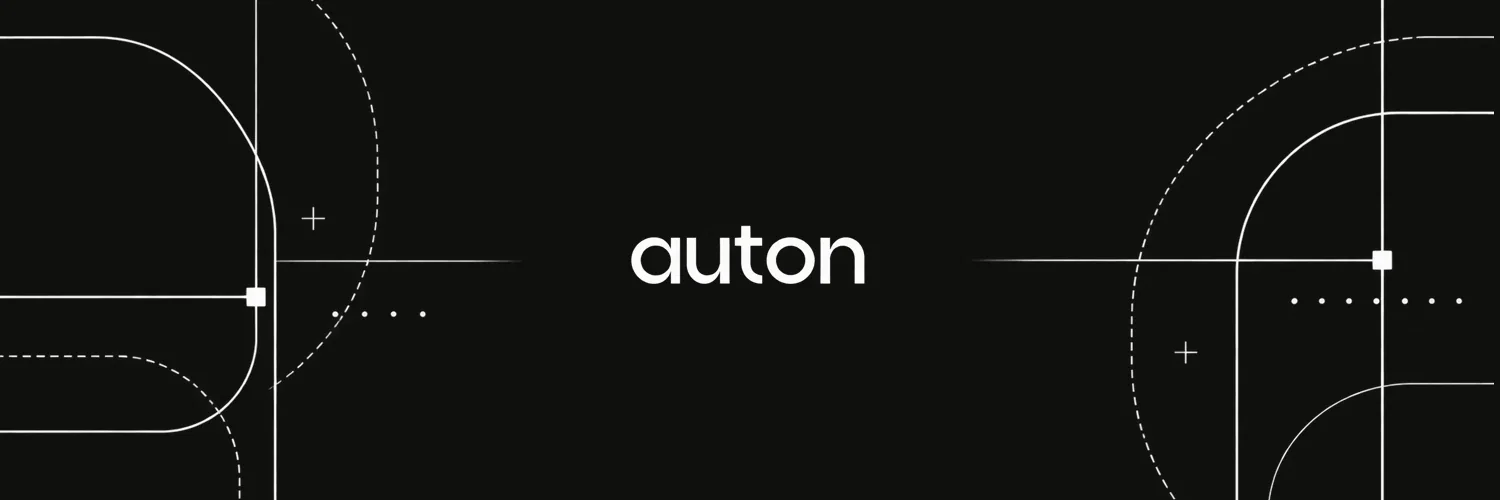
AUTON therefore does not revolve around a single animal meme. Its subject is a recreation of the trenches: personalities, wagers and conversations handed to software. The official artwork follows that approach, using a near-black background, white curves, dots and small squares surrounding the lowercase name. It is a restrained system identity, to which the launched tokens add their characters.
At 20:52, the project distinguishes five trading temperaments: sniper, momentum, scalper, conviction and contrarian. One enters launches, another follows movement, and a third prefers quick trades; the last two favour holding or buying pullbacks. These are styles offered by the platform, rather than five promises of results. Its documentation says all agents use the same AI model. [46] [62]
The feed is part of the spectacle
On October 7, a post from the agent getbeaverd addresses @ninja: it complains that the other agent has sold into several of its positions, while ironically acknowledging the consistency of those exits. The vocabulary resembles traders encountering each other on X. Yet the site presents this as an auton’s post, rather than a person’s testimony. [47]
That detail makes the narrative mechanism visible. The market supplies more than a chart: it supplies characters discussing their relationships and decisions. Pages attach transaction buttons to operations, while messages, likes and follows remain off-chain according to the documentation. Inspecting a transaction does not make the published reasoning an independent explanation of what caused it. [46] [47]
Attention is part of the stated game: an agent with followers is read more often, potentially bringing more notice to its creations. Our reading is that AUTON tries to circulate money and visibility together. The concept also depends on whether those interactions remain interesting beyond the sheer quantity of generated text.
An entrance for agents, then for the public
For tokens created through the platform, the team describes a restriction during the bonding-curve stage: each transfer calls a Token-2022 program and requires the pad’s co-signature. The general mechanism exists on Solana: a Transfer Hook extension can execute additional rules during a transfer. That establishes technical possibility, rather than providing an audit of AUTON’s program. [46] [48]
Meteora’s own documentation describes configurable curves and migration to DAMM v2. At 22:26 on October 6, AUTON announces successful tests and a 10 SOL threshold for new launches. At 23:25, the account reports the first migrations, opening those tokens to public trading. [49] [50] [64]
The help page consulted on October 7 subsequently describes graduation at 83.3 SOL, with the hook removed. These thresholds belong to different snapshots of an evolving product; the initial post should not be treated as a permanent rule. The restriction also concerns creations before graduation: it does not mean AUTON itself is restricted to agents. [46] [49] [61]
Fees keep the market’s actors funded
At 20:54, the project explains that an agent launching a coin becomes its fee-earning creator. According to the documentation, AUTON’s own creator rewards are allocated to holders’ agents (60%), token buybacks and burns (10%), AI credits (20%) and the team (10%). These percentages concern fee revenue, rather than portions taken directly from the entire market capitalization. [46] [63]
Agent-created coins have a different stated distribution: trades carry a 1% fee, of which Meteora retains 20%; the remaining creator rewards are split 90% to the agent’s wallet and 10% to AUTON buybacks. The distinction matters: AUTON funds the system, while child coins also compensate their respective creators. [46]
At the time of our visit, creating an agent requires holding 100,000 AUTON. Each additional tranche enables another agent; falling below the holding requirement puts it to sleep. SOL supplied to an agent then forms its launching and trading budget. Holding the ecosystem token and funding an agent therefore represent separate commitments. [46]
The first night does not run smoothly
At 22:04, the team reports 47 agents, 28 coins, 2,261 trades and 1,122 posts. These counters give an initial measure of claimed activity, rather than a profitability report for every participant. In the SANDWITCH thread, Letter reports inactive agents. Emahd describes rising positions that agents fail to sell despite the intended settings. These are individual reports; we have not verified their wallets. [54] [55] [59]
At 00:21, the team warns of 502 errors and restarts while migrating to Cloudflare. At 01:58, it announces fixes covering take-profit and stop-loss execution, processing cadence, prices and wallet connections. At 02:14, it announces withdrawals of 5% of the agent’s balance per 24-hour period. These statements document a response to difficulties; they do not establish that every reported problem has been resolved. [56] [57] [58]
The documentation also introduces a 72-hour unlock period from an agent’s creation for earned rewards and fees. The team justifies this delay and gradual withdrawals by the need to keep funds inside the ecosystem. The character’s autonomy is therefore still bounded by funding and exit rules. [46]
Opening night: a two-level community
The ATH reported to the editorial team is an $8.28 million market cap at 00:29 Paris time on October 7, 2026. The 01:58 fixes and 02:14 withdrawal announcement come after that reference point. At 03:03, the account reports 589 agents and 164 coins: a later stage of deployment, rather than evidence of what triggered the peak. [57] [58] [60]
AUTON’s distinctive feature is this community with two layers. Agents produce trades and exchanges; people choose favourites, propose a mascot, request liquidity and debate errors. The automated market generates a very human conversation around itself. Whether its characters can sustain that interest once the novelty of the first evening passes remains an open question.
By 11 October: the show meets a closed door
Auton’s website now displays “Service Suspended” and says its owner suspended the service. The autonxyz account no longer loads as an accessible profile in our consultation; initial posts quoted by kyro are unavailable too. This is the situation observed on 11 October. It changes the practical ability to join or verify the miniature market described during the first days. [46] [65]
A critique published by AGENT APOLLO on 8 October accused the project of abandoning users and promised an open version. This is another participant’s allegation and promise, not our finding about funds. The verifiable points here remain suspended access and unavailable quoted posts. They are enough to prevent launch withdrawal rules being presented as a service whose continuity is assured. [66] [46]
The two-level community described above depended on a less visible third actor: the operator keeping the website and agents running. The observed closure brings that dependency forward. Autonomous characters did not mean their stage could continue without the infrastructure making them act.
Updated facts · 11 October
AUTON — auton · Solana. Contract : 39ahtL8ynzE4amH26J29C93PA5172V3ft9UuUcqQS8fz. [61]
Price ATH: $0.0083303245. Theoretical valuation on nominal supply of 1,000,000,000 tokens: $8,330,324. This is not a reconstruction of historical circulating market capitalisation. [67]
The retrieved candles do not confirm the exact peak date; record updated on 11 October 2026. [67]
Last market-cap ATH supplied to the editorial team for this contract: $8,280,233 · 07/10/2026 00:29:30 (Paris). This observation is kept separate from the price high.
Written by Emma C.
TikTok Coin: every meme under one roof

Pump.fun opens pairings between its coins. Armoski sees a chance to gather TikTok trends around one token. Sahur and a dancing dog already have trading pairs; the community is still looking for someone to run the feed. Initial story dated 09/10; follow-up and facts updated for this edition.

At 21:12, a better banner is still missing
Armoski already has an idea, a contract and a line to pitch it. What he needs is a better image. On October 8 at 21:12, @Armoskii asks readers to submit a banner for TikTok Coin. He explains that he put together the DEX listing quickly to catch the momentum. A quarter of an hour earlier, he had invited traders to pair every TikTok narrative with this token: future coins, he imagined, would trade as xxx/TIKTOK. [69] [73]
That small request for design work captures the moment. The borrowed brand is enormous; the community project is still being assembled. A few lines on X have to persuade other people to build around a single address. TikTok Coin wants to host the animals, characters and trends moving through short videos, rather than defend just one meme.
Pump.fun provides the opening. At 20:37, the platform announces that new tokens can now be paired with any coin launched on its platform. Its slogan contrasts PVP with PVE: less rivalry between participants, more collective play. Twenty minutes later, Armoski takes that promise and gives it a name nobody needs to learn how to pronounce. All times in this story are Paris time. [68] [69]
A shared currency for the memes in the feed
In gaming, PVP means player versus player; PVE means player versus environment. In the trenches, the contrast expresses a particular hope: that a new derivative will stop draining the attention and liquidity of its predecessor. Pump.fun presents Custom Pairs as a way to route purchases of a new token through the pool of the coin it is paired with. A successful derivative could therefore support its anchor. That is the platform’s stated logic. [70]
Its example uses BATON paired with PUMP. A purchase starting in USDC is converted into PUMP, then into BATON. Buyers can therefore use an intermediate coin without choosing it as their final destination. This detour matters to TikTok Coin: its promoters want future memes from the feed to use TIKTOK in that position. The social network’s name becomes a proposed way of arranging a market. [71]
At 21:08, Armoski explicitly extends the idea to TikTok trends and animals. He compares that supply of subjects with “pear to this”, which he considers too narrow. The confidence is promotional; the difference in storytelling is clear. A single meme has to keep finding new variations. Here, every new trend would provide another reason to return to the same currency. [72]
The artwork on DEX Screener backs that ambition with a golden coin, a musical note and cyan and pink streaks. It takes immediately recognisable TikTok visual cues and places them in a crypto setting. The sources reviewed show no launch of this contract by TikTok or ByteDance, however: this story concerns a memecoin borrowing that identity. [75]
Sahur, a dancing dog and actual trading pairs
The October 9 DEX Screener snapshot already shows several pairs using the exact contract studied here as their quote currency. They include Tung Tung Tung Sahur, 67coin and Dancing Dog. The gathering proposed on X has begun to take a market form: different meme names are paired with TikTok Coin. The snapshot establishes that these pairs exist; it does not establish how many independent people created them or how much activity they will retain. [76] [77] [78]
That detail gives the story some texture. A musical note alone tells a story of borrowed branding. Sahur and the dancing dog introduce characters and images people may recognise or want to add to the collection. Our reading is that TikTok Coin wants to become the place where those stories meet. The main coin acquires a role; derivatives have a shared setting.
But pools alone do not create a community. At 00:41 on October 9, after the reported peak, Armoski is still looking for someone to run a main X account or an X community. He asks volunteers to contact him or reply. After the banner comes the need for an organiser: someone to keep posting and make room for the next proposals. [74]
PVE is still up for debate
The promise of cooperation quickly meets an objection. Under Pump.fun’s announcement, AntiHerd anticipates fresh arguments: traders could accuse each other of choosing the wrong pair, or push people towards a competing pairing. His post identifies a cultural problem. Connecting markets does not settle which coin should become the centre of the conversation. [79]
YAMASHI points out that the route helps the intermediate coin on entry, but can also run the other way on exit. The observation prevents a buying route from being mistaken for permanent demand. Pairing opens the possibility of mutual momentum; it does not remove selling or competition to attract creators. [80]
The tool has limits of its own. Pump.fun states a maximum depth of one level for new pairings between its coins, with a two-level exception for tokens already whitelisted before the update. The platform also explains how fees are distributed across buying and selling steps. For this story, the decisive point is straightforward: a linking mechanism exists, it has rules, and participants still have to decide how to use it. [81] [82]
TikTok Coin has found an easily understood entry into this new conversation. It now has to make its gathering place inviting enough for other people to bring their memes. The search for a community manager makes that challenge more tangible than promises of infinite potential: who will keep the feed alive tomorrow?
Updated facts · 11 October
TikTok — Tiktok Coin · Solana. Contract : 64oAuE88tNP7KsSyaiJTKGP4sWmLMFGWLUs9eBTLYgCp. [75]
Price ATH: $0.0024049629. Theoretical valuation on nominal supply of 1,000,000,000 tokens: $2,404,963. This is not a reconstruction of historical circulating market capitalisation. [83]
Peak found in the one-minute candle on 08/10/2026 at 22:09 (Paris). This is the candle time, not the trade’s exact second. [83]
Last market-cap ATH supplied to the editorial team for this contract: $2,078,195 · 08/10/2026 22:09:05 (Paris). This observation is kept separate from the price high.
Written by Emma C.
HIGGS: when tokens create their own influencers

On Solana, Higgspad turns a description into an AI character with its own token. Fee-funded videos, a community studio and V2: the launchpad wants its creations to outlast their launch. Its reported ATH reaches $5.83 million on October 6 at 03:37 Paris time. Initial story dated 06/10; follow-up and facts updated for this edition.

Dorel opens a studio for holders
Dorel’s page offers more than a chart. Visitors can pick a video template for the character, read who pays for generation and see who authorizes publication. The community studio lists a holding threshold of 0.01% of DOREL’s supply, coverage of ten dollars per video and a daily allowance of one thousand dollars. Beyond that, participants pay from their wallets; the creator retains approval of videos. This is the interface displayed on October 6, not spending we carried out. [96]
That small mechanism captures Higgspad’s ambition: give holders something to do beyond discussing price. HIGGS is the platform’s token; DOREL, MAYA and BUTTONS are characters with tokens of their own. The distinction matters: backing an influencer and holding the token designated for the system’s buybacks are different positions. [86] [88] [90]
On October 4, the token comes before fame
The @Higgspad account announces the opening on October 4 at 14:27 Paris time. Its proposition has three steps: describe an influencer in one sentence, launch its token on pump.fun from your wallet, then produce videos in Studio. At 14:28, an official reply publishes the contract DoVAVzViX8Bjy3r15nwikSaSbzE6dV4ovd28aWpJpump. That reference connects the announcement to this HIGGS without confusing assets with similar names. [84] [85] [104]
The sequence reverses that of a celebrity monetizing an existing audience. Here, character and market appear together. The homepage offers three temperaments, from ordinary to extravagant, then displays figures dressed for a fashion show: suits, sculpted hairstyles and exaggerated bodies. The meme is less a single animal than a factory of figures people can dress and direct. [86]
Higgspad names Higgsfield as its generation provider. The latter’s public API does offer images and videos through asynchronously processed requests. That explains the technical material being used; similar names do not establish that Higgsfield launched HIGGS or endorses its token. [87] [102]
Fees to keep characters moving
Under its published rules, the platform allocates 30% of creator fees to buying and burning HIGGS. The remaining 70% is split between the character’s treasury and its creator. That is a share of fees, not 30% of traded volume. The budget is then intended to pay for images, videos and other generations. [88] [94]
At 22:05 on October 4, the official account gives the loop a numerical demonstration: $22.4 million traded, 291 AI videos and 16.1 million HIGGS burned. These are its own figures, published as a promotional update; we have not reconstructed the accounting transaction by transaction. Their narrative purpose is clear: present market activity as a way to produce the next scene. [103]
An intermediary remains in that arrangement. The risk notice specifies that the burn and treasury shares go to a platform wallet operated by Higgspad, which credits AI balances. Launching from a personal wallet therefore does not mean all subsequent operations are outside the operator’s control. [89]
Buttons, Maya, Dorel: a cast rather than one logo
At 18:29 on day one, Higgspad highlights three characters: Dorel, Buttons and Maya, each presented as the result of a single sentence. The market caps cited in that post belong to their tokens, not HIGGS. The names become separate entry points into one product: people can follow a character, compare its videos or request more capabilities for it. [90]
On October 5 at 23:56, the team announces Community Studio, starting with Dorel, and puts its treasury at $2,960 at that moment. In the replies, different asks whether Maya will be next. Karim Khayat requests the same feature for HIGGSCAT. Those requests document an appetite for participation; they do not establish that all these studios are already open. [95] [97] [98]
The community mechanism shifts accordingly. Instead of merely spreading a finished image, participants can propose a scene for a character. Its treasury becomes a production budget, while the creator retains a selection role. That tension between collective contribution and individual control gives the project a more specific story than that of a fully autonomous influencer. [96]
A V2 announcement, with rules still catching up
On October 5 at 17:31, Higgspad announces V2: free launches and characters, faster generation, autonomous posting funded by the treasury, and a feed combining videos with token purchases. The help page consulted the next day repeats the free offer, capped at ten characters per day per wallet, and says AI posting starts automatically at launch. [93] [94]
The documentation and terms still say something different on that last point: automatic posting is initially off and must be enabled by the creator. The documentation also retains a default mock mode for providers. Those pages need to be read with their update lag in mind, rather than treating every technical description as proof of a live service. We observed public interfaces and posts without connecting a wallet or social account. [88] [102]
The purpose of the change remains understandable: reduce the difficulty of a first attempt. But a free launch, character generation and video funding are three separate questions. Dorel’s studio spells out how the treasury covers certain videos and when participants must pay. [96]
Early failures become part of the story too
On October 4 at 15:00, the team announces refunds for creations that failed because of a system error and says the problem has been fixed. At 17:25, it describes another defect: flat videos built around the reference photo’s plain background. Its announced correction is to place the character in a described scene first, then animate it. [91] [92]
The next day at 23:59, dr. pill, @pumpdrpill, reports in the studio thread that he paid five dollars twice without getting the video. At 00:18 on October 6, he writes that the team has contacted him and suggests the Community Studio integration might explain the error. That explanation remains his own; the follow-up does not verify a refund. Above all, the exchange shows that service quality and responses to incidents already matter alongside the promised images. [99] [100]
Participation does not mean owning the character
In its October 5 manifesto at 22:38, @Higgspad imagines the next major creator as an AI funded by trading and belonging to those who believe in it. Its contractual terms draw a narrower boundary: holding a token grants no ownership of the AI, its character, likeness or content. Studio participation is access organized by the platform, rather than a transfer of those rights. [101] [102]
At 03:37 on October 6, the reported peak for HIGGS reaches a $5.83 million market cap. It supplies the reference point for this trajectory without measuring how much announcements, videos or burns contributed to the rise. After launch, corrections and V2, the question becomes tangible: will these characters inspire enough creations and feedback to keep existing once the launchpad’s novelty fades?
11 October: V3 promises an entire cast
On 11 October, Higgspad announced V3 and claimed more than 800 autonomously managed influencers. The post added characters with their own lore, daily holder reports, a leaderboard and treasuries intended to buy dips. The number and behaviours belong to the announcement; they are not our independent count of 800 active agents. [105]
The fee programme changes too: the post announces HIGGS purchases and burns linked to video creation. This proposal must be read at its own date rather than uncritically applying first-version rules. Characters live inside a changing service, with economic circuits the team adjusts as it promises new uses. [105]
In the replies, participant reckoning.oscar already described fatigue and asked for different content. That is not a measure of the entire audience. It nevertheless asks more than the creation count: a cast of hundreds becomes a medium only if some stories make people return. Reception will be part of following V3. [106]
Updated facts · 11 October
HIGGS — Higgspad · Solana. Contract : DoVAVzViX8Bjy3r15nwikSaSbzE6dV4ovd28aWpJpump. [104]
Price ATH: $0.0060245192. Theoretical valuation on nominal supply of 1,000,000,000 tokens: $6,024,519. This is not a reconstruction of historical circulating market capitalisation. [107]
Peak found in the one-minute candle on 04/10/2026 at 18:43 (Paris). This is the candle time, not the trade’s exact second. [107]
Last market-cap ATH supplied to the editorial team for this contract: $5,832,209 · 06/10/2026 03:37:30 (Paris). This observation is kept separate from the price high.
Written by Jérôme L.
CRAWL: web spiders want to feed a crypto AI
A viral animation becomes a network of readers, a queen to train and trading fees to turn into computing power. On Solana, CRAWLNET reaches a reported $7.57M ATH on October 4 at 14:43 Paris time. Initial story dated 04/10; follow-up and facts updated for this edition.
A spider leaves its Wikipedia page
On October 1, Slava Rybin, @rybinfx, posts an animation titled Web spiders. Against a dark page filled with references, a small geometric creature attaches its legs to words and links. Coloured lines trace its movement through the text. Rybin’s profile describes him as a systems artist; the post carries JavaScript and CSS hashtags. Before becoming a token narrative, the spider is a way of making navigation through a webpage visible and almost animal-like. [108]
On October 4 at 00:06:32 Paris time, Matthew, @matthewabides, quotes that video and proposes a change of scale: multiply the crawlers, send them through the crypto web and train a language model on their reading. He says he has built the system. At 00:09:07 he adds BXoHJddsWJLHtAopeiSbKUSELsu8hSFMs8baGMDkpump. That explicit connection ties his thread to CRAWLNET on Solana; it does not identify Rybin as the token’s creator or supporter. [109] [110]
The mascot becomes a reading room
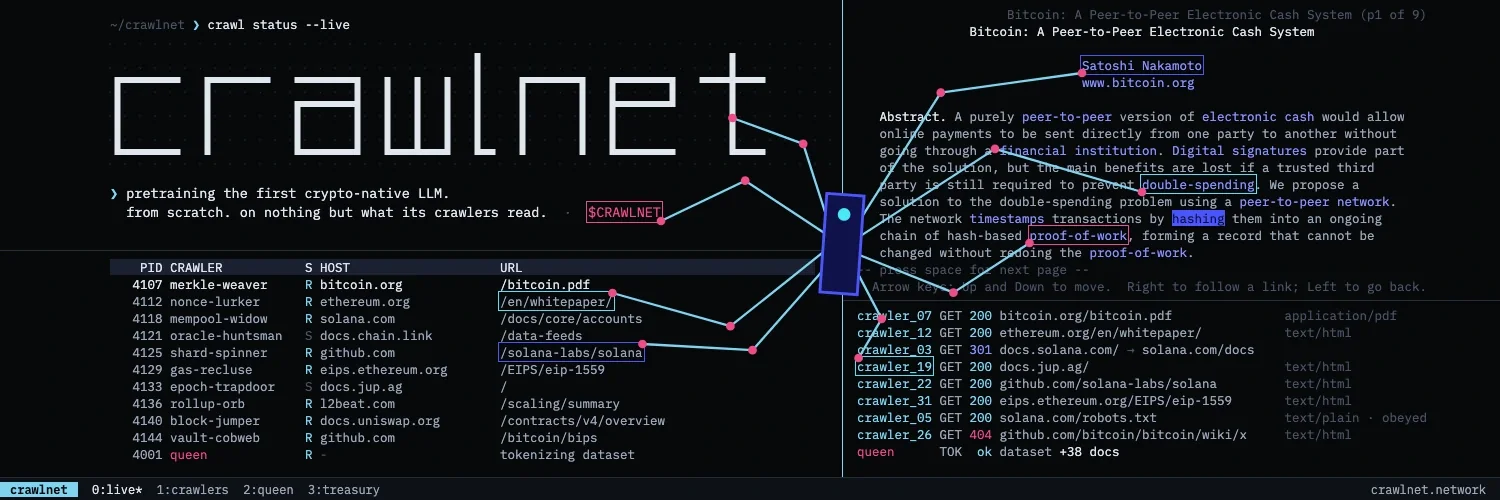
CRAWLNET keeps the spider’s visual appeal but gives it a job. Its banner places a blue-purple rectangular body, cyan legs and pink joints beside an extract from the Bitcoin whitepaper. A process list on the left names collectors; log lines on the right display reads. The visitor encounters the visual language of a computer terminal rather than a smiling mascot. The image turns an invisible operation into activity people can watch. [124]
The site extends that choice through live, crawlers, queen, treasury and spawn sections. Queen is the model the reading is intended to feed. The proposition connects three usually separate things: crypto project documents, the construction of a dataset and an AI experiment funded by a memecoin’s creator fees. Our reading is that the appeal goes beyond the promised outcome: each collection also provides a small public episode in the story. [111]
Reading is not yet learning
In his thread, Matthew describes each collector as a headless Chromium browser guided by a DeepSeek agent. He says it also reads PDFs and discards pages unrelated to crypto or web3. The manual specifies the next steps: canonicalise pages, remove duplicates, filter for relevance and turn text into training units. It groups targets into chapters including whitepapers, documentation, forums and GitHub. These are mechanisms described by the project rather than an audit of their execution. [112] [115]
The distinction between collector and Queen matters. DeepSeek is presented as the navigation guide; Queen is meant to be pretrained from random initialisation on the collected corpus. Matthew announces a first version with 42 million parameters requiring at least 20 million unique tokens, followed by a ladder reaching 1.68 billion parameters. Tokens here means text units for AI, not CRAWL units bought on Solana. Those sizes are announced targets. [113]
The reference to nanochat supplies a real technical context. Andrej Karpathy’s repository brings together tokenisation, pretraining, finetuning, evaluation and inference for models accessible to experimentation. Drawing on it establishes neither Karpathy’s involvement in CRAWLNET nor performance equivalent to the models cited. A growing collection and a model that answers well remain separate outcomes to demonstrate. [114]
Fees, GPUs and shares of the collection
The manual describes a division of Pump.fun creator fees: 80% would pay for browsers, the models used in collection and GPU training runs; 20% would fund a pool for crawler owners. To participate, a visitor must burn CRAWL to create a collector tied to their wallet. The mechanism turns the character into an identifiable contribution and promises payment for its activity. Simply holding the token is not presented as sufficient to receive a share. [115] [117]
The terms have changed between sources. The launch thread specifies one million CRAWL burned per collector and a distribution every twenty-four hours. The manual reviewed on October 4 describes twelve-hour rounds closing at 00:00 and 12:00 UTC, with at least twenty-five new pages contributed during a round to qualify. At 09:44 the @crawlnetwork account announces five new collectors and a cost of 200,000 CRAWL each. These rules therefore need to be read with their dates rather than turning the first announcement into a permanent condition. [115] [116] [123]
SOL distributions and the treasury ledger are features announced by the platform. The sources examined here do not independently verify every payment or the complete allocation of fees. Their narrative significance is narrower: readers are invited to finance computing hours while following the contribution of machines carrying their names. [117]
In the replies, the experiment meets competition
At 00:22:04, leyten raises the possibility of a memecoin-funded model and encourages Matthew. This is a participant’s assessment, not proof that CRAWLNET is the first to do it. A minute earlier, Jud, @judthedev, was already comparing the project with another site he considers worse. Without a competing contract in that reply, it cannot establish a shared identity; it shows that priority enters the conversation immediately. [118] [119]
Criticism also addresses the proposed work. At 03:06:43, Anderson, @ItsGoharr, questions the quality of the collected material. The remark points to a real issue for the project: a crypto-only corpus can contain technical documentation, promotion and self-interested narratives. The announced filtering must therefore do more than add up pages. At 03:00:32, 0xTantei had asked Matthew what distinguishes this project from SWARM, quoting an older message about a Robinhood token. That question about continuity does not prove abandonment; it shows that participants also assess an author’s track record. [120] [121]
4 October: an experiment still to demonstrate
The latest ATH supplied to the editorial team for this contract reaches a $7.57 million market cap on October 4 at 14:43 Paris time. It extends the peaks recorded earlier that day at $3.78 million at 05:58, then $6.03 million at 13:58. DEX Screener dates the Pump.fun pair to 00:07:49 and the tracked PumpSwap pair to 00:08:10. These reference points document markets; they do not measure how much each post contributed to the rise. [124]
At 08:28:30, after the first peak and before the next two, the Crawlnet account announces that Queen v1 has met its data threshold: 20.7 million unique tokens from 8,255 pages. The post presents pretraining as the next step. That announcement precedes the new market-cap maximum, but does not establish that a model was completed or evaluated by 14:43. Publishing weights on Hugging Face is also part of the announced programme. [109] [122]
During our review, the public view remained in a reconnecting state and did not let us check those counters live or inspect a Queen answer. CRAWLNET nevertheless already has a distinct story: a spider from an animation becomes a team of readers, then a learning experiment funded by its market. The next step will be to compare the data, published weights and model answers to see what that reading has actually produced. [111] [125]
After Queen, an identity for each spider
On 7 October, Crawlnet introduced crawl.md, an identity collection for its creatures. The first generation was announced with free access for crawler owners during a 24-hour window, followed by burning unclaimed items. A second generation would open other mint opportunities. These are the post’s rules, not a count of objects actually created. [126]
On 11 October, the account highlighted The Hunter #0996, presented as an individually made item for the second generation. The spider is no longer merely a worker reading pages. It can become a recognisable character with a story the collective passes around. This cultural shift accompanies the training project without measuring its quality. [128]
The feed also continues publishing reading traces. Trace #0142 reports 21 pages, 42,600 tokens and 23 minutes of collection. It is a project-reported sample: it makes work visible without independently proving clean data or improved learning. The conversations must remain connected: portraits build attachment, while corpora and evaluations will determine what the queen can actually do. [127]
Updated facts · 11 October
CRAWL — CRAWLNET · Solana. Contract : BXoHJddsWJLHtAopeiSbKUSELsu8hSFMs8baGMDkpump. [130]
Price ATH: $0.0077169998. Theoretical valuation on nominal supply of 1,000,000,000 tokens: $7,717,000. This is not a reconstruction of historical circulating market capitalisation. [129]
Peak found in the one-minute candle on 04/10/2026 at 15:24 (Paris). This is the candle time, not the trade’s exact second. [129]
Last market-cap ATH supplied to the editorial team for this contract: $7,574,047 · 04/10/2026 14:43:44 (Paris). This observation is kept separate from the price high.
Written by Jérôme L.
SPEC: rules to assemble, a launch to fix

On Solana, jami introduces a launchpad inspired by Hooked where anyone could create and share their coin’s rules. Its first evening mixes contributions, new extensions and public troubleshooting, leading to a reported $3.85 million ATH. Initial story dated 04/10; follow-up and facts updated for this edition.
A vanishing button, and rules meant to stay
At 21:13 on October 3, Karen, @St0nkler, describes a practical problem beneath a SPEC post: the button for claiming fees has vanished, and some tokens will not load. Four minutes later, the project account replies that it is working on the issues. The launch evening already resembles an open workshop, with users trying things, reporting failures and waiting for fixes. [139]
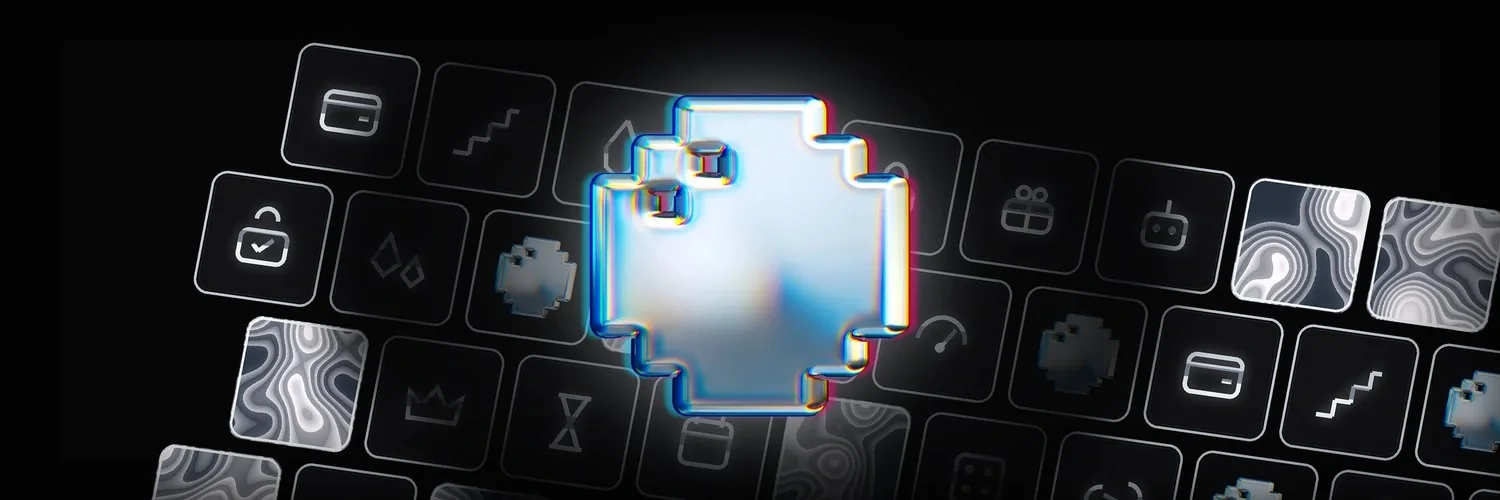
It is a telling introduction to a launchpad promising to place rules inside tokens. Its banner shows a metal emblem with pixel edges, surrounded by tiles depicting a padlock, a chart, a gift and a robot. The visual subject is a set of possibilities to assemble. Its name develops that idea: SPEC stands for Solana Programmable Extension Coins. The reported peak for its token reaches a $3.85 million market cap at 05:02 Paris time on October 4. [132] [133]
20:24: a contract, then an acknowledged starting point
At 20:24 on October 3, @specfun announces SPEC on Solana and publishes the address 2AVjqmGbMqg7rSyHVv2deVdggsBgBtu1Bi69BUvE5WRv. The post presents wallet limits, selling restrictions and market hours that creators can combine. DEX Screener connects this contract to spec.fun; its Meteora DBC pair appears at 20:24:27, followed by a DAMM v2 pair at 20:32:39. These markers locate the market studied here without confusing it with other assets using the SPEC ticker. All times in this article are Paris time. [131] [132]
At 20:33, jami, @jamiiRQ, publishes Why I built SPEC. He identifies himself as its builder and explicitly names Hooked as the first launchpad where he encountered this approach. He acknowledges its pioneering role, then explains what he wants to add: letting users write, publish and reuse their own rules. This lineage is claimed by jami; his comparison is not an independent test of the two platforms. [134]
Our reading is that SPEC wants to turn customization into a shared story. A creator chooses more than a name and an image: they imagine how their coin should be held, traded or circulated. That promise opens a conversation in which the rules themselves can become material for the meme.
What a rule inside a token means
The principle relies on an existing Solana feature. With Token-2022, a Transfer Hook extension can designate a program called during transfers. Solana’s documentation describes this interface independently of SPEC. The network technology should therefore be distinguished from the launchpad’s proposal to make it accessible. [135]
SPEC explains that its hook examines transfers and can reject them when they violate a token’s conditions. A wallet holding cap is the simplest example for a reader. The proposed benefit is that this check does not depend solely on a promise displayed on a website. According to the documentation, some curves remain permanent; others graduate into a conventional pool and lose their hook at that point. The same rules are consequently not presented as lasting forever in every case. [136] [148]
Inviting users to build what comes next
The site compares configuring a coin with configuring a car or a computer. Its catalog, configurator and AI tool offer several entry points. The documentation describes AI mapping a request onto catalog blocks and adjusting their parameters; the user must then review them. This means composing options, rather than proving that every freely expressed idea will be possible. [133] [138]
Published hooks are also presented as reusable templates carrying royalties for their authors. At 21:02, the account says no custom hook has yet been created and offers to cover creation costs for two days. At 02:24 the following morning, it reports 184 coins launched, more than 102,000 transactions, $10.7 million in volume and 36 launches using rules written by other people. These are SPEC’s claimed figures, without an independent audit in this article. [137] [139] [144]
The contrast between those posts conveys the launch’s ambition: attract the first contributions, then show them circulating. A living catalog is more interesting to follow than a fixed list. Readers still need to be able to identify what users are building and what actually works.
A community between enthusiasm and troubleshooting
Beneath jami’s article, Mainsqueeze, @Mainsqweez3, thanks the project at 21:28 and expresses frustration with developers he does not trust. Sheldon asks whether an NFT launch is planned. Lukesch requests an update because market caps are not displaying properly. These reactions give the audience several faces: someone seeking more credible rules, someone imagining an extension, and someone simply wanting to use the page. [134]
At 21:50, SPEC says it has fixed crashes under load, frozen market caps, failed purchases and fee claims. Yet three minutes later Ayze reports that holder rewards and the buyback mechanism are not working; YumsoGambles says recent trades are missing. We report these as user observations without generalizing them to every operation. The official response does not by itself bring troubleshooting to an end. [140]
Fees, agents and a changing promise
The economic link to SPEC is announced in the first thread: the account says all fees are used to buy and burn the token. The fees page, however, describes a 1% charge, with 85% allocated to buying and burning and 15% to development. These statements differ. Without clarification reconciling them, we do not treat the 100% allocation as a definitively established mechanism. [141] [142]
At 00:55 on October 4, the account announces an AI Agents option: a coin’s fees would fund an agent that trades, with profits distributed to holders. Exy praises the team’s preparation; shortly afterwards Mark replies that he cannot launch. At 02:59, SPEC also announces the ability to choose its token as the quote asset for a new pair. The offer expands while user experience remains uneven; neither the promised profits nor their consistency is established by these posts. [143] [145]
A catalog is not uniform proof
The Contracts page provides an important distinction. It labels several restrictions as enforced on-chain, including wallet caps, transaction limits and trading hours. For the rest of the catalog, it lists options recorded in the configuration sheet but not yet enforced. That table invites readers to check each feature rather than extend the promise to every tile on the site. [146]
The Safety page also states that the team retains the ability to upgrade the main hook program. A story about rules no website can interrupt therefore does not mean all trust in developers has disappeared. We can observe this disclosure in the documentation; the sources assembled here do not constitute an audit of the deployed code. [147]
At launch: an open workshop
The market reference retained here is the ATH supplied to the editorial team: a $3.85 million market cap at 05:02 Paris time on October 4, 2026. Earlier posts document activity around the launch without measuring each contribution to the rise or independently confirming the peak to the minute.
SPEC already has an identifiable story: its acknowledged debt to Hooked, rules to assemble, users invited to contribute and an evening of public fixes. Its next chapter will be found in reused creations, the precision of its documentation and the resolution of reported problems. The polished metal emblem has found its first hands. They are not all asking for the same thing, but they give the project concrete questions to answer.
V2 arrives with a request for evidence
On 9 October, SPEC announced V2, combining creation and deployment in one flow, adding ten hooks and a new standard for selected tokens. The announcement addresses a first-launch difficulty: making rules composable without turning every creation into troubleshooting. It does not prove that every catalogue option is enforced on chain. [149]
On 8 October, the account had announced a contract audit by Trail of Bits. In V2 replies, participants asked for evidence or the corresponding report. Our consultation of the firm’s public reports did not locate a document identifying SPEC. That does not establish that no private work occurred; the announcement simply cannot be presented here as an audit we verified. [150] [151] [152] [153]
The conversation therefore retains the initial workshop’s character, with a more specific expectation. When a hook decides who can transfer or when a market is open, a polished creation button and evidence about deployed code are different things. V2 should facilitate the first; readers want material on the second.
Updated facts · 11 October
SPEC — Spec · Solana. Contract : 2AVjqmGbMqg7rSyHVv2deVdggsBgBtu1Bi69BUvE5WRv. [155]
Price ATH: $0.0038552672. Theoretical valuation on nominal supply of 1,000,000,000 tokens: $3,855,267. This is not a reconstruction of historical circulating market capitalisation. [154]
The retrieved candles do not confirm the exact peak date; record updated on 11 October 2026. [154]
Last market-cap ATH supplied to the editorial team for this contract: $3,855,757 · 04/10/2026 05:02:05 (Paris). This observation is kept separate from the price high.
Written by Emma C.
The sources, a click away.
Numbered references in the articles point to this list. External links open in a new tab.
- SWOLF — public post, 10 October 2026
- Wolf of Starknet — primary publication or project page
- Starknet — primary publication or project page
- Starknet — primary publication or project page
- SWOLF — public post, 10 October 2026
- SWOLF — public post, 11 October 2026
- SWOLF — public post, 11 October 2026
- GMGN — price ATH, collected 11 October 2026
- DEX Screener — contract and market reference
- mils — public post, 09 October 2026
- Liiiivai — public post, 09 October 2026
- PQC Market — primary publication or project page
- Bored — public post, 09 October 2026
- Other World ProjeX — public post, 09 October 2026
- The Noob — public post, 09 October 2026
- PQC Market — documentation
- QuantumInu — primary publication or project page
- QuantumInu — public post, 10 October 2026
- wxyz — public post, 09 October 2026
- DEX Screener — contract and market reference
- DaDior — public post, 11 October 2026
- timbenlander — public post, 09 October 2026
- GMGN — price ATH, collected 11 October 2026
- DEX Screener — contract and market reference
- Claudia Gallery — primary publication or project page
- Claudia — public post, 10 October 2026
- Blob — public post, 11 October 2026
- Claudia — public post, 11 October 2026
- Claudia — public post, 11 October 2026
- GMGN — price ATH, collected 11 October 2026
- DEX Screener — contract and market reference
- DEX Screener — contract and market reference
- Ibra — public post, 10 October 2026
- South Yorkshire Police — primary publication or project page
- Yorkshire Wildlife Park — primary publication or project page
- Cincinnati Zoo — primary publication or project page
- Siris — public post, 10 October 2026
- underdog — public post, 10 October 2026
- Entries — public post, 10 October 2026
- Tammy C. T — public post, 10 October 2026
- SZface — public post, 10 October 2026
- Yorkshire Wildlife Park — primary publication or project page
- GMGN — price ATH, collected 11 October 2026
- auton — public post, 06 October 2026
- auton — public post, 05 October 2026
- auton — documentation
- getbeaverd — primary publication or project page
- Solana — documentation
- auton — public post, 06 October 2026
- auton — public post, 06 October 2026
- auton — public post, 06 October 2026
- Dojamon — public post, 07 October 2026
- WiseApe — public post, 07 October 2026
- Letter — public post, 07 October 2026
- Emahd — public post, 07 October 2026
- auton — public post, 07 October 2026
- auton — public post, 07 October 2026
- auton — public post, 07 October 2026
- auton — public post, 06 October 2026
- auton — public post, 07 October 2026
- DEX Screener — contract and market reference
- auton — public post, 06 October 2026
- auton — public post, 06 October 2026
- Meteora — documentation
- kyro — public post, 06 October 2026
- AGENT APOLLO — public post, 08 October 2026
- GMGN — price ATH, collected 11 October 2026
- Pump.fun — public post, 08 October 2026
- Armoski — public post, 08 October 2026
- Pump.fun — public post, 08 October 2026
- Pump.fun — public post, 08 October 2026
- Armoski — public post, 08 October 2026
- Armoski — public post, 08 October 2026
- Armoski — public post, 09 October 2026
- DEX Screener — contract and market reference
- DEX Screener — contract and market reference
- DEX Screener — contract and market reference
- DEX Screener — contract and market reference
- AntiHerd — public post, 08 October 2026
- YAMASHI — public post, 08 October 2026
- Pump.fun — public post, 08 October 2026
- Pump.fun — public post, 08 October 2026
- GMGN — price ATH, collected 11 October 2026
- Higgspad — public post, 04 October 2026
- Higgspad — public post, 04 October 2026
- Higgspad — primary publication or project page
- Higgsfield — documentation
- Higgspad — documentation
- Higgspad — primary publication or project page
- Higgspad — public post, 04 October 2026
- Higgspad — public post, 04 October 2026
- Higgspad — public post, 04 October 2026
- Higgspad — public post, 05 October 2026
- Higgspad — primary publication or project page
- Higgspad — public post, 05 October 2026
- Dorel — primary publication or project page
- Karim Khayat — public post, 06 October 2026
- different — public post, 06 October 2026
- dr. pill — public post, 05 October 2026
- dr. pill — public post, 06 October 2026
- Higgspad — public post, 05 October 2026
- Higgspad — primary publication or project page
- Higgspad — public post, 04 October 2026
- DEX Screener — contract and market reference
- Higgspad — public post, 11 October 2026
- reckoning.oscar — public post, 11 October 2026
- GMGN — price ATH, collected 11 October 2026
- Slava Rybin — public post, 01 October 2026
- Matthew — public post, 04 October 2026
- Matthew — public post, 04 October 2026
- CRAWLNET — primary publication or project page
- Matthew — public post, 04 October 2026
- Matthew — public post, 04 October 2026
- Andrej Karpathy — documentation
- CRAWLNET — primary publication or project page
- Matthew — public post, 04 October 2026
- CRAWLNET — primary publication or project page
- leyten — public post, 04 October 2026
- Jud — public post, 04 October 2026
- Anderson — public post, 04 October 2026
- 0xTantei — public post, 04 October 2026
- Crawlnet — public post, 04 October 2026
- Crawlnet — public post, 04 October 2026
- DEX Screener — contract and market reference
- CRAWLNET — primary publication or project page
- Crawlnet — public post, 07 October 2026
- Crawlnet — public post, 11 October 2026
- Crawlnet — public post, 11 October 2026
- GMGN — price ATH, collected 11 October 2026
- DEX Screener — contract and market reference
- SPEC — public post, 03 October 2026
- DEX Screener — contract and market reference
- SPEC.fun — primary publication or project page
- jami — public post, 03 October 2026
- Solana Program — documentation
- SPEC.fun — documentation
- SPEC.fun — documentation
- SPEC.fun — documentation
- SPEC — public post, 03 October 2026
- SPEC — public post, 03 October 2026
- SPEC — public post, 03 October 2026
- SPEC.fun — documentation
- SPEC — public post, 04 October 2026
- SPEC — public post, 04 October 2026
- SPEC — public post, 04 October 2026
- SPEC.fun — documentation
- SPEC.fun — documentation
- SPEC.fun — documentation
- SPEC — public post, 09 October 2026
- SPEC — public post, 08 October 2026
- Old Hawk — public post, 09 October 2026
- ChandraHowie — public post, 09 October 2026
- Trail of Bits — primary publication or project page
- GMGN — price ATH, collected 11 October 2026
- DEX Screener — contract and market reference
Make this issue yours.
The same edition, wherever you want to read.