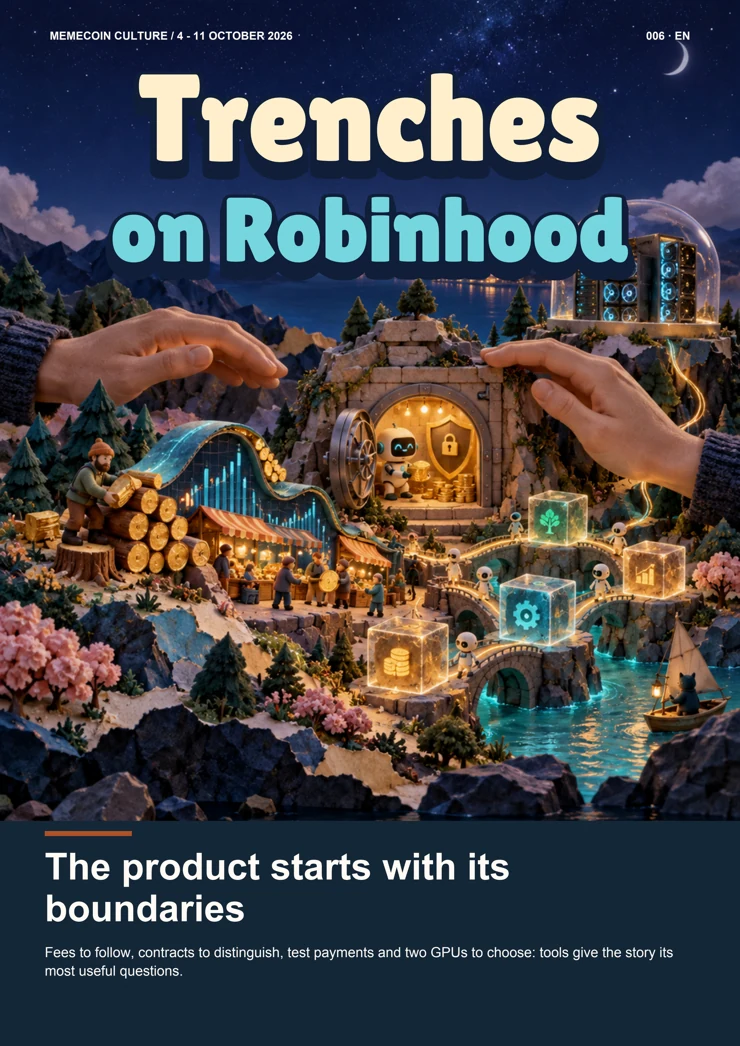
The product starts with its boundaries
Fees to follow, contracts to distinguish, test payments and two GPUs to choose: tools give the story its most useful questions.
CHOP offers to work market oscillations like wood. TasQ asks holders to choose two machines. Images make products approachable; they do not replace following fees, controls and revenue.
At Sectoral, a rent receipt gives privacy a human scale. The public repository nevertheless describes a test deployment with a provisional verifier. At opcode, chain and contract changes are already part of holders’ experience.
These four tokens are followed on Robinhood Chain, checked as an EVM network distinct from the brokerage application. Neither name nor launch establishes Robinhood approval. Understanding the product this week means knowing what works, what is announced and who retains the controls.
 Written by Jérôme L.
CHOP: logs for a market that cannot decide

The project turns price reversals into a yield narrative. Its sawmill metaphor makes the mechanism readable, while fees and control powers remain decisive.
CHOP calls its wrapped assets “logs”. The image is almost an instruction manual: the market’s reversals would supply wood to work with rather than merely a direction to guess. At its 7 October launch, the project account published the Robinhood Chain contract and presented this approach to volatility. [1] [2]
The attraction is a proposed change in the holder’s role. As a market rises and falls, a trader can feel they are watching the same scene without capturing its movement. CHOP asks them to view exchange activity as something that pays fees. It turns “chop”, usually an indecisive, jagged market, into raw material.
Where do the woodchips go?
A log is a wrapped version of an asset. Documentation connects it with liquidity and farmed positions. Wrapping, exiting and trading generate different charges. Following those stages makes the advertised yield understandable: it does not come from interest created without activity, but from payments around the mechanism. [2] [3]
The documentation’s example is instructive. Without a partner, of $10,000-equivalent value, 15% goes to burning logs. The remainder is converted into CHOP; 20% of that portion is burned and 80% distributed to farmers. The resulting 1,500, 1,700 and 6,800 are value equivalents in the example, not comparable quantities of three tokens. If no farmer qualifies, the reward allocation is burned too. [3]
The diagram makes the promise tangible. It also exposes a dependency: without sufficient activity, the fees feeding the system change. A past rate is not guaranteed income for the next holder. Documentation treats APYs as historical observations, not fixed commitments. [4]
A sawmill with controls
A 10 October update reported three logs during the first five days, roughly $30,000 locked and a portion of supply wrapped. These are CHOP’s figures, not an audit of positions. Their narrative role is clear: demonstrating that a launch vocabulary is starting to produce objects people use. [6]
Objects do not remove controls. The admin-powers page describes upgrade functions for existing logs and the factory producing new ones, as well as fee settings before locking. It also discusses pausing rewards and the team’s initial positions, which can earn farming revenue. These are parts of the economics, not a generic caution to be separated from the explanation. [5]
Entry and exit costs matter in the same way. Documentation gives wrapping and withdrawal fees of up to 1% each, alongside liquidity risks and changes in relative asset values. Trading income can coexist with a loss on the position. “Farming” does not remove the need to calculate the whole journey. [3] [4]
The project claims infrastructure derived from Peapod. Software ancestry can explain design choices; it does not replace an independent report on this deployment’s contracts and settings. CHOP’s documentation at least makes addresses and powers available, giving participants something specific to examine. [5] [7]
CHOP is interesting when followed as the transformation of a trader’s frustration into a product: an indecisive market becomes a sawmill. The image makes the proposal memorable; fees, liquidity and controls determine what it actually produces. Keeping those three elements beside the logs is what makes the story useful.
Updated facts · 11 October
CHOP — Chop · Robinhood Chain. Contract : 0x100765a16f42636bd84ee1e86bc5107b84bcdba3. [9]
Price ATH: $0.000015736863. Theoretical valuation on nominal supply of 100,000,000,000 tokens: $1,573,686. This is not a reconstruction of historical circulating market capitalisation. [8]
Peak found in the one-minute candle on 07/10/2026 at 16:32 (Paris). This is the candle time, not the trade’s exact second. [8]
Written by Jérôme L.
OP: the address becomes the story

Launches, token burns and refunds follow one another around opcode. Before discussing its AMM, Robinhood events must be separated from Solana ones.
On 9 October, opcode published a Robinhood Chain contract and announced an AMM for real-world assets, with multichain ambitions. A few posts later, the same account discussed burned tokens, refunds for Solana holders and a backend problem. Readers did not lack announcements; they lacked a map connecting them. [10] [11] [13] [14]
This edition’s address ends in d31fb03. It was explicitly supplied in the Robinhood launch. That is the fixed point. OP and opcode are insufficient identifiers for every subsequent operation, because the project also uses Solana contracts. Merging the stages would create a tidy but false chronology.
Burning does not solve identity
Soon after the launch, opcode shared a transaction link for a token burn. lora described a 71% supply reduction. That percentage must remain attributed to the commentator’s reading: an announcement and a reply do not replace a full reconstruction of circulating supply at every moment. [11] [12]
This matters for ATHs too. A peak price multiplied by nominal supply can yield a very different valuation from one calculated after a burn. The factual panel therefore separates the historical price from a theoretical valuation using the referenced supply. It does not claim to reconstruct circulating market capitalisation at the exact second of the peak.
The refund post targeted Solana holders, with a snapshot announced for 18:00 UTC and a claim deadline. It does not establish that the Robinhood contract was refunded in the same way. The account then acknowledged a backend issue and announced checks around the Robinhood deployment. Separating chains is part of the news, not incidental technical detail. [13] [14]
A product and its incarnations
On 10 October, a post announced an internal contract review and a new deployment. “Internal” remains the important word: the review is not presented here as an independent audit. Later, opcode said it had built a multichain AMM and announced another burn, this time displaying a different Solana address. That post cannot establish destruction of the entire Robinhood contract followed here. [15] [16]
The currently accessible terminal’s FAQ also lists a different Solana mint. It therefore describes a product incarnation whose functions cannot automatically be assigned to this edition’s token. The shared name creates continuity of communication; contracts reveal economic discontinuity. [17]
The complication already has a public reception. On 9 October, treyerl asked why the launch appeared on their screen in this form and pointed to the limited information available. This response does not prove wrongdoing. It shows the extra work participants are being asked to do: understand what they own before evaluating what is promised. [18]
Opcode’s cultural interest may lie in a tension rarely centred in launch stories. The community must keep a name coherent across assets, fixes and announcements. The same words can refer to a product vision, an old token or a new version. Each change forces readers to rebuild their reference points.
The article therefore settles the story with neither an innovation slogan nor an accusation. It follows objects the sources identify. The Robinhood contract’s launch and corresponding announcements are documented. For other stages, chain and address remain distinct. This is the minimum needed to prevent the product’s story erasing its holders’ experience.
Updated facts · 11 October
OP — opcode · Robinhood Chain. Contract : 0xd577f45d1e43730955213a2ac3e513052d31fb03. [20]
Price ATH: $0.0013708609. Theoretical valuation on nominal supply of 1,000,000,000 tokens: $1,370,861. This is not a reconstruction of historical circulating market capitalisation. [19]
Peak found in the one-minute candle on 09/10/2026 at 22:35 (Paris). This is the candle time, not the trade’s exact second. [19]
Written by Jérôme L.
Sectoral: a receipt, not your whole statement

The project imagines payments whose amounts stay private. A rent example makes the idea accessible; its public repository locates the prototype more precisely than the word “bank”.
A landlord needs to know the rent was paid, not read your whole financial history. On 9 October, Sectoral chose this situation to explain its product. It gives a technical expression an immediate human scale: revealing useful evidence without opening the rest of someone’s financial life. [21]
The account had published its Robinhood Chain contract on 5 October. The website presents a “private bank” for people and agents spending on their behalf. That is the project’s positioning. The sources describe software and contracts; vocabulary alone does not establish a licensed banking institution. [24] [22]
What remains visible
Documentation defines confidentiality more narrowly than some homepage language. Sender and recipient addresses remain visible; amounts are encrypted. The project uses encrypted balances and proofs intended to verify that transfers obey rules without publishing their value. This does not mean every payment trace disappears. [22] [23]
The distinction gives the rent example its meaning. Privacy can be selective, with information shown to the appropriate party. But a public network of addresses retains clues of its own. “Private” must describe what the mechanism protects, rather than general invisibility inferred from a logo.
The public contract repository is particularly useful. It describes a test deployment dated 4 October, with a USDG stand-in and a temporary verifier that does not check proofs. The README explicitly says this component must be replaced before real value is involved. The documented prototype is therefore not evidence of secure confidential production payments already operating. [23]
Giving an agent a budget
The project also separates an owner from software acting for them. An agent should receive a budget, per-transaction and daily limits, authorised recipients and, sometimes, an approval threshold. The stated aim is to enforce constraints through contracts rather than merely instructing the agent to be careful. [23]
The README exposes pause, key-rotation and revocation controls. A compromised agent key should therefore prompt withdrawal of its mandate, rather than being treated as an unrestricted holder of the owner’s funds. These choices describe bounded autonomy. They are not our measurement of the entire system’s actual resilience. [23]
On 11 October, Sectoral announced payment handles that distinguish humans from agents. This interface detail extends the same issue: knowing who is being addressed and under what mandate money moves. An agent is not simply another name in a contact book; it is a delegation that must remain understandable and interruptible. [25]
Between demonstration and promise
A 9 October post discussed virtual cards. We retain it as a project announcement: the sources consulted do not independently establish the issuer, terms or effective service access. On 11 October, a community meeting was announced for the following week, without a confirmed time in the post. Questions about moving from prototype to product thus have an announced place to be asked. [26] [27]
Sectoral becomes more interesting when “neobank” gives way to permissions, receipts and actual deployment. The rent receipt is a clear idea; documentation exposes the pieces needed to realise it. The distance between that idea and a production system must not be erased by the token. It is precisely the story its next developments should make possible to follow.
Updated facts · 11 October
SECTORAL — Sectoral · Robinhood Chain. Contract : 0x6effbf4438140222b8a6e7bd0dc3245206946fce. [29]
Price ATH: $0.00095620027. Theoretical valuation on nominal supply of 1,000,000,000 tokens: $956,200. This is not a reconstruction of historical circulating market capitalisation. [28]
Peak found in the one-minute candle on 05/10/2026 at 20:52 (Paris). This is the candle time, not the trade’s exact second. [28]
Written by Jérôme L.
TasQ: holders choose the machines

A vote proposes buying or leasing two GPUs. Behind this tangible step, the technical paper still distinguishes models, simulations and the network to be built.
Two GPUs, bought or leased, with their revenue allocated to token buybacks and burns. On 11 October, TasQ published proposal number one and invited holders, even of small amounts, to vote. Governance had acquired a tangible object: physical machines. The voting link uses Privy; the invitation is not evidence of the ballot’s outcome. [30]
The contrast is useful. Launched on Robinhood Chain on 7 October, TasQ wants a compute market where clients need not take GPU providers at their word. Its hardware proposal offers a close, readable step; its 23-page paper describes a much larger undertaking. [31] [32]
Three ways of asking for proof
The Yellow Paper separates three paths. One uses attestation of a hardware environment to protect execution. Another replicates work and introduces hidden checks to discourage fabricated results. The third uses cryptographic proofs when their cost suits the job. The three provide different combinations of confidentiality and integrity. [32]
This choice is more interesting than a universal “verifiable compute” slogan. It admits that not every job can be proved in the same way at an acceptable cost. The paper discusses providers colluding to submit bad answers: public selection enables certain attacks, while hidden audits aim to change their economics. [32]
It also locates its results. Secure GPU-environment costs are modelled rather than measured in a final deployment. Experiments include simulations and microbenchmarks; the document does not present a completed test-network evaluation. Coordination remains operated by TasQ. These are the project paper’s own qualifications, preventing the market being described as already proven and decentralised at scale. [32]
Available machines and proposed machines
The website displays hardware offers and prices. Interface elements alone do not independently verify each machine’s availability. On 11 October, the account also announced access to more than fifty on-demand GPUs through Google Cloud credits. That is an infrastructure-access claim, not proof of an official commercial partnership with Google. [33] [34]
Voting on two project-owned GPUs concerns something else again. The proposal would put some machines under direct control and allocate all their revenue to buybacks and burns. That percentage concerns the proposal’s scope, not necessarily every revenue stream across the infrastructure. Costs, implementation and flows must remain readable after the vote if holders are to follow their decision. [30]
The project names its roles: Jun Ting leads, Paing Chan handles technology, Baris marketing, and Newman Wang advises. The team page is TasQ’s presentation, not independent verification of every biography. It nevertheless makes responsibilities more identifiable than an entirely anonymous collective would. [35]
Voting together needs somewhere to talk
In replies to the proposal, Berlin asked for a Telegram or community space. This identifies a practical limit to governance: ticking an option does not replace somewhere to discuss costs and alternatives. An asset can have a ballot before organising the conversation around it. [37]
The allocation page says team tokens were bought on the market and vested rather than taken from an initial reserve. That presentation and launch links provide points to check; they do not align every incentive between machine operators and token holders. [36] [31]
TasQ therefore offers a story moving at two speeds. A collective decision can reach two GPUs quickly. Compute-market guarantees require technical work and measurements that the paper still locates in construction. The vote gives holders an initial handle. Its narrative value will depend on what they can observe next: machines, their activity and execution of the promised use of revenue.
Updated facts · 11 October
TasQ — TasQ Network · Robinhood Chain. Contract : 0xdc453b1405cfe25e2afba8e7f4272b0a00437777. [39]
Price ATH: $0.0022747581. Theoretical valuation on nominal supply of 1,000,000,000 tokens: $2,274,758. This is not a reconstruction of historical circulating market capitalisation. [38]
Peak found in the one-minute candle on 10/10/2026 at 23:44 (Paris). This is the candle time, not the trade’s exact second. [38]
Written by Jérôme L.
The sources, a click away.
Numbered references in the articles point to this list. External links open in a new tab.
- CHOP — public post, 07 October 2026
- CHOP — documentation
- CHOP — documentation
- CHOP — documentation
- CHOP — documentation
- CHOP — public post, 11 October 2026
- CHOP — documentation
- GMGN — price ATH, collected 11 October 2026
- DEX Screener — contract and market reference
- opcode — public post, 09 October 2026
- opcode — public post, 09 October 2026
- lora — public post, 09 October 2026
- opcode — public post, 09 October 2026
- opcode — public post, 09 October 2026
- opcode — public post, 10 October 2026
- opcode — public post, 10 October 2026
- opcode — documentation
- treyerl — public post, 09 October 2026
- GMGN — price ATH, collected 11 October 2026
- DEX Screener — contract and market reference
- Sectoral — public post, 09 October 2026
- Sectoral — documentation
- Sectoral — documentation
- Sectoral — public post, 05 October 2026
- Sectoral — public post, 11 October 2026
- Sectoral — public post, 09 October 2026
- Sectoral — public post, 11 October 2026
- GMGN — price ATH, collected 11 October 2026
- DEX Screener — contract and market reference
- TasQ — public post, 11 October 2026
- TasQ — public post, 07 October 2026
- TasQ — technical paper
- TasQ — primary publication or project page
- TasQ — public post, 11 October 2026
- TasQ — primary publication or project page
- TasQ — primary publication or project page
- Berlin — public post, 11 October 2026
- GMGN — price ATH, collected 11 October 2026
- DEX Screener — contract and market reference
- Robinhood Chain — documentation
Make this issue yours.
The same edition, wherever you want to read.