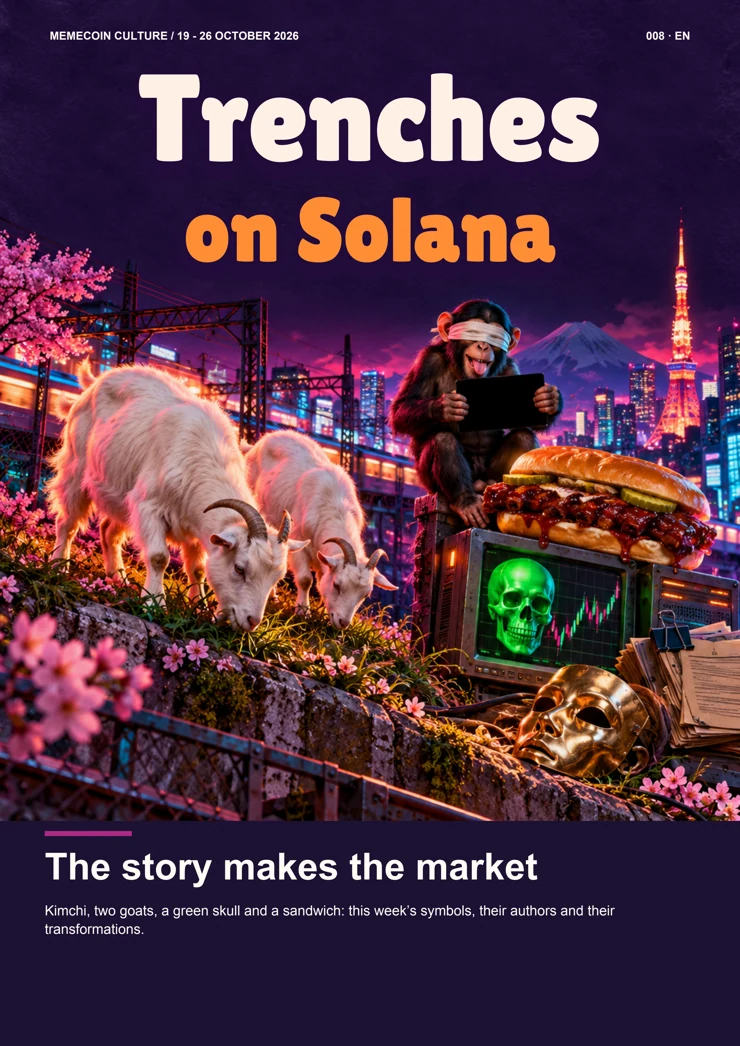
The story makes the market
Kimchi, two goats, a green skull and a sandwich: this week’s symbols, their authors and their transformations.
A Musk sentence becomes three letters. Two working goats gain another life on Solana. A sandwich enters a market indicator. The week’s stories start in different places and meet in the same feeds.
We revisit the Kimchi, Nagi and Pokke, and PHP dossiers in their dated contexts, then follow five more requested contracts. New reporting examines chosen words, built tools and the objections participants exchange.
Reputation can be staged; a meme can also develop through a rule, correction or disagreement. This issue follows those gestures: what people add to a story before it becomes a market.
 Written by Emma C.
Kimchi: yet another Pumpfun racket?
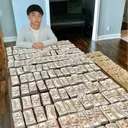
A flattering notification, a forty-million-dollar dream and wallets investigators are starting to connect. Behind Aura Final Boss lies a constructed reputation—and allegations about how it was monetised. Dossier published on 23/10, reproduced in its dated context.
The October 23 dossier
This account revisits allegations and evidence available at publication. The connections and intentions alleged remain attributed to the cited investigators, not conclusions of an independent editorial audit. The narrative’s figures and time references belong to October 23. Updated price data appears in the facts at the end.
The world’s biggest trader, by push notification
The screenshot published by Fto on October 21 has a simple message: Kimchi has joined Pumpfun; follow the biggest trader in the world. The app’s green icon sits beside the influencer’s face. This is no longer just a fan celebrating his success: the reproduced notification gives him a platform’s apparent endorsement. [1]
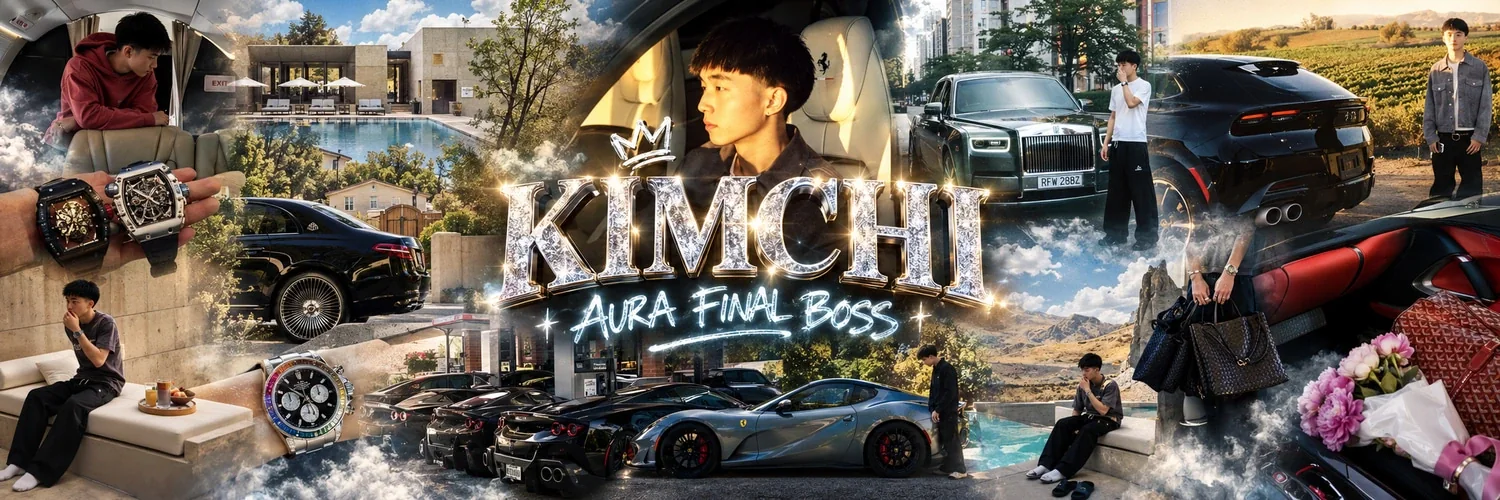
A token built around that promise carries a name made for social media: Aura Final Boss. Its banner stacks cars, watches, villas and portraits of Kimchi. The persona is already the product. Then come wallet addresses, transaction screenshots and a less photogenic question: who is selling to the people attracted by that aura? [11]
This is the central criticism directed at Pump.fun: turning a disputed reputation into a source of financial attention. The posts examined allege manipulation; they do not, by themselves, establish fraud organised by the platform. That distinction does not erase the reported promotion or the questions it raises.
Before the coin, a fortune becomes a persona
The October 7 profile on BitcoinFoundation.org associates the alias with Clayton Kim and recalls an appearance in an Orangie video before TRUMP launched. It describes a young memecoin trader whose public image later became dominated by an alleged $40 million TRUMP win. The same article notes the absence of a complete record verifying that amount. [2]
On the profile consulted on October 23, Kimchi links to Pioneer and to Instagram as claytonkimm. Recent posts give images far more space than explanations: the October 21 post simply announces a vlog. The token banner takes that approach into a luxury collage. A trading reputation becomes an aesthetic that people can buy as a token. None of this proves ownership of the cars or watches shown, or that TRUMP paid for them. [10] [11]
Warnings that predate the decline
On July 27, Specter had already published an investigation into an address he said Kimchi had shared publicly. He described purchases very close to the launches of STAR, DADDY ANSEM and MUVA, followed by highly profitable sales. For STAR, he reported a roughly $407 purchase within the deployment minute and a $45,600 exit. Transaction signatures accompanied the claims. [3]
Specter interpreted the trades as evidence of bundling and rug pulls. On August 22, MLM repeated the accusation and supplied two addresses, including Ex7TL…noMS3, which would reappear in October’s investigation. There was therefore a public record of criticism before Aura Final Boss surged. [3] [4]
Two timelines that must stay separate
Zeropnl’s October 21 post criticises a launch named 40M Runner. In his reconstruction, deployment follows Pump.fun’s visual rebranding by thirteen seconds and precedes Kimchi’s bio change. He interprets this as advance knowledge and reports more than a million dollars earned by top traders. Those are his timeline and interpretation. [5]
Fto focuses on Kimchi, reproducing a wallet map and a position of 750 million tokens. He alleges that an address holding 75% of supply connects to selling wallets while Pump.fun promotes the influencer. That juxtaposition fuels suspicions that public demand benefits insiders. The screenshots alone cannot attribute every address to one person or show Pump.fun directing the sales. [1]
What CryptoGag connects—and what those links cannot establish
In the first post, CryptoGag explicitly identifies this contract and deployer EFSr396A6Jh7bNCSujGRLMkyXspbWitEvjNVatGD56oF. He describes a route through 2UXgY…Bo4h and then EMJRBL…fzRN, an address he also associates with BAKSO’s launch. He reports 170 transactions with a wallet said to be connected to Staticcs. This is his tracing work. [6]
The second part connects the deployer’s network to addresses attributed to Kimchi, including AsaWoy…PMxq and Ex7TL…noMS3, and to an address described as Coinbase-associated. CryptoGag concludes that Kimchi appears to have arranged his own launch. But using the same exchange service does not establish common ownership: personal accounts must be distinguished from shared infrastructure. His first post itself notes that transfers alone cannot establish fraud. [6] [7]
These posts offer concrete leads rather than indignation alone. They justify seeking explanations about connections between the deployer, the influencer and his circle. They do not prove that Pump.fun controls this network.
Bubblemaps brings the forty-million story back to evidence
On October 22, Bubblemaps said it had identified additional addresses by starting from Kimchi’s donation wallet and an older token bearing his name. Its estimate of TRUMP profits within the identified network is $6 million. The thread acknowledges that another profitable address could exist. That challenges the routinely repeated $40 million figure without establishing an exhaustive account of his wealth. [8] [12] [13]
This investigation concerns the TRUMP legend.
On October 23, CryptoGag also disputed the hacking hypothesis, referring back to his wallet connections. His post contains no technical analysis of an account compromise. We did not find a detailed response to these points in the Kimchi profile posts consulted. That limited observation neither confirms a hack nor establishes that no response exists anywhere. [9] [10]
The October 23 snapshot, below ten million
In the latest observation supplied to the editorial team on October 23, the token has fallen below $10 million in market capitalisation, against a reported $47.57 million ATH. The decline from that high therefore exceeds 79%.
A reputation for winning, promotion attributed to Pump.fun and wallet connections presented by investigators: together, these underpin allegations of manipulation involving Kimchi and the platform. Fto alleges selling during the promotion; CryptoGag argues that the influencer arranged his own launch. These allegations make the story more than a memecoin’s price collapse. [1] [6] [7]
The contrast is stark: the promotion promised access to the world’s biggest trader; buyers now hold a token worth less than one fifth of its peak market capitalisation. Pump.fun and Kimchi should answer questions about the promotion, financial connections and who benefited. Aura is no substitute for accounts.
Token facts
Kimchi — Aura Final Boss · Solana. Contract : CSocnzcRpgSCr1naKcNTieWZUxb6rABe45j844m7pump. [11]
Supplied market-cap high: 47570000 USD · 21/10/2026 · 18:55 (Paris).
Price ATH recorded on GMGN on October 26: $0.047785354. This observation supplies neither an exact peak time nor an updated historical market capitalisation. [14]
Written by Emma C.
Nagi and Pokke: two goats clock in, the trenches take notice
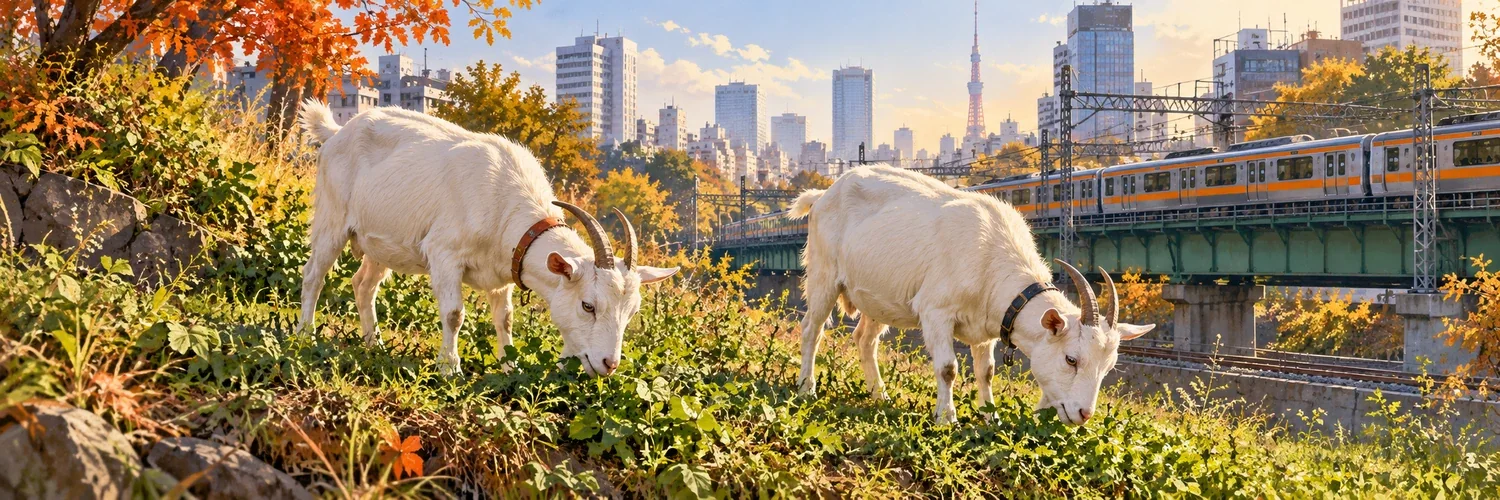
At Yotsuya station, two goats are clearing weeds. Commuters film them, the clips travel, and Solana adopts the pair: behind ヤギ lies a lunch-break story turned market narrative. Dossier published on 23/10, reproduced in its dated context.
A lunch break with an audience
Office workers come to see the goats on their lunch break; the goats are having lunch too. On October 23, the account ren plays on that contrast in a post shared under the names Nagi and Pokke. A video accompanies the joke, along with a Solana address. That combination captures the transition: an everyday scene in Japan, an easily shared punchline, then a contract to buy. [21]
The original job, however, is simply to graze. On October 19, JR East introduces two goats on X as part of a weed-clearing trial at Yotsuya station. Three pictures, a practical explanation and a request to watch the animals kindly. When checked on October 23, the post shows more than 4.7 million views and 28,000 likes. That audience belongs to the animals and the railway initiative, not a token promotion. [15]
Two colleagues who eat their workload
Nagi is a one-year-old male; Pokke is a two-year-old female. A TV Asahi report carried by KBC dates their arrival to October 9 and attributes the idea to station employees. The trial is scheduled to last until December, or end sooner if the grass runs out. A student interviewed for the report describes a new after-class routine: stopping to watch the goats before going home. [16]
SoraNews24’s photographic report supplies a useful detail: visitors look down at the plot from a pedestrian passage near the Akasaka exit. The attraction sits directly on an everyday route. The outlet also notes the instruction not to feed the animals: filling them up with treats would defeat the purpose of their work. [17]
The pair needs little explanation. Two names, a recurring task and a place where people can see them again. In the replies to JR East, okame2525 posts a short video on October 21, noting that the goats are there in the evening too. Visitors themselves add small instalments to the story. [18]
From the station to the ticker
The story moves beyond Japanese accounts. On October 21, Eric, posting as shinobu_books, shares a television clip in English and introduces Nagi and Pokke. Jeffrey J. Hall also shares their work near Yotsuya. Both posts give English-speaking audiences the names and context needed to recognise the pair. Neither amounts to a recommendation of the contract examined here. [19] [20]
In crypto circles, the language shifts. CryptoGorilla includes the goats in his memecoin roundup for October 22. The Pump.fun Ecosystem account subsequently announces them as trending in the app. These are identifiable carriers of the narrative; they do not establish that any particular post caused a price move. [22] [23]
Ren’s post is more revealing than a performance slogan: it keeps the joke about workers on a break, then adds the contract. The same material now serves both amusement and speculation. The token borrows a story that already had characters, pictures and spectators. [21]
That is its cultural appeal: people can recognise the goats without knowing Solana. Familiarity does not create an official relationship with JR East, whose inspected post concerns weed clearing alone. The station needs the grass to disappear; the market needs the attention to stay. There is no reason for those two schedules to coincide. [15]
Token facts
ヤギ — Nagi and Pokke · Solana. Contract : EU1MHvQvBoJ7DnLorurze1hwR2JWuyoKyAmkwymwpump. [24]
Latest market-cap high supplied to the editorial team: $2,690,150 · 23/10/2026 · 08:42:41 (Paris).
Price ATH recorded on GMGN on October 26: $0.002725285. This observation supplies neither an exact peak time nor an updated historical market capitalisation. [25]
Written by Jérôme L.
PHP: a researcher finds his work trading as memecoins

A green skull, a cybersecurity write-up and a list of lookalikes. With PHP-UP-2026, traders do more than borrow a name: they invite the researcher into their economy. Dossier published on 22/10, reproduced in its dated context.
One screenshot, several PHPs
On October 21, Jλckλι, @J4ck3LSyN, posts a search screenshot. The query is “php-up-2026”; the interface shows 45 results in its coins category. Several visible rows carry the same name and green skull, but different addresses. At the top is an abbreviated contract beginning Cbkg5w7V and ending pump. His cybersecurity write-up now has tradable doubles. [26]
That number belongs to a screenshot, not a verified census of 45 clones. Yet the image shows the shift clearly: a research title has become a label that multiple token creators can reuse. Following this story requires the full address, not just the letters PHP. The DEX Screener listing for the contract examined here does link to J4ck3LSyN’s write-up and X account. [26] [35]
The terminal becomes a flag
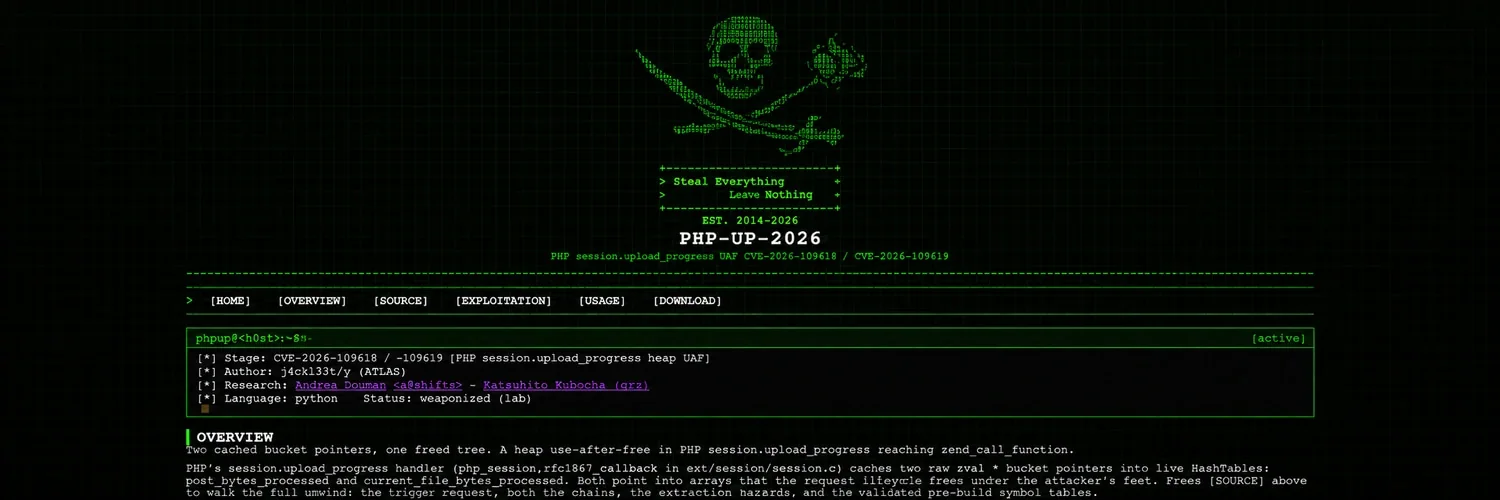
The PHP-UP-2026 write-up concerns security problems in the PHP programming language. Its presentation is immediately recognisable: black background, green text, a skull and crossed swords, a terminal-style interface. The token banner borrows that visual vocabulary. Even before understanding the technical subject, readers have an image to recognise. [28] [35]
The news did not originate in the trenches. On October 21, PHP released fixes for two critical vulnerabilities allowing unauthenticated remote code execution. A joint statement published by ENISA urged organisations to apply the updates. The token therefore borrows its name from a real security emergency; neither advisory endorses it. [27] [34]
The distinction between the texts matters. The personal write-up carries an October 21 correction that rejects its initial exploit chain and describes a narrower issue. PHP’s official advisory still identifies a critical remote-code-execution risk. The blog’s conclusions should not be generalised to all the vulnerabilities or replace the software project’s guidance. The token narrative is circulating while the technical account is being corrected. [27] [28]
What if the fees paid for the research?
Under the screenshot, replies already suggest a different next chapter. Shakespeare, @prottlegang11, asks for a Solana wallet to receive donations. Alphaval, @alpha_vl, imagines fees funding further research, companies paying to fix problems and a portion returning to holders. This sketches a model in a reply; it does not document a functioning arrangement. [29] [30]
Fred, @Fred__42069, jokes about how easily the researcher could become a KOL, a market influencer. The compliment concerns attracting attention more than writing code. The same author can be read as a technical source by one audience and a prospective promoter by another. [31]
This is PHP’s most revealing turn. Participants are not simply borrowing a name without its author: some try to give him a place in the economic arrangement they imagine around it. Those invitations prove neither that he created this contract nor that he controls its supply or that any revenue sharing has actually occurred.
Two audiences in the same thread
On October 22, Jλckλι quotes his screenshot and posts a Pump.fun link, framing the gesture as a joke. The connection is now public on his own account. It documents his participation in the crypto conversation, without by itself identifying the contract’s creator or establishing an official relationship with the PHP team. [32]
Not every reply resembles a trader’s celebration. ねこち, @cgmali9, reproaches him for overnight maintenance work that this person attributes to his actions. That is an accusation in a thread, not established responsibility. Its presence nevertheless shows that spectators are judging different things: some discuss funding or visibility, others the consequences of disclosure. [33]
At the October 22 observation, Degen Flow also shares the exact contract while advertising a multiple on his own call. We do not treat that return as a verified result. The post illustrates a third way of telling PHP’s story: the technical news recedes behind the promotional record of someone claiming to have spotted it. [36]
The green skull brings together perspectives that remain distinct. The defining scene is still the screenshot in which a researcher finds his subject in a list of coins. Replies immediately try to turn that recognition into an ongoing relationship. Whether it produces anything beyond a link, proposed funding and another name in traders’ performance posts remains an open question.
Token facts
PHP — PHP-UP-2026 · Solana. Contract : Cbkg5w7V7W2J2sUmecnyN825CbvwvXwasfhduVtNpump. [37]
Latest market-cap high supplied to the editorial team: $2,140,495 · 22/10/2026 · 07:09:14 (Paris).
Price ATH recorded on GMGN on October 26: $0.0021404953. This observation supplies neither an exact peak time nor an updated historical market capitalisation. [38]
Written by Emma C.
UHI: one Musk adjective becomes a ticker contest

High rather than basic: Universal High Income holders defend three letters by revisiting a promise of abundance. The meme’s real work lies in that choice of words.
One word shifts the bet
On October 19, Finn argues on X that Universal High Income is the right term to follow. He attaches the Solana contract and a recirculated Musk clip. river backs the same wording; HAKI uses an almost identical argument. Before the charts, these posts compete over a phrase. Holders want to own the words a public figure might repeat. [40] [41] [42]
The reference in the token listing is much older than this week: on May 19, 2024, Elon Musk replies to Mario Nawfal that there will be universal high income, specifying in parentheses that he does not mean basic income. The reply exists. It names neither this contract nor a redistribution scheme. [39]
Abundance in three letters
The distinction between basic and high makes effective trenches material. It offers a more ambitious version of the same idea: automation would provide not merely subsistence but shared abundance. By choosing UHI, the token turns that nuance into a badge. Participants can understand what they are invited to hope for without reading an economic programme.
On October 24, Mike says he is holding UHI and ENERGY and imagines a community with strong enough content overtaking established memes. His post discloses a position and an ambition; it does not document a mechanism capable of paying that income. The enthusiasm concerns the narrative’s potential more than an available product. [43]
What repetition does to the phrase
The revealing detail is repetition. Finn, river and HAKI offer no three independent demonstrations: they favour the same contrast between basic and high income. Their convergence shows a community settling on a public argument. It measures neither all of X nor new buyers. [40] [41] [42]
Musk’s sentence provides a verifiable origin, but no schedule. Traders must choose a moment and a contract. Here the stories diverge: a hypothesis about an automated society unfolds over years; a ticker can be discarded at the next phrase. The meme travels more easily because its name conceals that distance.
Token facts
UHI — Universal High Income · Solana. Contract : FGkCj28xhabWTYg9QyzACvs4NsN6LUyesP6EwiHepump. [44]
Price ATH recorded on GMGN on October 26: $0.0018413886. This observation supplies neither an exact peak time nor an updated historical market capitalisation. [45]
Written by Emma C.
███: the ape hides its eyes, the ticker hides its name

Blind Ape Hoe turns privacy into a shared costume. A black blindfold works as an image, a joke and a market name.
Censorship becomes an accessory
Under Blind Ape Hoe’s pinned video, kjclear sums up the joke: becoming private apparently means censoring one’s eyes. The account replies that everything remains private. The October 25 exchange establishes the game. Readers need no cryptographic explanation; they are offered an immediately reproducible gesture. [46] [47]
The same post presents a blind ape supposedly seeing a brighter future by holding its token, alongside the full Solana contract. The ticker, three black rectangles, extends the blindfold. The market name becomes part of the picture. [46]
A familiar critique of the phone
Another post starts with everyday traces: a phone knows when its owner wakes up, apps know where they go, the timeline knows their meals. The list turns data collection into ordinary situations. The ape is a comic countercharacter to this overinformed environment. This is criticism through a meme, not a verified account of the contract’s properties. [48]
Its visual economy makes participation easy. Anyone can add a blindfold to an avatar or repeat the phrase without a long explanation. Holders become recognisable through what they conceal. The contrast suits X, where protecting an identity can coexist with making one’s presence visible.
The secret needs publicity
The account nevertheless celebrates public signs of progress. It says it has applied for a CoinGecko listing and supplies a request number; an application is not acceptance. It also shares Chairman’s remark about buying blindly. Privacy thus travels through familiar token-discovery and reputation channels. [49] [50]
That contradiction is the story’s appeal. The meme needs attention for a character supposedly avoiding it. An unreadable ticker can become recognisable through repetition. A successful symbol, however, says nothing by itself about wallet or transaction anonymity. In the inspected material, the clearest achievement is cultural: making a character whose secret everybody recognises.
Token facts
███ — ███ · Solana. Contract : EwX2T1p2PmgTsSq2Bi6XtQYxPC5krR4P2fxPfN4Qpump. [51]
Price ATH recorded on GMGN on October 26: $0.00094740906. This observation supplies neither an exact peak time nor an updated historical market capitalisation. [52]
Written by Emma C.
LAUNCH: a launchpad tries to rewrite the first-block rules

One wallet, filtered tickers and recycled fees: Launch turns the launch procedure itself into a narrative.
The same name should not win twice
In Launch’s examples, changing PEPE to P3PE is not enough. Its page describes ticker filtering that folds together case, spaces, lookalike letters and numerical substitutions. Resized or recoloured image copies are also meant to be rejected. The telling detail comes before a first purchase, when one character starts multiplying into competing versions. [53]
The documentation links LAUNCH to the inspected contract and presents a platform built on Raydium LaunchLab. Creations are centralised in a treasury wallet. This is the project’s stated architecture; having no separate developer wallet for each coin does not by itself establish an absence of control or risk. [53]
A procedure rather than just a mascot
Its cultural starting point is launch fatigue. Copies adopt nearly identical names, early blocks become contests and participants wonder where fees go. Launch turns those complaints into a product proposition. Its public argument is less about finding another character than changing the ground on which characters compete. The October 25 post still described StonkFun deployments; the page inspected on October 26 describes its own LaunchLab platform and distinguishes older coins. These are dated versions of the account, not one merged rule. [53] [54]
The site also describes creation through a private bundle without publishing the mint beforehand, seeking to reduce the creation-block advantage. It says subsequent trading proceeds normally and promises no complete protection from snipers. Removing one particular advantage does not make all participants equal. [53]
A market meant to feed its own story
The page describes a platform charge split between buying and burning the traded coin, buying and burning LAUNCH, and treasury funding. The narrative link is direct: each new story is meant to sustain the token of the venue hosting it. Ledgers and transactions would need to establish how well that ambition works; reading documentation is no substitute for checking execution. [53]
The _LaunchX account’s post appears among the contract’s attached links. That helps identify the project without attributing every subsequent trade to its announcement. Raydium and StonkFun refer to tools or stages mentioned by the platform, rather than outside guarantees. [54]
The proposition goes beyond a slogan against copies: can a venue preserve a meme’s spontaneity while deciding which names and images may enter? Rules can limit abuses while shifting power to whoever applies them. Launch will therefore be judged as much by the launches it refuses as those it lets succeed.
Token facts
LAUNCH — Launch · Solana. Contract : AhBidGAgv6QbKSWfrSCegGrzFLcBx4E5FNYTKHNQQj6C. [55]
Price ATH recorded on GMGN on October 26: $0.00434691. This observation supplies neither an exact peak time nor an updated historical market capitalisation. [56]
Written by Emma C.
McRib: the sandwich traders want to turn into a signal
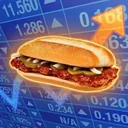
A menu return, an old TradingView script and a contract in a reply: the McRib Indicator compresses a market joke. Its chart also has challengers.
A reply turns the post into a market
On October 22, Bilngineer reacts to Guillaume Huin’s McRib return announcement. He highlights a crypto reference and links the sandwich to a supposedly bullish indicator. In his own reply, he then publishes the Solana contract. The route is unusually clear: a commercial announcement becomes a market interpretation, then a tradable address. [57] [58] [59]
The announced date is October 27 at selected US restaurants. On October 25, sookee repeats it, urging people to eat the sandwich and then send the token higher. A commercial date becomes a shared occasion for holders. [59] [62]
The joke predates the coin
The TradingView link was not invented for this launch. MausIncognito published the McRib Bull Market Indicator on November 20, 2024. It marks sandwich release dates from 2012 to 2024 on charts and presents itself as a historical curiosity. A script demonstrates that a joke can become a tool; it does not establish predictive value. [60]
That is what makes the meme effective. It borrows the serious forms of a terminal, candlesticks and testable dates to discuss fast food. The mismatch is funny but supplies shareable objects: screenshots, chart recipes and previous releases. Participants need not agree about finance to recognise the sandwich.
The dates a chart leaves out
Quinten challenges the example selection. He says the bullish chart omits McRib returns that fail to fit the story and attaches a fuller version. This is a visible contrary reading in the thread, not a statistical study independently reproduced here. [61]
The reply belongs inside the story. One chart travels because it seems to confirm an intuition; the counterchart travels because it exposes date selection. Two ways of manufacturing a signal meet the same audience.
For the token, the menu return is a real but external event. McDonald’s sells a sandwich; holders trade the story of its return. Even a perfectly executed first event does not settle the second. The revealing collective reflex is that, before asking whether the indicator works, the trenches have already found it a ticker.
Token facts
McRib — The McRib Indicator · Solana. Contract : 8idEA8QovsZJka6d9Z35fejE5MbL37BJxvw5k5r6pump. [63]
Price ATH recorded on GMGN on October 26: $0.0014679774. This observation supplies neither an exact peak time nor an updated historical market capitalisation. [64]
Written by Emma C.
ELON: Musk’s name becomes part of the trading pair

Elon Coin offers more than a famous face. Promoters discuss MUSK4 and launchpad rewards while old posts circulate like present-day calls.
A name and what sits behind it
On October 26, Frag Pappy places MUSK4, ELON and TRUMP3 together in a post declaring a battle. The screenshot gathers an index, a meme and another political basket. It locates the token’s imagination between loyalty to a public figure and portfolio language. [67]
The Pump listing identifies the contract, its StonkFUN launch and a 1% transfer tax. On October 18, Damyan had already championed its pairing with a Musk-related company index. That post predates the reporting window: it documents the narrative’s origin rather than fresh news. [65] [66]
An old post tours the present
Another Frag Pappy post addresses Chamath while recirculating his January 29 remark about wanting to buy ELON. The detour lends a prestigious voice to demand. The visible date, however, prevents treating it as recent support for this contract. The new act is a holder putting the sentence back into circulation. [68]
Apez separately quotes Stonk’s vision of a world where every coin rewards holders. He adds ELON’s address and his own valuation ambition. The messages do different work: one promotes a platform idea, the other attaches a specific bet to it. [69]
Two exposures in one conversation
A basket-linked pair gives the story more layers than a simple rename. Participants need to understand what belongs to the meme price, quote asset, transfer tax and any distributed rewards. Mentioning MUSK4 makes ELON neither a share in a Musk company nor a collective mandate over his businesses.
The cultural story is that slide between registers. Financial language makes fan allegiance look structured; fan language gives a technical pair a face. A few tickers and a screenshot carry the community between them. That is a communication strength, but also the point where a name can become more persuasive than the rights actually held.
Token facts
ELON — Elon Coin · Solana. Contract : B2GESkSErPjuCq6n4LcaJP5v2z1kJnw3xHVZnop2sZx. [70]
Latest market-cap high supplied to the editorial team: $4,185,609 · 18/10/2026 · 08:36:30 (Paris).
Price ATH recorded on GMGN on October 26: $0.004714472. This observation supplies neither an exact peak time nor an updated historical market capitalisation. [71]
Written by Emma C.
The sources, a click away.
Numbered references in the articles point to this list. External links open in a new tab.
- Fto — public post
- BitcoinFoundation.org — documentation / reference
- Specter — public post
- MLM — public post
- zeropnl — public post
- 4cryptoGag — public post
- 4cryptoGag — public post
- Bubblemaps — public post
- 4cryptoGag — public post
- Kimchi — documentation / reference
- DEX Screener — market data, October 26 snapshot
- Bubblemaps — public post
- Bubblemaps — public post
- GMGN — market data, October 26 snapshot
- JR East — public post
- KBC / TV Asahi — documentation / reference
- SoraNews24 — documentation / reference
- okame2525 — public post
- Eric / shinobu_books — public post
- Jeffrey J. Hall — public post
- ren — public post
- CryptoGorilla — public post
- Pump.fun Ecosystem — public post
- DEX Screener — market data, October 26 snapshot
- GMGN — market data, October 26 snapshot
- Jλckλι — public post
- PHP — documentation / reference
- J4ck3LSyN — documentation / reference
- Shakespeare — public post
- Alphaval — public post
- Fred — public post
- Jλckλι — public post
- ねこち — public post
- ENISA — documentation / reference
- DEX Screener — market data, October 26 snapshot
- Degen Flow — public post
- DEX Screener — market data, October 26 snapshot
- GMGN — market data, October 26 snapshot
- Elon Musk — public post
- Finn — public post
- river — public post
- HAKI — public post
- Mike — public post
- DEX Screener — market data, October 26 snapshot
- GMGN — market data, October 26 snapshot
- Blind Ape Hoe — public post
- kjclear — public post
- Blind Ape Hoe — public post
- Blind Ape Hoe — public post
- Blind Ape Hoe — public post
- DEX Screener — market data, October 26 snapshot
- GMGN — market data, October 26 snapshot
- Launch — documentation / reference
- Launch — public post
- DEX Screener — market data, October 26 snapshot
- GMGN — market data, October 26 snapshot
- Bilngineer — public post
- Bilngineer — public post
- Guillaume Huin — public post
- MausIncognito — documentation / reference
- Quinten — public post
- sookee — public post
- DEX Screener — market data, October 26 snapshot
- GMGN — market data, October 26 snapshot
- Pump — documentation / reference
- Damyan — public post
- Frag Pappy — public post
- Frag Pappy — public post
- Apez — public post
- DEX Screener — market data, October 26 snapshot
- GMGN — market data, October 26 snapshot
Make this issue yours.
The same edition, wherever you want to read.