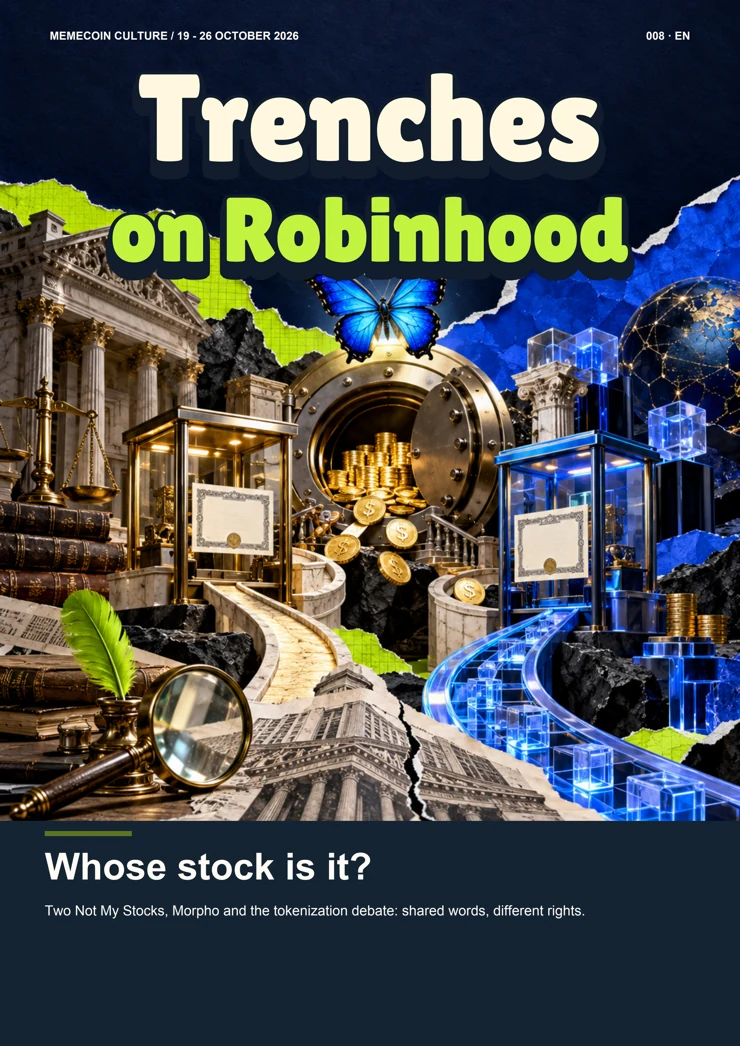
Whose stock is it?
Two Not My Stocks, Morpho and the tokenization debate: shared words, different rights.
A QR code leads to a Nasdaq FAQ. Traders find initials, give them another meaning and launch markets. In the same week, Morpho announces a new use for Stock Tokens: credit collateral.
That contrast connects four articles. We follow the two requested NMS contracts separately, then examine Morpho’s new markets and the rights discussed in this week’s regulatory documents.
Robinhood Chain culture is therefore more than a runner count. It also concerns a phrase invented by holders meeting assets whose rules are written elsewhere.
 Written by Jérôme L.
Not My Stock: a QR code becomes a coin name
An advertisement about tokenization leads to a Nasdaq FAQ. The trenches find three letters and rewrite them as a phrase. The first selected contract turns that appropriation into a market.
A detour through a serious page
On October 25, bwamwifprivacy shares a reading of a Wall Street Journal advertisement highlighted by Mike MacCana. The entry point is its QR code, leading to a Nasdaq tokenization document. The account extracts a meme proposition, Not My Stock, and a Nasdaq-related pairing idea. This act is visible in the thread; the institution is not launching the coin. [1] [2]
The 0xfcca…40a4 contract appears in market data under that name, including a pair against Robinhood’s QQQ Stock Token. HoodScan attributes it to Pons. The quote asset echoes the meme’s stock-market vocabulary without giving holders rights over Nasdaq or its index. [6]
The initials did not mean that
Replies quickly correct the account. rollieboss says NMS means National Market System; dwool disputes the Not My Stock reading too. The cited document does use a regulatory term, not the name of an example token designed by Nasdaq. [3] [4] [5]
The correction does not make the meme unintelligible. It clarifies the transformation: administrative language becomes an anxious owner’s sentence. Not My Stock can suggest protest at an unwanted representation or a comic refusal to own an asset. That ambiguity gives the phrase more personality than its regulatory origin.
The route is quick: scan a serious advertisement, isolate three letters, give them a voice and find a pair that extends the joke. None of the inspected sources turns that appropriation into institutional endorsement.
The pair tells part of the joke
QQQ is more revealing than a logo colour. A pair’s second asset is part of what participants exchange. A joke about stock markets can therefore become a market already using an equity-exposure instrument. It gives the narrative material scenery without merging the assets’ rights.
The name is public; the contract remains specific. Another NMS appears in this Robinhood Chain selection and a version circulates on Solana too. Their prices and communities are not combined here. This first coin is solely the address beginning 0xfcca and ending 40a4. [6]
The story’s cultural interest lies in an appropriation that can survive its correction. Once Not My Stock enters conversation, the precise definition of NMS cannot erase the invented phrase. It changes the story that should be told: Nasdaq did not name a memecoin; participants gave its vocabulary another voice.
Token facts
NMS — Not My Stock · Robinhood Chain. Contract : 0xfcca112411268fc28c2c5acbf633c745803040a4. [7]
Price ATH recorded on GMGN on October 26: $0.0012178823. This observation supplies neither an exact peak time nor an updated historical market capitalisation. [8]
Written by Jérôme L.
The other NMS: when a story outruns its address
The same name and source document, another contract. The LONG version reveals the identification work participants face after recognising a meme.
A shared phrase, separate markets
On October 25, Ryan posts the 0xbf6b…1e18 contract while quoting bwamwifprivacy. He treats it as major tokenized-equity news. That is the address his message promotes, not the 0xfcca NMS examined earlier. The distinction sits in a line hurried readers can easily skip. [9]
Gian places it on LONG in another post. The launchpad page presents Stock Token launches on Robinhood Chain; HoodScan connects this NMS with a QQQ pair. This provenance description is attributed to available sources, not inferred from an address suffix alone. [11] [13] [14]
Doubt is community evidence too
treyerl says the public material he finds amounts to a redirect and calls it thin. That response matters: the narrative already has a recognisable name, while this particular address lacks an equally developed public dossier. Recognising a joke is not knowing the organisation behind it. [10]
hekt0 puts the meme-making back in place: regulatory vocabulary was read as Not My Stock and versions followed. His technical claims about synchronised launches have not been reproduced transaction by transaction here; the interpretation of the pun is a separate matter. [12]
The thread reveals two tasks. One is understanding why a name becomes funny and shareable. The other is identifying the contract an interlocutor recommends, its network and its pair. Conversations often move between them without marking the shift.
The venue enters the coin’s culture
LONG provides another marker in this version. Participants discuss not only NMS but what is moving on the launchpad. The venue becomes a selection frame, almost a market neighbourhood. It narrows the search without guaranteeing the project. [11] [13]
This issue keeps both contracts because coexistence is part of the story. One phrase can produce separate capital, holders and trajectories. Combining them into a single ATH would erase precisely what deserves explanation.
The contrast with Morpho is useful. There, an institution specifies a new function for already-defined assets. Here, participants seek the asset that will represent a discussion. Both belong to onchain culture, but narrative maturity and the maturity of rights need different vocabularies.
Token facts
NMS — Not My Stock · Robinhood Chain. Contract : 0xbf6bd9aa3e6a5ddac553527dec7e671ac0f41e18. [15]
Price ATH recorded on GMGN on October 26: $0.00097673339. This observation supplies neither an exact peak time nor an updated historical market capitalisation. [16]
Written by Jérôme L.
Morpho: a Stock Token can do more than wait for a price
Since October 22, credit markets allow Stock Tokens to be posted as collateral. The news is less about a new ticker than what a retained asset can do.
Keep exposure, obtain another kind of liquidity
Soul Labs summarises the combination under Morpho’s announcement: keep the stocks, borrow the stables. The shorthand conveys the attraction. A position is no longer simply held for a price move; it enters another operation. On October 22, Morpho announces that Robinhood Stock Tokens can collateralise stablecoin borrowing. [17] [21]
The protocol immediately separates responsibilities: curators deploy markets and configure parameters and compliance controls; Morpho supplies the credit network. It says the product is unavailable to US persons and restricted jurisdictions. Public infrastructure is not a universal offer. [18]
What the wallet actually holds
Robinhood describes Stock Tokens as debt securities issued by Robinhood Assets (Jersey) Limited. They provide economic exposure to underlying securities without transferring ownership rights in them. Their ERC-20 format enables application integration. The distinction between exposure and directly owned shares survives their use as collateral. [19]
The novelty is functional. Software can recognise a token, lock it under a market’s rules and associate a loan with it. A different use does not replace the issuer or product terms. Composability describes connecting functions; it does not turn several commitments into one frictionless asset.
Useful questions appear in replies
finest.eth asks how the credit markets work. Mr.Curly asks how collateral affects rates. Both show that the news goes beyond placing Morpho and Robinhood logos together. Participants want to know what the rules mean for a concrete position. [22] [23]
Morpho’s public Robinhood Chain dashboard separates supplied assets, collateral and borrowing. This matters: deposits are not automatically loans, and opened capacity is not proof of usage. The categories can be followed without collapsing them into one adoption figure. [20]
A different clock from a runner
Robinhood already described DeFi uses for Stock Tokens in July. Morpho markets extend that direction concretely rather than inventing the idea this week. Developers gain a component to integrate; eligible users gain a function to assess. [24]
For the trenches, the shift is notable. A meme often needs the next post to stay interesting. A credit market must work when the posts stop: understandable rules, available liquidity, reference prices and position management. Those needs differ even on the same network.
This week’s announcement cannot establish a revival in all Robinhood Chain fees. It shows something narrower: assets now have a new place in a sequence of operations. The story’s quality depends on that place becoming useful rather than the announcement’s brightness.
Written by Jérôme L.
Tokenized equities: the contest concerns rights, not tickers
The SEC staff’s October 20 FAQ and Nasdaq’s recirculated campaign sharpen the debate. The word stock can describe different constructions.
The document the meme skipped
NMS traders found a name in regulatory material. The underlying dossier needs a separate reading. The SEC’s September 17 order creates temporary, conditional relief for certain tokenized-securities venues. It distinguishes those securities from third-party products providing only synthetic exposure. A stock-related token name therefore cannot place every construction in the same category. [27]
This concerns structure, not a logo contest. Two assets can reference similar economics while giving holders different rights and recourse. Before saying stock markets have arrived on a chain, it is worth asking which representation has arrived.
On October 20, procedure becomes visible
The SEC staff FAQ addresses public notice at least thirty days before a covered venue begins operating, updated disclosures and issuer objections. It identifies itself as staff views, not an amendment to the order or law. It supplies procedural markers rather than blanket approval of onchain products. [26]
The SEC tracking page, reviewed on October 26, lists declared intentions to operate. It says inclusion does not establish that all conditions are met. Even a name in a register needs qualification. [25]
Why established venues speak up
Nasdaq’s FAQ defends issuer involvement and comparable market information. The advertisement recirculated on October 25 takes that position beyond regular readers of regulatory documents. Its format helps explain how the debate reaches the trenches: legal material becomes an image people can quote and repurpose. [3] [2]
The issue is not resolved by opposing closed old finance to open new finance. A representation can be easy to transfer and difficult to compare; it can enable a new use while retaining dependence on an issuer. Analysis starts by separating those properties instead of packaging them as modernity.
What it changes for Robinhood Chain
Robinhood Chain hosts both memes and equity-exposure products. One asset’s rights do not follow from sharing a network with another. A pool-traded NMS and a Stock Token collateralising a Morpho loan do not become interchangeable because their stories meet in this issue.
For developers, the distinctions shape integration. For readers, they shape a precise question: who owes what to whom, under which document and jurisdiction? That is more useful than asking whether a ticker looks familiar.
The week shows two appropriations of tokenization. Memes make it a rallying symbol; institutions negotiate its conditions of circulation. The former can tell inventive stories about the latter. They cannot borrow its rights through wordplay. That thread matters whenever a new pair arrives faster than its explanation.
Written by Jérôme L.
The sources, a click away.
Numbered references in the articles point to this list. External links open in a new tab.
- bwamwifprivacy — public post
- Mike MacCana — public post
- Nasdaq — documentation / reference
- rollieboss — public post
- dwool — public post
- HoodScan — documentation / reference
- DEX Screener — market data, October 26 snapshot
- GMGN — market data, October 26 snapshot
- Ryan — public post
- treyerl — public post
- Gian — public post
- hekt0 — public post
- Long — documentation / reference
- HoodScan — documentation / reference
- DEX Screener — market data, October 26 snapshot
- GMGN — market data, October 26 snapshot
- Morpho — public post
- Morpho — public post
- Robinhood — documentation / reference
- Morpho — documentation / reference
- Soul Labs — public post
- finest.eth — public post
- Mr.Curly — public post
- Robinhood — documentation / reference
- SEC — documentation / reference
- SEC — documentation / reference
- SEC — documentation / reference
Make this issue yours.
The same edition, wherever you want to read.