The playground just got bigger.
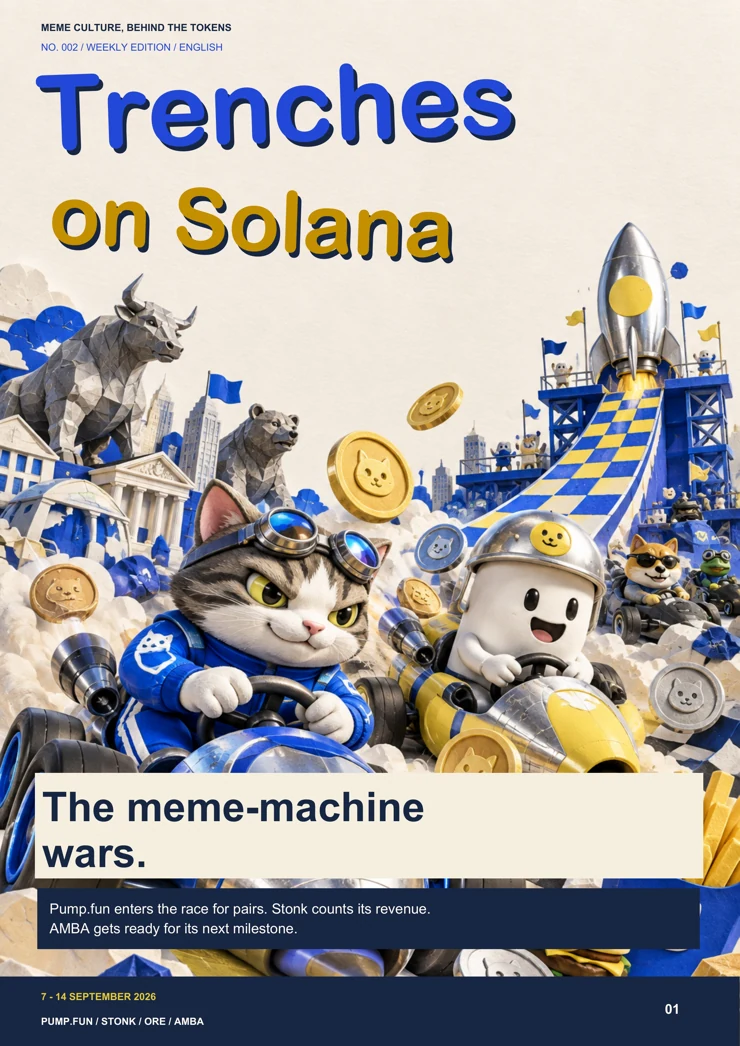
From 7 to 14 September, memes did more than borrow stock-market tickers. Their platforms fought over how to bring them to market.
On 9 September, Pump.fun announces custom pairs. The next day, Stonk offers coin launches against tokenised Grindr stock. On the 11th, Wendy's joins the catalogue. On the feed, the launchpad battle increasingly looks like a casting contest: which brand, asset or joke will inspire the next token? [1] [6] [7]
The story now reaches beyond a duel of mascots. Pairing a meme with something other than SOL is becoming a product several platforms want to offer. For creators, the pair becomes part of writing the story; for platforms, it opens another commercial battle.
Stonk answers the competition with numbers. Daily posts put revenue, buybacks and burned tokens centre stage. They are useful precisely because several days can be compared, rather than promoting the best number into a permanent run rate. [4] [5]
Alongside that race, Amoeba Farm introduces a different ambition: synthetic markets tied to computer memory and storage. It already presents itself as a product, but mainnet is still scheduled for 15 September. This issue also watches what is being built, without bringing the launch date forward. [10] [11]
 The Trenches On editorial team
Pump.fun joins the fray.

On 9 September, Pump.fun announces custom pairs. A Stonk selling point becomes contested ground.
Some announcements change the balance of power more than the vocabulary. Pump.fun's, on 9 September, makes a simple promise: launch a token paired with a tokenised stock, a major crypto asset or other assets. The platform also claims more choice, greater depth and lower fees. That superiority is its sales pitch; we do not measure it here. [1]
The timing gives the announcement weight. That same day, SolanaFloor describes three consecutive days in which Stonk's internal figures put it ahead of Pump.fun in launchpad revenue. The article reports a break in a market long dominated by Pump. Its scope matters: a few days of revenue comparisons do not crown a permanent winner. [3]
Two days after the announcement, DannyCrypt shares it and asks followers which pair they would choose. A technical feature is already a conversation starter. An asset choice can condense a stock-market conviction, a joke and group identity into a handful of characters. [2]
Meanwhile, Stonk keeps expanding its catalogue. On 11 September, ORE joins as a pairing asset. The mining reference immediately supplies a setting for creators. ORE is not a new meme launched that day: the news is its availability for use in new pairs. [9]
For a creator, the question becomes less 'Can I launch?' than 'Where will my story make sense?' A site's visibility, tools and community matter alongside a novel mascot. That is our reading of the announcements, not a measurement of market shares.
The next test comes in use: launches that sustain interest, markets that stay liquid and holders who return. This week has already changed one observable fact. Pump.fun has publicly set out its response, and Stonk can no longer present multiple pairs as territory it occupies alone.
The pair becomes part of the story.
The burn gets a daily bulletin.

Revenue and buybacks have become characters in the story. Two daily reports show why their pace matters as much as their size.
Stonk posts its figures like a short evening bulletin: revenue, buybacks, tokens burned. For 9 September, it reports $1,355,566 in revenue, $814,028 in buybacks and 4.55 million STONK burned. Four days later, the figures are $900,897, $538,655 and 2.24 million tokens. These are two project statements, not independent audit findings. [4] [5]
The difference is instructive. Reported revenue falls by about a third between those days. That establishes neither a long-term trend nor a collapse. It does establish that the flow varies. Mechanically annualising the strongest day would imply a stability these posts do not show.
The buyback story is powerful because it translates platform activity into a visible action on its token. Trades generate fees; part of the proceeds funds purchases; the purchased units leave circulation. That sequence can be described without claiming it determines a future price. Demand and liquidity still matter.
The two reports also expose a common confusion: dollars spent and tokens burned are different measures. If the acquisition price changes, the same sum removes a different number of units. A burn counter describes an operation; it is not income automatically paid to every holder.
This accounting language gives the brand a daily presence even when no new mascot breaks through. In the launchpad contest, the bulletin serves as narrative evidence: look, the machine is working. Full verification would require reconciling the calculation method, buyback transactions and burn addresses.
The question for the next issue is therefore more than whether another record has been set. Can activity withstand expanding competition, and do the reports remain comparable from week to week? A fee-generating machine also needs judging on the days it runs more slowly.
A daily figure is not a permanent income stream.
Grindr and Wendy's: stocks meet memes.
The pair catalogue draws on brands that already carry stories. Familiarity helps a meme travel, but does not make the assets interchangeable.
![Artwork from SolanaFloor's 11 September report on GRND's Solana launch. [8]](../assets/grnd-art.jpg)
On 10 September, Stonk announces coins paired with GRND, tokenised Grindr stock, with a pun about taking a 'position'. The next day, Wendy's provides another hook: the restaurant chain belongs in your portfolio rather than on your CV. Two companies, two jokes immediately legible to online market regulars. [6] [7]
The choices reveal something about the new catalogue. The asset's name is no longer a discreet line beneath a chart; it supplies a setting. Creators can attach a character, a community and a reference readers already know. Tokenised finance gives memes a stock of ready-made stories.
Grindr also provides a snapshot of attention. In its 11 September article, SolanaFloor reports more than $31 million traded in the tokenised version within 24 hours of its launch on the 10th. It compares that with roughly $16.6 million on the NYSE in the preceding session. These are different windows: a historical contrast, not equivalent market conditions. [8]
The article links the activity to meme/stock pairs. Reading it as proof that tokenised trading is replacing traditional equities would go too far. Heavy volume can consist of repeated round trips. It measures neither how many people believe in the company nor how much capital is committed to financing it over time.
Three things must stay distinct: the company's security, its tokenised representation and a meme using that representation in a pair. Similar names do not make them interchangeable. Rights depend on the product and issuer; a launchpad announcement cannot create them by magic.
This week's shift is more cultural than it first appears. The stock lends its familiarity to the meme; the meme gives people another way to talk about the stock. Stonk arranges the meeting through launches and slogans. The next question is which pairings outlive their first good joke.
A familiar name gives the meme a stage.
AMBA looks under AI's bonnet.

Memory, storage and synthetic markets: Amoeba Farm gives its token narrative an industrial subject. Mainnet remains scheduled for 15 September.
While launchpads add famous tickers, Amoeba Farm looks at less glamorous objects: memory modules and storage. Its site presents RAMX and NANDX, markets linked to component-price benchmarks. The idea is to trade synthetic exposure to those references without buying or taking delivery of hardware. [12] [13]
The calendar is crucial. In its update published before our cutoff, the team says it has delivered an SDK, CLI/TUI tools, a new website and the open-source Devnet programme. It schedules mainnet for 15 September. The site already exists, but the announced event belongs to the following week. Visible screens are not presented here as proof of an open production market. [10] [11]
AMBA's connection to the project is more concrete than a shared name. The risk page publishes the Solana contract Hy1LfQLL4zLQihmiQKZm7DQzXm5K8aVSfKtdHFYXbKMm; it matches the Amoeba Farm token whose metadata link to the site and X account. That establishes the identity investigated, not the token's economic quality. [13]
The cultural angle is striking. Instead of a dog embodying artificial intelligence, this project wants to talk about its components. The narrative moves closer to tangible industrial constraints. That does not turn AMBA into an equity investment in the memory sector or pass manufacturers' profits to holders.
The documentation gives RAMX and NANDX a defined scope. They do not cover the entire industry, and synthetic exposure does not guarantee the price of a real hardware order. The team also announces developer-token locks until the first quarter of 2027, followed by weekly unlocks. That schedule is attributed to the project; the locking contract has not been audited here. [13] [14]
The 15 September milestone will say more than the label 'utility'. It will allow the announcement to be tested against deployment, clear markets and actual activity. This week, AMBA has mainly introduced a different story to the trenches: the hardware behind the digital dream.
A live website is not a delivered mainnet.
The sources, a click away.
Numbered references in the articles point to this list. External links open in a new tab.
- Pump.fun: custom pairs
- DannyCrypt: amplification and responses
- SolanaFloor: launchpad competition
- Stonk: figures for 9 September
- Stonk: figures for 13 September
- Stonk: GRND pair
- Stonk: WEN pair
- SolanaFloor: tokenised Grindr
- Stonk: ORE joins the pair catalogue
- Amoeba: delivery update
- Amoeba: mainnet scheduled for the 15th
- Amoeba: RAMX / NANDX markets
- Amoeba: scope and risks
- Amoeba: developer-token schedule
Make this issue yours.
The same edition, wherever you want to read.