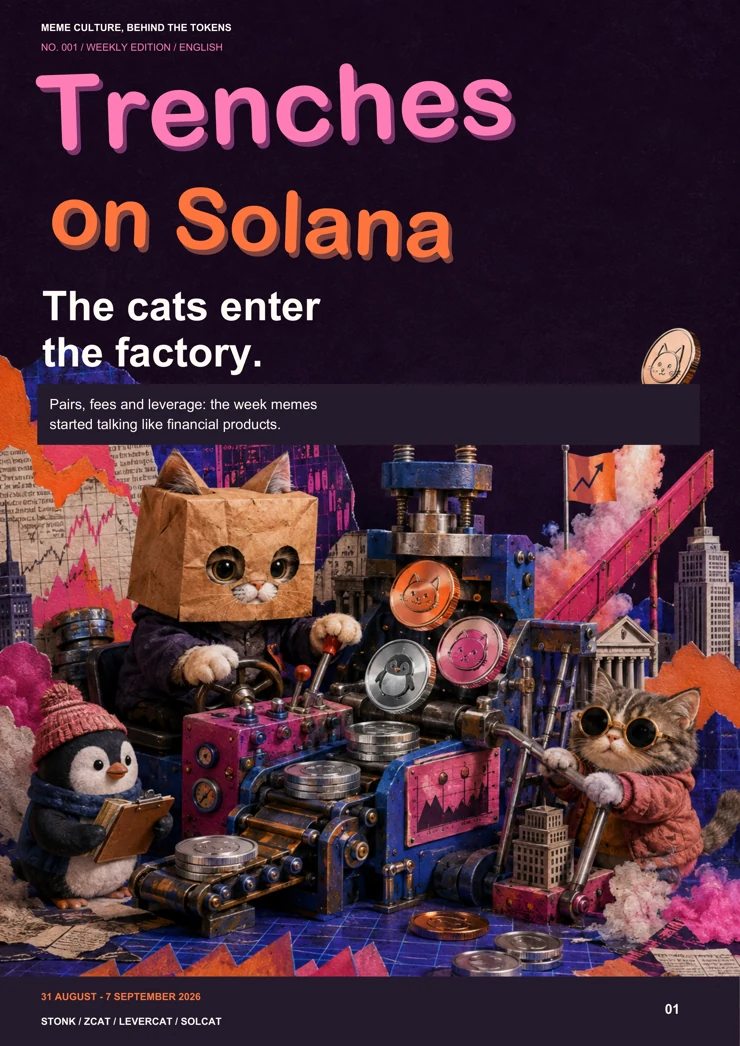
The meme wants to do something.
From 31 August to 7 September, the best-documented stories in our selection shared a promise: a mechanism behind the mascot.
On 1 September, StonkFun opens up coin creation with GPRO pairs. On the 5th, it announces its move to LaunchLab. On the 7th, a cat arrives with leverage. These could be filed as three separate stories. Together, they describe a shift: the meme no longer just wants to be recognised. It wants to explain what happens to the money flowing around it.
ZCAT gives that shift its most memorable face. A paper bag, two eyes and the promise of receiving ZEC: finance has found a character. Holders talk about their rewards; everyone else borrows the face. A narrative takes shape between those two gestures.
This issue follows those stories as they are made: the week's announcements, the accounts that spread them and the mechanisms they promote. Figures published by projects remain their own claims. A compelling image does not turn them into audited accounts.
 The Trenches On editorial team
The pair-making factory.

One more ticker is more than one more asset. It supplies a new cast of characters, communities and jokes.
![StonkFun announces GPRO pairs on 1 September. [1]](../assets/gpro.jpg)
On 1 September, StonkFun announces that users can now create coins paired with GPRO. The post is brief; the artwork looks like a stock listing card. But the pitch is aimed at meme creators: a company's name can become the starting point for a new market. [1]
The next day, the project says Raydium has deployed an upgrade needed for its LaunchLab integration. On 5 September, it announces that the integration is live for new launches. Lower launch costs, less exposure to snipers and liquidity reinvested after the bonding curve: these are the benefits StonkFun sets out. They are product announcements, not findings from an independent audit. [2] [3]
The sequence matters. The story is no longer just a parade of mascots. It also rests on a production line: choose an asset, attach a meme, arrange distributions and give the market a way to track activity. Raydium's posts about 'stonks' on 2 September already capture part of that ambition. [5]
The language is changing too. On 5 September, StonkFun claims $1 million in cumulative STONK buybacks. The platform is no longer only talking about launches; it is explaining what it does with revenue. That figure comes from the project and has not been reconciled here against a complete transaction record. [4]
This financial framing changes the conversation. A community can discuss a character alongside a pair or a stream of fees. There is more to it than a bet on a name, but also more room for confusion: holding the meme does not automatically confer the rights attached to the asset with which its market is paired.
The week's development is this meeting of infrastructure and culture. The mascot catches the eye; the mechanism gives it a story. What remains is to establish, project by project, whether that story matches what the contracts actually do.
A ticker becomes raw material, too.
One bag, two communities.

The anonymous cat brings Solana regulars and Zcash holders closer together. The cultural connection is easier to establish than the financial promises.
![Solana post, 7 September. It does not name ZCAT. [8]](../assets/bag.jpg)
Across the week's feed, ZCAT has two faces. One is a cat wearing a bag. The other looks like a rewards statement: holders describe how much ZEC they say they have received. A mascot and a promised flow of rewards are enough to start two conversations that did not necessarily share the same audience before.
On 6 September, Ansem picks up the idea of a native vehicle through which memecoin traders can engage with the Zcash narrative on familiar ground. That day, the account Value claims to have received about $5,000 in ZEC after holding just under 1% of ZCAT overnight. This is the testimony of someone with exposure to the token, not an outside observer. [6] [7]
Then comes 7 September. At 16:18 Paris time, Solana posts a bag-wearing character at an NYSE lectern. The caption is four words: 'The bag stays on'. The post does not name ZCAT. Its imagery echoes a visual language already used by holders, which explains the association; it establishes neither a partnership nor an endorsement. [8]
The exchange runs both ways. A financial reference gives the meme substance; the meme makes that reference recognisable in a second. You do not need to understand the distribution mechanism to reuse a paper bag.
The distinctions still matter. The pair data consulted identify ZCAT as a Solana token. That does not give it Zcash's privacy properties. Nor do holders' reward claims amount to a guaranteed return, let alone a representative measure for everyone holding the token. [15]
The narrative achievement is visible: the symbol breaks free of its explanation and travels alone. That is precisely when reporting needs to slow down, put names back under the pictures and distinguish what an audience recognises from what a product actually enables.
An image travels faster than its conditions.
The leverage was in the cat.
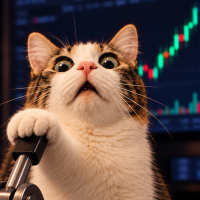
The 7 September launch distils the new MemeFi vocabulary: a mascot, a fee and an asset distributed to holders.
![LEVERCAT launch artwork. The promise is the project's own. [9]](../assets/levercat-art.jpg)
The cat poses beside a market screen and a lever. The image is deliberate: LEVERCAT wants to turn a financial mechanism into a character. Its launch announcement on 7 September promises distributions to holders in xSOL. [9]
The thread describes a 3% fee on token transfers. StonkFun reward cycles would then convert the collected amounts into xSOL and distribute them in proportion to holdings. The project stresses automatic receipt, with no claim step or staking. That is the announced mechanism; reading the thread cannot certify that it works as described. [9]
The reward asset is no minor detail. xSOL provides leveraged exposure to SOL. It adds another question alongside LEVERCAT's price: what happens to the asset received? A holder can accumulate rewards that lose value and do not simply track SOL's movements.
The project itself spells this out in the most useful part of its thread. It mentions potentially faster losses than SOL, erosion in some sideways markets and the possibility of approaching zero in a crash. It also points out that distributions depend on activity: without trading, this mechanism distributes no xSOL. [10]
At the reporting cutoff, the profile publishes a mint address. The pair data consulted identify it as LEVERCAT on Solana and link back to the same X account. That match helps distinguish the token from namesakes. It does not replace an examination of mint authorities or distribution contracts. [16]
LEVERCAT makes the week's shift unusually clear. Buying a meme can now bundle several exposures: the mascot, activity in its pair and the value of the reward asset. The drawing stays simple. The product takes more reading.
A stated 3% fee. A reward with risks of its own.
When a logo becomes a cause.

Among the stories about yield, a Nepal fundraiser carries a different promise: a community that can act.
![SOLCAT highlights its fundraiser and its place on Solana's profile. [11]](../assets/solcat-art.png)
On 2 September, the Solana account announces $166,946.50 raised to help flood victims in Nepal. It thanks participants and promises their logos a place in its profile image and pinned post for the following week. Recognition becomes visible, quite literally. [12]
Four days later, SOLCAT says it has raised more than $110,043 and highlights its appearance in Solana's profile image. The post calls for further support and tags several ecosystem figures. Here the token tells its story through a cause and the people who might amplify it, rather than leading with market capitalisation. [11]
Those two figures must not be added together. The posts do not establish that they concern separate fundraisers, matching periods or distinct pools of money. Treating them as entries in the same financial table would create a precision the sources do not provide.
Solana's post does establish something concrete: the network says it arranged visual recognition for participants. A reply from the same account credits mallow and quotes an organiser who says the funds were disbursed. These are identifiable claims. They are not an independent verification here of every transfer or of the amounts specific to SOLCAT. [13]
The cultural pull is strong. A logo beside a familiar brand can quickly read as validation. For community members, it can also be a symbolic reward: evidence of taking part in something beyond the token. Both readings coexist, and the slide from one to the other deserves attention.
The fundraiser offers a counterpoint to the issue's other stories. Memes can bring people together around a concrete objective. To report that mobilisation accurately, the collective effort, the visibility granted and the documented destination of funds have to remain distinct.
Recognising participation is not a token audit.
The sources, a click away.
Numbered references in the articles point to this list. External links open in a new tab.
- StonkFun: GPRO pairs
- StonkFun: preparing for LaunchLab
- StonkFun: LaunchLab goes live
- StonkFun: claimed cumulative buybacks
- Raydium: Stonks
- Ansem: ZCAT and Zcash
- Value: claimed rewards
- Solana: The bag stays on
- LEVERCAT: launch thread
- LEVERCAT: stated limitations
- SOLCAT: claimed fundraising total
- Solana: Nepal fundraiser
- Solana: mallow and organiser credit
- LEVERCAT: profile and published mint
- DEX Screener: ZCAT / Solana identity
- DEX Screener: LEVERCAT / Solana identity
Make this issue yours.
The same edition, wherever you want to read.