After the contest, community life goes on.
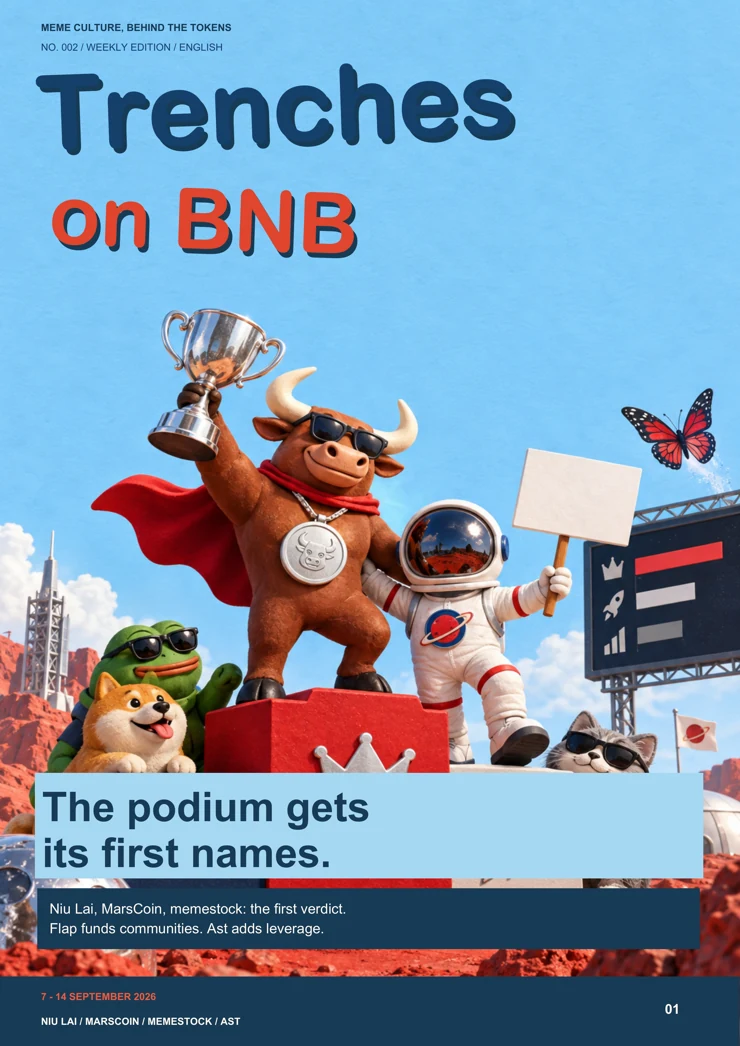
This week puts names on the BNB Stonks Szn podium. It also shows how platforms hope to hold attention after the rewards are distributed.
On 11 September, BNB Chain names its three week-one winners: Niu Lai, MarsCoin and memestock. On the 12th, it says $400,000 in BNB has been distributed to winning wallets. The rulebook discussed in issue one now has a winners' list and a payment announcement. [1] [2]
There is more to the week than that result. On 8 September, Flap announced a $1 million fund to buy and burn selected community tokens. Its first claimed purchases concern Niu Lai and MarsCoin. The same names appear in two different programmes, whose rules and purposes need to stay distinct. [4]
Memestock builds an identity around GameStop and GMEB distributions tied to certain sales. Ast.fun pushes pairing towards leveraged perpetual positions. In both cases, understanding what someone actually holds requires more attention to the mechanism than the slogan. [7] [11]
Week two of the contest is scheduled for 14 September at 12:00 UTC, after this issue's early-morning cutoff. We stop at the first verdict and the announcements available by then. The open question is simple: what keeps a community together when the next occasion is more than an airdrop? [3]
 The Trenches On editorial team
Three names on the podium.
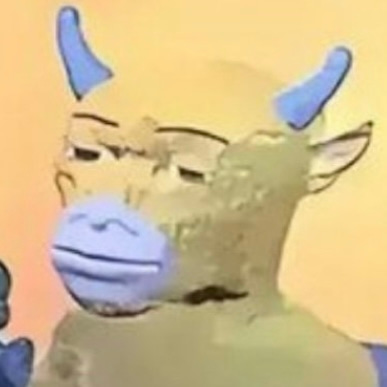
Niu Lai, MarsCoin and memestock win the opening round. The move from provisional rankings to final results shows that a contest has its own filters.
![MarsCoin is one of the three announced winning communities. Token artwork via DEX Screener. [1]](../assets/marscoin-art.png)
The verdict arrives on 11 September: Niu Lai, MarsCoin and memestock make BNB Chain's announced top three. Their communities share the week-one pool of $400,000 in BNB. The announcement sets a distribution deadline of 12 September at 16:00 UTC. The next day, the account confirms the funds have been sent, highlighting Binance Wallet. We report those statements without claiming to check every wallet. [1] [2]
The week also shows how the result took shape. On 9 September, the ranking dashboard is announced as available. On the 10th, BNB Chain reiterates that holding at least $100 of a single selected meme is required to qualify. After ambiguous wording in the initial rules, the clarification matters: buying the entire basket was not required. [15] [16]
The final post notes that an anti-wash-trading filter was applied to the snapshot data. Rankings displayed during the competition can therefore differ from the results after review. An interim screenshot cannot establish a winner; nor can it justify publicly accusing a project of manipulation without specific evidence. [1]
The contest gives communities a shared, measurable and dated story: hold until the snapshot, reach the top three, await distribution. That drama travels well on X, where a rank and a deadline are easier to share than a lengthy mechanism. It still describes a promotional campaign, not an independent assessment of asset quality.
The winners' list should not become an instruction for the following week. The HODLer Index and contest criteria serve a particular rulebook; they guarantee neither future liquidity nor price resilience. The opening round's $400,000 is also distinct from the $4 million announced for the whole season.
BNB Chain has already scheduled week two for 14 September at 12:00 UTC, or 14:00 in Paris. That is after our 06:14 cutoff. Issue two stops before the start: the first podium is known, but the next round's results remain unwritten. [3]
Winning a round is not winning the market.
Memestock keeps its costume.

A place in the top three strengthens a story already built around GameStop. Behind the imagery, the project describes a specific GMEB distribution mechanism.
On 13 September, Memestock posts a statement of conviction built around 'diamond hands'. It follows the BNB Stonks Szn announcement naming the project among the winning three. The account identifies itself as parody. It speaks the familiar language of communities that turn holding a token into a collective identity. [1] [8]
The site gives a less symbolic account. It describes a BNB Chain memecoin in which eligible sales feed GMEB distributions to holders. Its diagram directs 1% to this mechanism. We describe the published rule, not a realised return for a particular wallet; unloaded data displays are not treated as observed zero balances. [7]
The token is identifiable by contract: 0x6FF45323817d1d53bbb8A8dFbA9245aE74057777. This address appears on the site and matches metadata linking to MemeStockbnb. The check matters because several tokens use similar names. A GameStop narrative is never enough to identify the right asset.
The familiar reference does much of the work. It evokes retail holders, conviction and a market experienced as cultural confrontation. The BNB contest adds recognition within the ecosystem. A distribution rule and a group identity can reinforce each other without being the same thing.
The site nevertheless states that the memecoin confers no GameStop ownership rights and has no affiliation with the company. GMEB is presented as a third-party tokenised asset whose operation and redemption terms the project does not control. Receiving it through a fee mechanism is therefore not the same as receiving a dividend declared by GameStop. [7]
After the contest reward comes the test of continuity. The mechanism depends on eligible activity: trades must happen for fees to be distributed. The community has a success to retell. That does not yet answer the longer question of what activity will give the costume substance once the celebration is over.
The name connects the stories. The rights remain distinct.
Flap puts its fund on the table.

A stated $1 million allocation and $50,000 in claimed initial purchases: the Flap Fund adds platform selection alongside BNB Chain's competition.
![Niu Lai is named among the Flap Fund's first purchases. Token artwork via DEX Screener. [4]](../assets/niulai-art.png)
On 8 September, Flap announces a $1 million fund to buy and burn selected community tokens launched on its platform. The same post specifies the first purchases: $25,000 of MarsCoin and $25,000 of Niu Lai, with two transaction links. Announcing an allocation and initially deploying $50,000 are separate pieces of information. [4]
The wording matters. Flap says it wants to recognise strong, organic communities. That judgement comes from the platform funding the programme, not an outside certification. It introduces another kind of contest: persuade not only a dashboard, but the actor deciding where to direct purchases.
Niu Lai and MarsCoin subsequently appear among the first BNB Stonks Szn winners. The overlap is worth noting without inventing causation. Flap's fund and BNB's contest are not one programme, and the posts consulted do not establish that the fund's purchases determined the competition result. [1] [4]
The communication also targets user identity. On 11 September, Flap introduces Wrapped, a card presenting a wallet's history alongside a profile image. The tool turns a sequence of transactions into something to show others. The platform wants to be where users tell their story as well as where they create a token. [5]
An operational reminder accompanies that ambition. On 10 September, Flap says congestion in its onchain trigger service has been resolved. Its communication describes a limited incident, not a general BNB Chain outage. It nevertheless illustrates that automation promises depend on services working every day. [6]
Between funds, cards and launches, Flap is building several reasons to stay in its world. Following the fund means examining actual selections, executed amounts and burn operations, rather than only its headline size. This week, one thing is clear: the platform has added its own capital to the battle for attention.
An announced allocation is not money already spent.
Ast makes the reserve move.
On 13 September, Ast.fun highlights perpetual positions beneath tokens. Market movements enter the story even without another trade in the meme.

On 13 September, Ast.fun asks readers to imagine a memecoin with a real leveraged position beneath it. The post names Aster and invites readers to inspect the positions. The documentation describes the model: a creator selects a market, direction and target leverage, and the bonding-curve reserve uses a token representing that perpetual exposure. [9] [11]
The crucial point is that the reserve can change even when nobody trades the meme. The underlying asset's price becomes another force alongside token buys and sells. The character gives the position a story; it does not neutralise its movements or the effects of leverage.
On 12 September, Ast announced new pre-IPO markets bearing the names OpenAI and Anthropic, alongside an AST buyback. Those familiar names expand the narrative catalogue. They must not be presented as an allocation of company shares, an official relationship or an endorsement from the companies' teams. [10]
The risk page usefully changes the perspective. Ast describes beta software, contracts not yet audited and a hedge position held in an Aster account operated by its keeper service. Custody of that hedge therefore involves trust. The documentation also mentions possible losses during sharp moves and leverage-related erosion in choppy markets. [12]
AST requires a further distinction. Its official page identifies it as the platform token, launched on Four.meme, without a leveraged reserve of its own. On 13 September, the account announces a buyback and burn of one million AST. That is a token count, not one million dollars, and the operation does not change the nature of other products' reserves. [13] [14]
Ast takes pairing a step further: the underlying is not only a recognisable name, but a live position. That makes the subject both interesting and demanding. Following the story requires attention to the chosen market, hedging mechanism and exit conditions, alongside the meme doing the advertising.
Leverage is part of the mechanism, not the scenery.
The sources, a click away.
Numbered references in the articles point to this list. External links open in a new tab.
- BNB Chain: week-one winners
- BNB Chain: announced distribution
- BNB Chain: week-two schedule
- Flap: fund and initial purchases
- Flap: Wrapped
- Flap: congestion resolved
- Memestock: mechanism and contract
- Memestock: diamond-hands narrative
- Ast: perpetual positions and Aster
- Ast: newly announced markets
- Ast: mechanics
- Ast: risks and custody
- Ast: official AST token
- Ast: 13 September buyback
- BNB Chain: 9 September dashboard
- BNB Chain: threshold clarification
Make this issue yours.
The same edition, wherever you want to read.