Characters and their evidence.
From Vrax to subnet markets: identities and products require different checks.
Commander Vrax has a recognisable origin; OffYield presents a product ambition; TAOLaunch organises markets around Bittensor. Botbook shows another case: the contract remains identifiable while its associated channels no longer respond. Four subjects, four ways to investigate what a name represents.
The ranking contains two VRAX tokens, kept separate with their contracts. Articles follow the selected addresses and distinguish presence on Robinhood Chain from a listing in the app. Last-page performances remain observed maximums, each with its own starting point.
 Written by Jérôme L.
VRAX, the commander who did not want to be a cat

A science-fiction antagonist, a cat’s face and a Robinhood post: Commander Vrax leaves HOOD Summit and enters traders’ conversations. On Robinhood Chain, the token using his name reaches a reported $11.36 million ATH on September 30 at 09:49:27 Paris time.
At 01:29, the joke leaves the stage
Robinhood’s message is brief: Commander Vrax is now a cat. Published on September 30 at 01:29 Paris time, it contains neither a contract address nor a token launch announcement. Within minutes, however, participants add a ticker, VRAX, and a market. The transition from character to memecoin is visible almost in real time in the post’s quotes. [1] [5]
At 01:37, Krog has already replaced the character’s rank with “Pawmander,” a play on a cat’s paw. At 01:38, Pons responds with a cat and a feather. One twists the name; the other joins the conversation without identifying a contract. These are tiny gestures, but revealing ones: the audience has a character it can immediately reuse. [6] [7]
A conference dressed as a space adventure
The origin is identifiable. Announced on August 10, the third HOOD Summit takes place in Houston on September 29 and 30. Vlad Tenev’s presentation is scheduled for the first evening at 17:30 US Central time, or 00:30 on September 30 in Paris. Its title, Engines of Creation, wraps product announcements in a science-fiction adventure. [2]
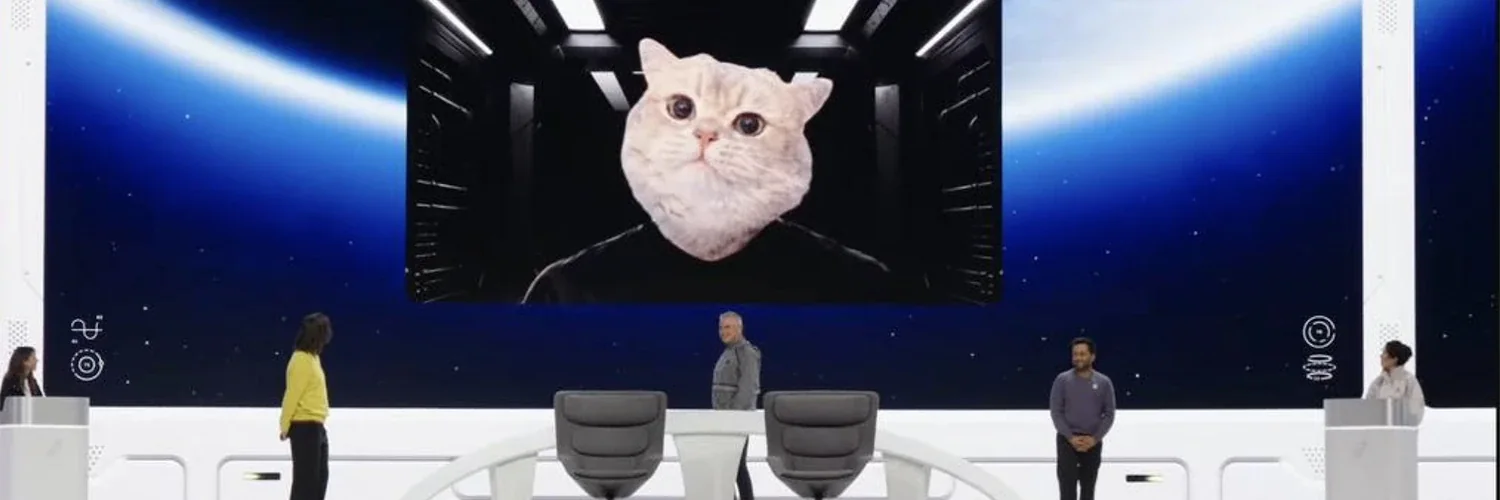
In the official broadcast, the team occupies a starship bridge with command chairs, white consoles and a panoramic screen. Tenev plays the captain. Demonstrations alternate with a plot in which a hostile ship threatens the crew. Around minute 41, the Vrax are introduced as a civilization that began with ideals of decentralization before seeking to control markets. This is the conference’s satirical story, not a description of a real organization. [3]
The commander then appears remotely. His entrance uses a familiar mishap: he speaks without being heard, then claims to be using frequencies beyond human hearing. The scene makes his authority ridiculous before the cat arrives. It also provides an adversary for the products being presented: within this advertising fiction, each tool becomes a way of resisting those who close markets. [3]
The great enemy reduced to a cat’s head
Around 1:13, the commander returns with absurd one-upmanship. Robinhood’s longer trading hours prompt a promise of even longer hours; a twenty-four-hour market is answered with twenty-five hours. Then his face becomes feline and he protests that he is not a cat. The punchline turns a recurring threat into an easily isolated image. [3]
The token’s artwork preserves that contradiction. A cream-coloured head, large eyes and a small pink nose sit above a dark outfit against a metallic backdrop. The banner still shows the crew facing the giant screen; the logo tightens the crop around the face. One tells viewers where the image came from, while the other makes it recognizable in a token list. [4]
Our reading of the joke rests on this mismatch: the commander continues defending his rank while his appearance undermines him. Understanding the scene does not require following every product announcement. The official post subsequently supplies a name and caption for people who have only encountered a screenshot.
One scene, several interpretations
The replies do not all tell the same meme story. At 01:31, L4VA compares the commander’s appearance with Brian Armstrong. At 01:47, Beeradtv invokes Roaring Kitty, insisting there is only one cat. These associations belong to the participants: they establish neither that Armstrong plays the role nor that Keith Gill is involved. [12] [13]
At 01:57, Schyrs points out a different contradiction: the character has just said he is not a cat. The comment preserves the punchline instead of inventing another identity. Between a joke about a competitor, memories of another market cat and a line from the sketch, the community creates multiple ways into the same image. [9]
This collective work contributes more than repetition of a ticker. It supplies nicknames, comparisons and minor disagreements. The character is already becoming more than a presentation prop: different accounts use him as a surface onto which they project their own market culture.
The contract enters the conversation
At 01:33, Happy Doge Solana quotes the official message and attaches the contract examined here. The account characterizes Robinhood’s action as promotion of the cat. That is its interpretation; the quoted post discusses the character and does not recommend this token. At 01:40, WNB thanks Robinhood and Vlad Tenev for the presentation’s ending, adding the same address. Those participants connect the image with this asset; Robinhood does not announce its issuance. [5] [8]
DEX Screener identifies Commander Vrax, ticker VRAX, on Robinhood at 0x94641b97010608c3827fb058074889f19868ff33. It dates the tracked VRAX/USDG pair to September 30 at 01:29:23, roughly twenty seconds after the official post. That timestamp documents the indexed pair; it does not identify the contract’s creator or establish coordination with the company. [4]
The listing itself uses Robinhood’s post as its social link. This points readers back to the character’s origin, but does not make that account an official token account. The sources reviewed do not establish that Robinhood issued or endorsed this contract.
From a joke to market-cap targets
At 02:10, Ottodix says he has bought VRAX, mentions a $3.5 million market cap and targets at least $50 million. His market link contains the exact contract. At 03:42, 0xSenku includes the same address, compares the story with Cashcat and advances a $100 million projection. These are self-reported positions and promotional targets, not demonstrated trajectories. [10] [11]
The posts reveal a change in register. The first audience laughed at a cat’s head; these participants now seek a comparable valuation and a potential market size. Cashcat supplies a precedent in their argument. The comparison establishes neither a common team, equivalent adoption nor an identical future. It shows what buyers want to see in the character.
At 09:49, a new morning peak
The observation supplied to the editorial team places the ATH at $11.36 million on September 30, 2026, at 09:49:27 Paris time. It follows the official post, the first connections with the contract and the projections from Ottodix and 0xSenku. This chronology situates the rise within a documented conversation; it does not measure the individual impact of any post.
VRAX chiefly illustrates how quickly a product launch can supply markets with a character. Robinhood writes the scene, its account publishes the punchline, and participants give it a contract and ambitions. The commander has lost his threatening face. He has gained a second story, without the company having claimed to create that story’s token.
This week’s reference
The weekly selection supplied to the editorial team retains $360,657 at the signal and $11,361,126 at the maximum, or 31.50x, for this contract. This maximum supplements the dated references above; the ranking supplies no new timestamp for it. It is an observed market-cap amplitude, not a return realised by every holder.
Written by Jérôme L.
OFY, the card that wants to leave savings alone

OffYield arrives on Robinhood Chain with an easily understood idea: spend the interest without spending the deposit. Between a USDG vault, prepaid cards and questions about the token’s role, its launch opens a discussion about what a crypto “neobank” actually delivers. Reported ATH: $2.41 million on September 29 at 21:05 Paris time.

At 21:00, a question behind the card
What does holding your token actually do for its holder? That is the question Sllab asks in the replies to OffYield’s launch at 21:00 on September 29. The website describes a working deposit, interest becoming spendable and a card. But where does OFY fit into that arrangement? The question runs through the project’s first evening. [18]
Five minutes later, according to the observation supplied to the editorial team, its market capitalization reaches $2.41 million. The proximity of those timestamps establishes no causality. It locates a discussion already accompanying the rise: an application can attract interest through its use case while leaving open the value it brings to token holders.
A launch borrowing fintech’s visual language
At 20:08, @offyield announces OFY with the exact contract examined here. DEX Screener dates the main OFY/ETH pair to 20:08 as well. The website displays the same address. These matches connect the market under review to the project’s communications, beyond a name or ticker that could be reused elsewhere. [14] [15] [17]
The promotional artwork shows a pastel card suspended above a payment terminal. Little text, ample white space, a chip and the familiar contactless gesture: we read these as the visual conventions of a financial application intended for everyday life. OffYield turns that promise into a name: living off what savings generate instead of drawing them down.
At 21:08, Poti compares the project with Avici and asks whether it signals a Robinhood neobank trend. This is a participant’s comparison, not an established relationship. The word chiefly places OFY in a readily understood category. OffYield nevertheless states that it is independent of Robinhood, Morpho and Paxos. Building on a chain does not make the application their banking service. [15] [19]
Two balances, one rule and a lending market
The documentation describes an application that does not hold users’ keys, in early access with deposit caps. A user supplies USDG; the vault is intended to route it into the Steakhouse USDG vault on Morpho. Interest comes from lending, at a variable rate. Principal and available yield are accounted for separately: an excessive charge should be rejected rather than topped up from the deposit. [16]
That separation is the core of the proposed product. It gives a savings discipline a concrete form: the spending balance should not consume the reserve. It does not mean the reserve is protected from every loss. The documentation explicitly anticipates that losses in the underlying market may reduce recoverable value, and says deposits have no government-backed bank insurance. [16]
Another essential distinction is that deposits and interest never pass through OFY, according to the website. Buying the token therefore does not amount to depositing USDG in the vault. The two actions carry different expectations even though the brand brings them together. This supplies an initial answer to Sllab: the token’s utility must be sought somewhere other than the production of lending interest. [15] [16]
Some cards available, others still promised
The documentation presents prepaid cards supplied by CryptoRefills and a reloadable card still in development. It sets out constraints that a banner cannot communicate: online use, product-dependent fees and the absence of 3-D Secure, which can cause some merchants to decline payments. Its example uses about $33.60 of interest to purchase a $30 prepaid Visa, including fees. [16]
At 21:29, the team announces physical cards for the fourth quarter and reloadable cards around the following week. It also says its non-reloadable cards work with Apple Pay and Google Pay. These are the team’s availability claims and timetable; we did not purchase a card or execute a payment to test them. BOLD specifically says in the launch thread that the cards are what attracts his attention. [20] [26]
The same announcement says card purchases are now open even to people who have not generated yield. This broadens the original pitch. The vault offers spending from interest; the shop also wants customers who prefer not to wait. The project thus combines a savings tool with more immediate card access, two uses that need to be separated when reading its reported figures. [20]
Cashback enters the token debate
At 21:40, OffYield claims roughly $9,000 in cards and $250 in cashback paid during its first hour. The account says accessing 5% cashback requires connecting the wallet holding OFY to the dashboard and purchasing a card there. These are team-reported figures, not independently verified sales or evidence of a sustainable token return. [21]
The documentation still discusses this cashback in the future tense, while the post says it has started. That update gap is useful to identify: the pages should not all be treated as describing exactly the same product stage. The documentation also says cashback is funded separately from deposits and their interest. [16] [21]
Reactions extend beyond enthusiasm. In the launch replies, @vvalter argues that establishing a company and connecting a card provider are insufficient to make the offering distinctive. This challenges differentiation; it does not establish that the product fails to work. It nevertheless raises the commercial question behind the narrative: why retain this application rather than access similar services elsewhere? [27]
What the security review actually covers
At launch, OffYield describes itself as a Wyoming-registered LLC and invokes Shieldify to reassure readers about its code. The document available in Shieldify’s repository supplies a narrower scope: a review dated September 11 covering OffyieldVault.sol. It lists two medium, four low and six informational findings, all marked fixed in its summary table. [22] [23]
That report documents work on the vault. It does not by itself certify the entire card shop, every integration or the identity of the code actually deployed. The project’s company-registration claim does not establish banking status either. These materials make assertions more examinable without turning “audited” into a blanket guarantee. [22] [23]
After $2.41 million, delivering the timetable
The evening continues after the reported peak. At 22:08, the account announces work on an Android application; at 22:38, it publishes a preview described as showing the interface and code. These posts follow 21:05. They extend the story and cannot be presented as the triggers of that particular market milestone. [24] [25]
The ATH retained is the observation supplied to the editorial team: $2.41 million at 21:05 Paris time on September 29, 2026. OFY has found an immediately legible proposition: a card that leaves savings alone. Its next chapter will depend on more concrete questions about what ships, what using it costs and what the token contributes once the novelty of launch fades.
This week’s reference
The weekly selection supplied to the editorial team retains $182,660 at the signal and $2,416,409 at the maximum, or 13.23x, for this contract. This maximum supplements the dated references above; the ranking supplies no new timestamp for it. It is an observed market-cap amplitude, not a return realised by every holder.
Written by Jérôme L.
BOTBOOK: the book with missing public pages

An identified contract and observed maximum remain. The associated channels no longer support reconstructing a product promise with comparable precision.
The address remains; the links do not
Market metadata associates BOTBOOK — Botbook with contract 0x00a6075b0487877eb83687c90d7643c3524a8601 on Robinhood Chain. It supplies a name, image, market and two presentation leads: trybotbook.com and @trybotbook. During October 4 collection, the website returns a 404 error and X says the account does not exist. This describes those channels at that date; it establishes neither when they disappeared nor who removed them. [28] [29] [30]
The name might suggest an agent directory, social network or notebook. None of those functions can be attributed to the token merely from “book”. Without recoverable documentation or an authenticated initial publication, turning the suggestion into an application description would invent the missing page.
A discussion that has turned critical
A contract search retrieves @basecatfanbase publications on October 3 and 4. The account criticises the token and questions legitimacy conferred by tracking tools. It refers to an “alleged rug pull”. This is that account’s allegation, not a finding established by our collection. We have not reconstructed the transactions needed to conclude that liquidity was fraudulently withdrawn or identify a responsible party. [31]
The response nevertheless supplies a dated piece of reception. The public story extends beyond a name promising bots to whether that name can be verified. Automated tracking can display a technically existing market without certifying the surrounding product. A token entry and editorial validation have different meanings.
Other results include reward claims on external websites. They are not retained as team publications. Repeating a contract does not establish continuity with its creator, and a rewards link does not replace missing documentation.
The maximum remains a market observation
The supplied selection retains $95,636 at the signal and $922,473 at the maximum, or 9.65x. The ratio describes an observed capitalisation maximum for that address. It establishes neither that a buyer could exit an entire position at the same multiple nor that a Botbook product operated.
The address must also remain separate from DOTS — Dotsbook, further down the ranking under another contract. Similar names cannot combine their histories or results. Here the contract is the only stable thread between market metadata, an observation and identifiable reactions.
This dossier’s limitation is specific: collection finds the market and critical discussion, but no initial launch announcement or still-accessible documentation describing a service. That absence belongs in the story. It recalls what a price rise cannot restore: pages, people and actions that would explain what was actually promised.
Written by Jérôme L.
TAOLAUNCH: giving Bittensor narratives a market

Discover a subnet, compare its reserves, then launch a token around its thesis: the project joins three actions across networks that must be distinguished.
From intelligence to a marketplace
On September 29 TAOLaunch publishes an article presenting Bittensor as an economy of specialised intelligence. Inference, data, research, agents and infrastructure represent different theses. It starts with a discovery problem: finding subnets, comparing their economics and gathering their communities requires navigating several tools. TAOLaunch promises to combine that experience in one interface. [32]
The proposition goes beyond launching a memecoin. It treats subnets as subjects of conviction, with discovery, comparison and a community market. This issue’s token, 0x0441a16767215fe33056a0fb9ce2e4dee842fa8f, is identified on Robinhood Chain by market data. That address must be retained: announcements about other networks describe product capabilities, not a demonstrated migration of this contract. [33]
A name and NetUID are not a guarantee
The website allows subnet searches by name or NetUID, their Bittensor identifier. The September 29 article announces 128 browsable subnets and indicators such as alpha price and TAO reserves. That count belongs to the project’s dated presentation; it is not an independent census of all active subnets at this issue’s close. [32]
The documentation makes a useful distinction between a community launching an EVM token and the subnet it chooses to reference. A NetUID association must be checked when displayed. It means neither ownership of the subnet nor approval by its operator, nor a right to redeem the token for alpha. A narrative can align with an intelligence activity without constituting title to it. [34]
This separation prevents a hasty reading of “intelligence as a reserve”. A market can use a subnet-related asset as its liquidity pair without making every associated token a financial claim on the subnet’s entire activity. A pool reserve and a communications subject remain different objects.
Battles compare rather than crown
Subnet Battles places two subnets side by side: alpha price, TAO liquidity and associated markets. Its stated purpose is to show where capital and attention move. On the page consulted, some data is unavailable. A missing number must remain missing rather than being replaced by an invented ranking. [35]
The project says its index uses finalised state and recovery checkpoints. A temporary indexing interruption can therefore differ from a market’s disappearance. That gives an on-screen freshness claim a precise meaning: the last displayed state can be consistent without being the state of the present second. A comparison must also consider dates and data availability. [34]
Among replies to the pinned article, one reader says the impersonal publications make them nervous. Another, on October 3, complains that the project did not sufficiently involve the TAO community. These are individual responses, not a representative verdict. They nevertheless expose tension between an interface claiming community and the way it addresses that community. [32]
Three networks within one interface
The documentation distinguishes several routes. A launch on Bittensor EVM uses native TAO on chain 964. The creator configures the token and supplies opening liquidity; the website describes a permanently locked pool without a bonding curve. On Robinhood, TAO pairs use bridged TAO. Subnet alpha must use canonical wrapped assets admitted by the platform. [34]
A separate page describes funding from Base in USDC, with a 5% price-impact limit and delivery tracking separate from the initial transfer. A wallet debit alone therefore does not prove arrival of the destination asset. These stages form a funding route, not a single product interchangeable across every chain. [36]
Robinhood Chain has its own official configuration: mainnet 4663, an Arbitrum-based infrastructure and ETH for gas. The retained token’s presence on that network must not be confused with a listing in the Robinhood app. The magazine label describes the contract’s chain, not a selection by the broker. [37]
From demonstrations to contributions
On October 3 TAOLaunch presents its first niche as Robinhood subnet-alpha markets while announcing native Bittensor liquidity and Bittensor EVM. On October 4 a demonstration shows the launch route, from visual identity through liquidity to review before deployment. The account also promotes bounties for builders and contributors. [38] [39]
The progression matters because it shifts the effort. A manifesto supplies vocabulary; a demonstration shows an action; a bounty seeks people able to extend it. An announced program, contributions actually received and markets actually used still need to be distinguished. A locked pool alone does not establish an active community product, and contract verification is not a protocol audit. The risks page reiterates those boundaries. [40]
The observation supplied to Trenches On retains $114,014 at the signal and $900,286 at the maximum, or 7.90x, for the specified Robinhood contract. It places the platform token in the weekly ranking; it does not measure subnet gains or Battles users’ results. TAOLaunch opens a market experiment around specialised intelligence. Its substance will depend on the quality of displayed associations, the clarity of the assets used and communities doing more than reading the manifesto.
Written by Jérôme L.
The sources, a click away.
Numbered references in the articles point to this list. External links open in a new tab.
- Robinhood — Commander Vrax becomes a cat, 30 September, 01:29 Paris time
- Robinhood — Houston HOOD Summit announcement, 10 August 2026
- Robinhood — Engines of Creation official broadcast; Vrax around 41 min, cat scene around 1 h 13
- DEX Screener — VRAX / USDG on Robinhood, contract and token images
- Happy Doge Solana — official post and contract connection, 01:33
- Krog — “Pawmander Vrax”, Robinhood reply, 01:37
- Pons — Robinhood reply, 01:38
- WNB — presentation ending reaction and exact contract, 01:40
- Schyrs — character line remark, 01:57
- Ottodix — declared purchase, market cap and VRAX link, 02:10
- 0xSenku — promotional Cashcat comparison and exact contract, 03:42
- L4VA — interpretation of character resemblance, 01:31
- Beeradtv — Roaring Kitty reference in replies, 01:47
- OffYield — launch and contract, 29 September, 20:08 Paris time
- OffYield — official site and product presentation
- OffYield — vault, yield and risk documentation
- DEX Screener — OFY / ETH, Uniswap v4 pair on Robinhood
- Sllab — token utility question, 21:00 Paris time
- Poti — Avici comparison, 21:08 Paris time
- OffYield — physical reloadable cards and purchases open, 21:29 Paris time
- OffYield — stated card figures and cashback, 21:40 Paris time
- Shieldify — OffYield security review, 11 September 2026
- OffYield — company and audit presentation in launch thread
- OffYield — Android development announcement, 22:08 Paris time
- OffYield — mobile application preview, 22:38 Paris time
- BOLD — declared interest in card release
- 匿鱼 (W) — product differentiation criticism
- DEX Screener — BOTBOOK exact contract
- Botbook — associated site, unavailable on 4 October
- Botbook — associated profile, absent on 4 October
- BASECAT — critical response, 3 October
- TAOLaunch — founding article, 29 September
- DEX Screener — TAOLAUNCH contract
- TAOLaunch — product documentation
- TAOLaunch — Subnet Battles
- TAOLaunch — funding route
- Robinhood — network configuration
- TAOLaunch — Robinhood and Bittensor paths
- TAOLaunch — launch demonstration, 4 October
- TAOLaunch — risk disclosures
The week’s top 10 performances
| # | Token | Performance | MC at signal | Retained maximum MC |
|---|---|---|---|---|
| 1 | VRAX — Commander Vrax0x94641b97010608c3827fb058074889f19868ff33 | 31.50x | $360,657 | $11,361,126 |
| 2 | VRAX — Commander Vrax0xc6080ea62997b33c8e46360850cb4473913b61f0 | 16.02x | $85,466 | $1,369,256 |
| 3 | OFY — OffYield Neobank0xfd1a35778d9798f13c6fb97d29c07a5ce3f7fb5e | 13.23x | $182,660 | $2,416,409 |
| 4 | BOTBOOK — Botbook0x00a6075b0487877eb83687c90d7643c3524a8601 | 9.65x | $95,636 | $922,473 |
| 5 | TAOLAUNCH — TAOLaunch0x0441a16767215fe33056a0fb9ce2e4dee842fa8f | 7.90x | $114,014 | $900,286 |
| 6 | DelveTown0x1bb3f098c0aeb29d0430554881d4e908ac390ba3 | 7.19x | $124,109 | $891,926 |
| 7 | DOTS — Dotsbook0xe52c003f1a3abe8839447b1674d7bda62047a8b4 | 5.12x | $261,323 | $1,338,728 |
| 8 | ROBINHOOD — Gta6HaalandRizzler420690xeec414174f7dcba9e3aa1672a1cf57078e65ae28 | 4.96x | $194,131 | $962,829 |
| 9 | MOONLET — Moonlet0xcace05716778f86e4feb04bd7a2c2f2c31705f2b | 4.48x | $127,140 | $569,549 |
| 10 | NEPTUNE — neptune0x82f80846196f6067570588877d97dd6d06494ba8 | 3.88x | $121,708 | $472,555 |
Performance = retained maximum MC / MC at signal. Weekly figures supplied by the publisher. The two VRAX rows represent distinct contracts.
Make this issue yours.
The same edition, wherever you want to read.