The meme looks for a second life.
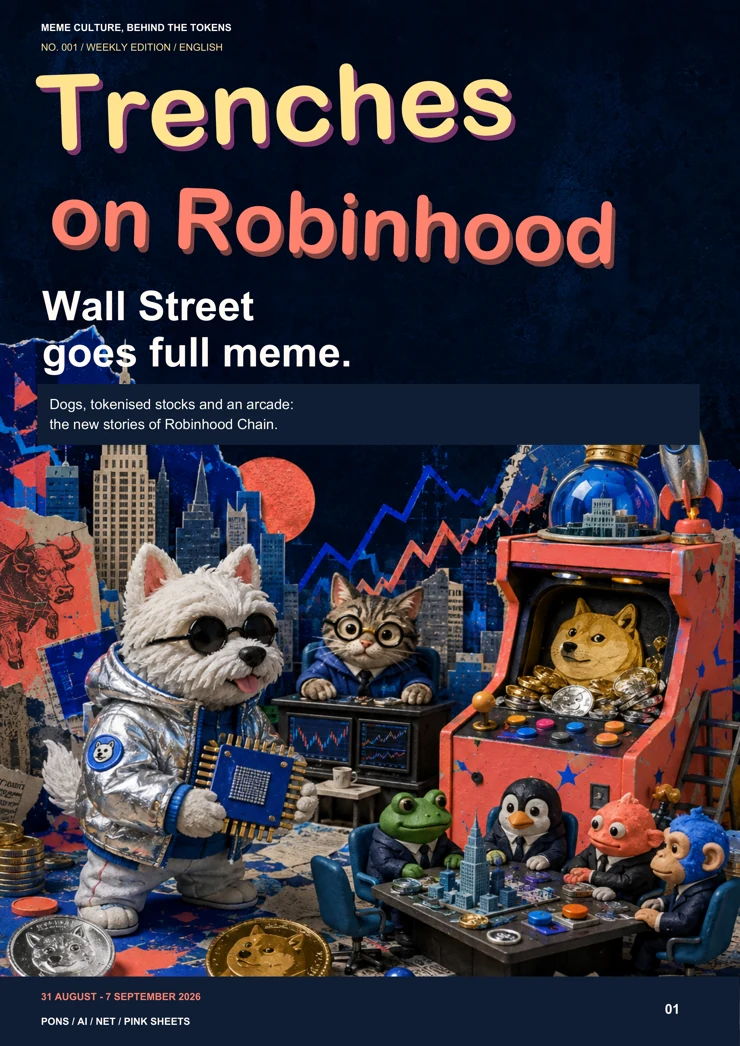
On Robinhood Chain, the story is moving beyond stock pairs. Tradable revenue, a laboratory experiment and a social game enter the conversation.
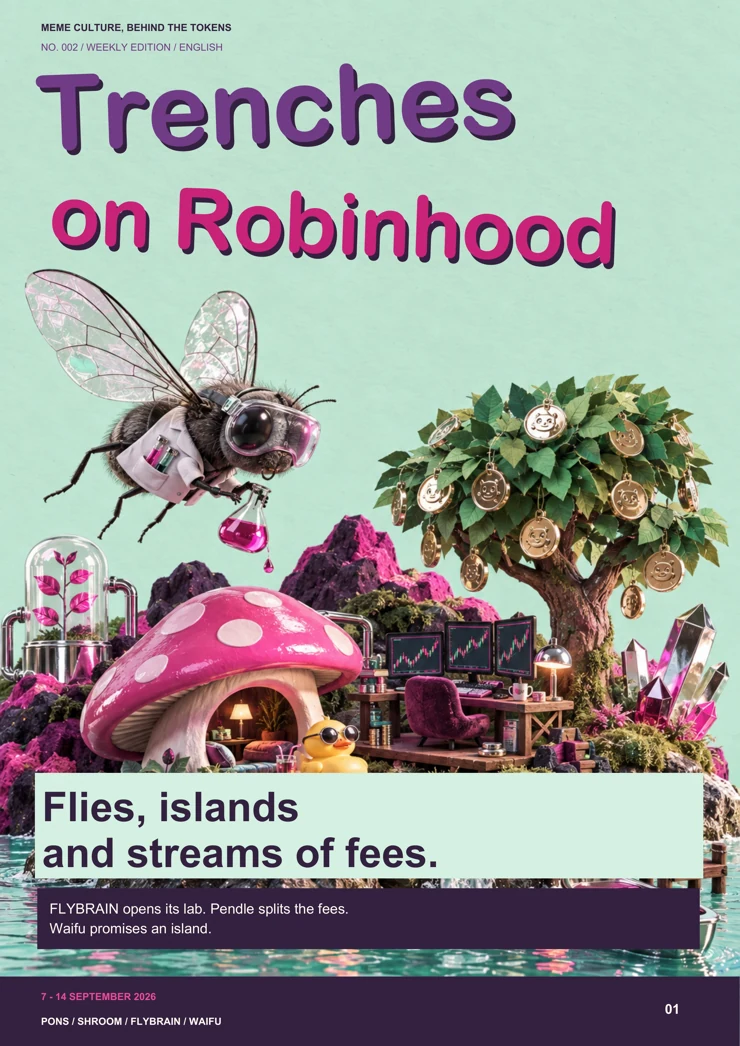
A fly about to receive a body. A mushroom whose fees can be traded separately. An island to join with friends. This week's posts resemble a cabinet of curiosities, yet describe three concrete ways to keep attention around a token. [4] [8] [11]
Pons remains the shared setting. The platform now claims $12 billion in volume over two months and more than $100 million earned by creators. These announced totals reach well beyond our weekly window. We treat them as new milestones in its public story, not as the proceeds of this week alone. [1] [2]
Visiting project websites is especially useful this time. FLYBRAIN explains that its fly does not think up the messages posted in its name. Waifu still directs visitors to a waitlist. Pendle describes the fee streams behind its markets. In each case, the mechanism is more precise, and sometimes less spectacular, than a summary on the feed might suggest.
Issue two follows these subjects on their own terms. An artistic experiment, a financial product and a proposed game are at different stages and require different evidence. They share a simpler ambition: having caught the eye, each wants a reason to hold it.
 The Trenches On editorial team
Pons scales up its story.

Twelve billion dollars over two months: Pons's latest milestone signals platform ambition. The counter still needs to be read correctly.
On 13 September, Pons posts a new headline figure: $12 billion over two months. It presents itself as Robinhood Chain's leading launchpad and highlights Uniswap v4. Two days earlier, it announced more than $100 million earned by creators in tokenised stocks, ETH, USDG and other assets. The scale of its messaging has changed. [1] [2]
Those milestones measure different things. Volume adds up trades, including when the same capital circulates repeatedly. Creator earnings refer to a fee stream attributed to one group of participants. Neither can be read as every user's profit, capital retained in the ecosystem or the PONS token's performance.
The clocks matter too. The first report's two months extend far beyond our week. On 12 September, Pons uses another window, claiming 65% of launchpad RWA volume over 30 days. That share depends on the chosen scope and remains the project's own statement. It does not mean 65% of the entire global tokenised real-world-asset market. [3]
The reporting interest lies in the shift of pitch. Pons is no longer only presenting a place to launch a coin. It wants to be the infrastructure through which stock references and community revenues circulate. Pendle's announcement, covered on the next page, offers a concrete example of what others can build around those fees. [4]
The catalogue remains another way to draw attention. On 13 September, Pons asks readers which tickers they want next. It is a simple way to involve the community in a future announcement, while stressing how central pairing assets have become to meme creation. The post is not a list of new markets already available. [16]
The next milestone needs judging beyond cumulative counters: comparable activity over a fixed period, varied uses and markets that stay alive. This week, Pons mainly strengthened its place in the network's imagination. Within that growth story, the shares going to creators, holders and the platform itself still need separating.
Cumulative turnover is not cash in the till.
The mushroom splits its income.

Pendle introduces markets for fees from Pons tokens. The meme keeps its mascot, while part of its economy becomes separately tradable.
On 11 September, Pendle announces Pons assets on its platform, naming SHROOM and microduck. This is more than adding two tickers to a list. The accompanying thread explains that trading generates fees, part of which periodically goes to holders. That flow supplies the raw material for the new markets. [4] [5]
Separation is the product's core. Pendle describes YT as a way to take a position on future fees, and PT as acquiring principal at a discount. This is yield-market language, not a promise of automatic profit. The purchase price, maturity, fees actually generated and contract risks remain decisive. [6]
SHROOM makes the mechanism less abstract. According to Pendle, it is paired with MU, with part of the fees paid in that tokenised stock asset. A holder can therefore face several exposures at once: meme trading activity, the yield product's structure and movements in the distributed asset. A charming mascot does not necessarily simplify the economy behind it. [7]
SHROOM shares the announcement on X that same day. The repost shows the integration entering the project's public identity. It does not, by itself, demonstrate mass adoption. We do not treat a displayed yield as a lasting rate, or this post as evidence of a listing in Robinhood's brokerage app. [17]
The distinction from a share also deserves to stay visible. Robinhood describes Stock Tokens as providing economic exposure to underlying securities without legal or beneficial rights to them. Adding a meme and a fee market above that layer does not erase the differences between the products. [15]
What makes this episode interesting is the meme's second life. A community can discuss not only its coin's price, but the value the market assigns to future trading. That bet still rests on a simple condition: people keep buying and selling. If attention leaves, the flow supporting the story may shrink with it.
The future of trading fees is on the market, too.
The fly and its narrator.

FLYBRAIN brings a laboratory into the trenches. Its own site separates the scientific experiment, public character and token.
![Simulated fly body published by the project. This render does not prove autonomous locomotion. [9]](../assets/fly-body.png)
On 13 September, Fruit fly dev announces that its fly's brain will receive a body. The sentence creates a character: a tiny digital being gaining new possibilities. But FLYBRAIN's site describes a more precise experiment, with tests, limits and results that resist the headline's pull. [8] [9]
The token can be identified. LBank's 11 September announcement names FLYBRAIN on Robinhood Chain, links to flybrain.online and publishes contract 0x4Eb990547BCe4a982432CA88Cf5fae7EED1A2d35. The metadata consulted match that site and the Fruit fly dev account. This avoids confusion with other fly projects without turning an exchange listing into a quality certificate. [13]
In its update dated 13 September, the lab describes a model built from a fruit-fly connectome and a simulated body. The therealfly repository says the selected test for producing a walking rhythm failed. Later stages are not presented as locomotion already achieved. Publishing an anatomical model or rendering a standing fly is different from making it walk through this mechanism. [9] [10]
The site is equally explicit about the character's voice. First-person posts are written by a language model using telemetry. The simulation does not read, form opinions or choose words. That removes an illusion but reveals a more interesting cultural construction: an audience follows a narrator giving measurements a human voice. [9]
Available code offers a route to scrutiny, not a universal guarantee. The therealfly repository specifies offline science, with no blockchain or wallet interaction. We have neither reproduced the experiments nor audited the token. The repository's existence alone cannot substantiate every story of autonomous decisions that the mascot might inspire. [10]
FLYBRAIN lives in that gap. A tiny fly carries a very large story; the visible work provides testable questions. The most interesting next step may not be another slogan. It may be a result the laboratory can show, together with its conditions and limitations.
Simulated neurons do not write the posts.
Waifu promises an island to share.

Friends, a tree and rewards in memes and tokenised stocks: the 12 September announcement offers a new setting for community economics.

On 12 September, Waifu invites readers to join an island with friends, grow a tree and compete for rewards in memecoins and tokenised stocks. The post links to a waitlist. It shows a product direction; it does not let us visit an open game or establish that rewards have already been distributed. [11]
The setting is revealing. Where a price board leaves readers alone with their decisions, an island promises shared appointments and visible progress. A growing tree can tell the story of time spent together. That social appeal, more than any particular ticker, distinguishes the announcement.
That day, Yen shares the project and imagines group chats becoming competitive. It is favourable anticipation, not feedback from someone who has used the product. It nevertheless shows one way the idea is received: the game is being sold as a future activity for groups that already exist. [12]
Replies to the original post mix signup confirmations, practical questions and requests for a release date. They document interest without providing an active-player count. We therefore keep views, replies and users distinct, and do not infer a token launch from the account name WaifuToken. [11]
The reward mix still needs examining. A tokenised stock, a memecoin and progress in a game have different properties. Distribution rules, asset origins, access conditions and exit options are needed to understand the proposed economic experience. The first announcement does not answer every question, and we do not fill in the gaps for it.
That does not diminish the story's interest. Waifu is trying to move attention from a one-off launch towards repeated activity with friends. If the product arrives, the test will be whether people willingly return to the island. At our weekly cutoff, this second life for memes remains a promise to follow, with a concrete entrance: a waitlist.
For now, the island is an invitation.
The sources, a click away.
Numbered references in the articles point to this list. External links open in a new tab.
- Pons: cumulative two-month volume
- Pons: cumulative creator earnings
- Pons: 30-day RWA volume share
- Pendle: SHROOM / microduck announcement
- Pendle: trading-generated fees
- Pendle: PT / YT separation
- Pendle: SHROOM and the MU pair
- FLYBRAIN: simulated-body announcement
- FLYBRAIN: laboratory and limitations
- FLYBRAIN: therealfly repository
- Waifu: announcement and waitlist
- Yen: Waifu commentary
- LBank: FLYBRAIN identity and announcement
- Robinhood: chain configuration
- Robinhood: Stock Token rights
- Pons: future pair catalogue
- SHROOM: integration repost
Make this issue yours.
The same edition, wherever you want to read.