Every market has its characters.
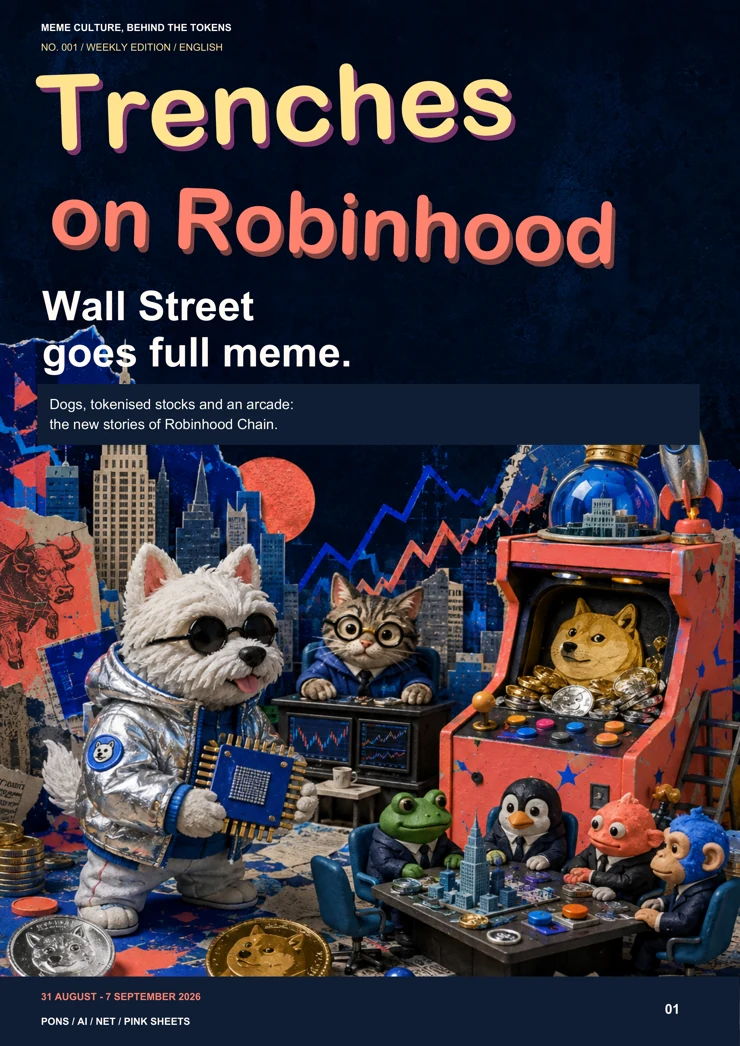
On Robinhood Chain, stock-market language meets crypto community culture. This week shows how far the combination can go.
A dog paired with NVIDIA, a project addressing its 'shareholders', a platform expanding its stock-pair catalogue: Robinhood Chain has attracted more than tokens. It offers projects a setting and a language to make their own.
The setting is real. The network documentation describes an Ethereum layer-2 blockchain built on Arbitrum, with fees paid in ETH. But the stories taking root there belong to their authors. An application operating on this network is not, by that fact alone, a Robinhood-approved product. [1]
This week is revealing. Pons promotes its pairs and volumes; Artificial Inu links its mascot to the world of NVIDIA; NetNet turns the trading floor into an arcade. Then Pink Sheets announces a service for block trades. Very different things are being presented in the same financial language.
This first issue follows those distinctions. The network is not the brokerage app, and a meme is not the stock it evokes. Much of the story unfolds between familiar names and unfamiliar mechanisms.
 The Trenches On editorial team
The stock market as a catalogue.

Pons offers meme creators a familiar raw material: the names and worlds of traditional markets.
![Pons artwork announcing additional stock references. [2]](../assets/pons-art.jpg)
On 4 September, Pons publishes a new list of references available for creating pairs, including SLV, BABA, F and INDA. The post talks about the evolution of financial markets. For meme communities, it mainly opens up a new set of starting points. [2]
Each reference arrives with a story. A technology company, a carmaker and a geographic exposure evoke different images. Pairing a token with one of them lets it borrow a vocabulary, an existing audience and sometimes a controversy. An asset catalogue becomes a catalogue of possible narratives.
Pons accompanies that expansion with numbers. Overnight on 3-4 September in Paris, the project says creators have earned $34 million in fees, paid in various supported assets. On the 6th, it credits its tokens with 73.5% of the network's launchpad volume over 24 hours. Later, it claims more than $842 million in RWA volume on v2 since its release the previous month. [3] [4] [5]
These figures cover different periods and scopes. They cannot be added together or treated as interchangeable measures of success. For this reporting, they remain platform claims: we have not reconstructed the underlying flows.
The most important distinction lies elsewhere. Robinhood's issuer describes its Stock Tokens as tokenised debt securities providing economic exposure, without legal or beneficial rights to the underlying securities. A meme paired with a Stock Token is a different instrument again. The visual shortcut between a mascot and a stock must not erase those layers. [16]
Pons's narrative works because it makes this world feel familiar. Users recognise the names before reading how the mechanism works. The question now is whether projects build lasting uses around those references, or mainly find new ways to move attention from one to another.
A pair can borrow a story. Not every right that comes with it.
The dog watching NVIDIA.

Artificial Inu turns a stock-market reference into a group identity, where the dog meme meets the AI narrative.
![Artificial Inu stages its machine-age folklore, 5 September. [7]](../assets/ai-art.jpg)
Artificial Inu's profile supplies the key immediately: the ticker is AI, with an announced NVIDIA pair. Its mascot wears glowing glasses; its imagery borrows from laboratories, machines and science fiction. The project speaks about finance in the language of a fan community. [6]
On 5 September, it frames that ambition as financial folklore for the machine age. This is not a presentation of an artificial intelligence model. It is a cultural pitch: give a stock-market exposure a personality, imagery and language that people can reuse on X. [7]
On 7 September, the account returns to liquidity depth and NVDA's pull. It also amplifies talk of capital allocators arriving. That adds a financial dimension to the character, but amplification alone proves neither the identity of those investors nor the amounts involved. [8]
The address published in the profile's community matches a pair identified as Artificial Inu on Robinhood Chain in the data consulted. The same record links to the X account and artificialinu.com. That correspondence identifies the subject of this article; it is not a quality seal. [18]
The narrative is more specific than simply using the label 'AI'. NVIDIA supplies an instantly legible reference: computing power, chips and the rise of machines. The dog turns it into belonging. People can display the mascot, share an image and join the conversation without sounding like an equity analyst.
That familiarity has limits. Nothing examined here establishes an affiliation between the project and NVIDIA. The announced pair does not make AI a share in the company, and the mascot is not an AI service. The story thrives on mixing these worlds; understanding it requires keeping them distinct.
Here, AI is an imaginative world before it is a feature.
The trading floor opens an arcade.
With Dial Up, NetNet makes its ambition explicit: bring trading, gaming, gambling and prediction into one world.
'Dear shareholders': at NetNet, even a game announcement opens like a letter from management. On 7 September, the project introduces Dial Up, the latest experience in its Play Cabinet series, with an intentionally outsized pitch: stated leverage of one million times the stake. [9]
The next post gives the announcement its real shape. According to the project, a round lasts 60 seconds; the player chooses a ticker and a direction. The outcome is presented as binary: win or be liquidated. 'Trading' is the framing for an experience the thread also explicitly calls a game. [10]
The token is more than interface decoration. NetNet says USDG deposits buy NET, which is staked and wrapped into wsNET. Winnings would be paid in that asset. Part of the losses feeds a jackpot; the house share would be burned periodically. This is the project's account of the mechanism. This reporting has not verified the odds, liquidation rules or contracts. [10]
That architecture explains why the launch is also a token story. Players arrive for a brief experience, but that experience is built around an asset and its flows. In the thread's final post, NetNet explicitly claims a convergence of trading, gaming, gambling and prediction. [11]
Two days earlier, the project said it had added $12 million to its treasury in 24 days. The register is the same: a community addressed as shareholders, headline-making amounts and a product programme that keeps anticipation alive. The figure remains NetNet's own claim. [12]
Dial Up is interesting for its candour. Rather than quietly adding game elements to a market, it makes that meeting its identity. The leverage headline is therefore only a starting point. Readers first need to understand the game, its settlement asset and the way losses feed the system.
60 seconds: NetNet's stated round duration.
Big orders want a different door.

Pink Sheets offers a counterpoint to the mascots: on the same network, some projects want to talk about execution rather than virality.
At 23:02 Paris time on 6 September, a new account announces that Pink Sheets is coming to Robinhood Chain. Its pitch is a block-trading desk for transactions that do not fit comfortably in a pool. The post links to a signup list. [13]
The announcement matters for what it assumes. If tokenised stocks become raw material for onchain activity, the demand is not only for more tokens. Some users may want a different way to execute large orders. Pink Sheets positions itself around that need; the post does not yet demonstrate that its service operates at the promised scale.
We are covering a planned service, not a memecoin for which we have identified a contract. Its name borrows a familiar reference from US markets. As with mascot-led projects, familiarity does some of the work: readers get a sense of the intended role before they have seen the product.
Around these announcements, rankings also shape the network's conversation. On 2 September, RobinHub places Pons, NetNet, Artificial Inu and several protocols in its 'Blue Chip' category. On the 5th, Whale Insider relays a record 24-hour DEX volume. These are editorial or promotional statements, not official categories or measurements reconstructed by this publication. [14] [15]
The trap is to mistake proximity for equivalence. Appearing in the same list as an established protocol does not give a project the same status, history or mechanics. Trading volume does not tell us how many distinct people are involved, or what they came to do.
The week ends with a question more useful than another ranking: which uses will remain once the first stories stop surprising people? Memes bring communities and images; projects such as Pink Sheets promise a service. Future announcements will show how those ambitions meet.
A signup list begins a story. It does not prove adoption.
The sources, a click away.
Numbered references in the articles point to this list. External links open in a new tab.
- Robinhood Chain: network documentation
- Pons: new stock pairs
- Pons: claimed creator fees
- Pons: claimed v2 RWA volume
- Pons: claimed share of volume
- Artificial Inu: profile and announced pair
- Artificial Inu: financial folklore
- Artificial Inu: liquidity and NVDA
- NetNet: Dial Up launch
- NetNet: stated mechanics
- NetNet: convergence of uses
- NetNet: claimed treasury growth
- Pink Sheets: service announcement
- RobinHub: editorial ranking
- Whale Insider: relayed volume figure
- Robinhood: what Stock Tokens represent
- DEX Screener: NET / Robinhood Chain
- DEX Screener: AI / Robinhood Chain
Make this issue yours.
The same edition, wherever you want to read.