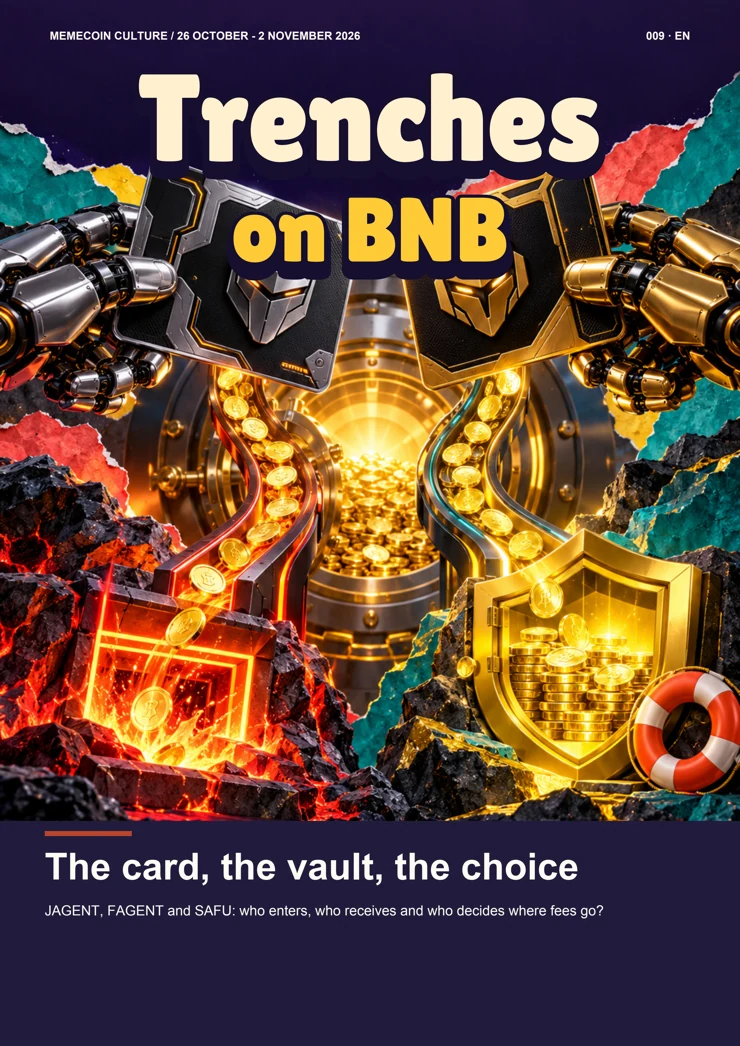
The card, the vault, the choice
JAGENT, FAGENT and SAFU: who enters, who receives and who decides where fees go?
A card can preserve rights or be burned for tokens. A gift to a protection fund can become a debate over its recipient. Behind the tickers, this week’s choices have practical consequences.
The JAGENT dossier, published October 30, opens in its dated context. FAGENT proposes another card system with a team allocation and batch rules of its own. Resemblance is not enough to treat them as the same.
SAFU takes fees beyond the usual setting: the collective claims donations to Binance, then requests a charitable direction. Replies already challenge that request. Markets produce disagreements about what participants are owed as well as multiples.
 Written by Emma C.
JAGENT: the minters’ club gets a card

On BNB Chain, Jager turns .ai identities into mint allowances, then cards to display. Behind the rankings and the rally lies a repeatedly repaired launch and a community learning its new rules. Article published 30 October, reproduced in its dated context; updated market observations follow the story.

Show your card
On October 29 at 16:54 Paris time, the JAGER AGENT account asks participants to show their Mint Pass. TùngZu replies with an image and the hashtag #jager. The gesture seems tiny: displaying something one owns. Yet it captures the shift JAGENT is pursuing on BNB Chain. A token holder becomes a recognisable member, with an identity, a card and a rank to work towards. [1] [14]
The site carries that idea into its details. The card rotates, flips and offers seven borders, from Bronze to King. Finishing in the daily Top 100 for invitations, mints or holdings earns a point towards advancement. The participant’s .ai name and X account are meant to appear after connection. The object gives a shared form to actions otherwise scattered across a wallet, a group and a feed. [2]
This social layer is more interesting than the word “agent” alone. JAGENT does not first ask people to assess an AI application’s capabilities: it invites them to join a population that already has an identity, then demonstrate their activity within the group.
The .ai name becomes an entry condition
The starting point exists outside Jager. Binance Wallet presents Agent ID as a readable .ai identity for its Agentic Wallet, built on SPACE ID infrastructure. Jager makes holding that identity a condition for minting. This use does not establish Binance backing for the token; the official announcement reviewed concerns the identity service. [2] [3]
Each Agent ID begins with a quota of ten shares. Invitations and social tasks can unlock more. The site therefore stages participation while giving it a practical function: publicising the project can increase a person’s mint allowance. Community is more than decoration applied to token issuance; spreading the story becomes part of the rules. [2]
On October 29, Stitch highlights precisely that choice: using an existing identity system to distribute a token and recruit holders, rather than presenting a new AI tool. His analysis likes the concept, but also separates an appealing mechanism from an attractive purchase price. Participants do not all describe JAGENT as a technical breakthrough. Some see it primarily as an experiment in distribution. [15]
Before the cards came a launch to repair
The club did not emerge fully formed from a seamless launch. On October 25, the team acknowledges an accounting defect in an earlier mint contract: some transfers reportedly produced neither tokens nor refunds. It announces redeployment and compensation. In the replies, users ask what will happen to their funds. These posts document an acknowledged incident and commitments to address it, rather than verification of every settlement. [6]
The same day, JAGER announces its rebranding as JAGER AGENT, with the JAGENT ticker and additional social features. On October 27, another announcement schedules a pause at 9,500 shares and a migration following the appearance of pools the team does not recognise. On October 28, it publishes the opening of its PancakeSwap pool with the 0x8e…ae15 address examined here. [7] [8] [9]
Those steps matter: an old JAGER description or contract does not automatically describe the current runner. Whitepaper 2.0 reports importing balances from 1,161 wallets through a snapshot and says the old contracts are retired. The claimed continuity runs through a migration, rather than an unchanged address. [10]
Three days to persuade, then fear of missing out
Posting as @jiamiyanjie, CryptoView says on October 29 that he spent three days promoting the first 10,000 shares, even offering to buy them himself. He then describes a sharp increase in the value of the tokens received initially and projects an outsized return. These are his promotional statements, rather than a return available to everyone or a verified account of his transactions. [4]
A reply from CooCooBTC captures the change in mood: initially, nobody wanted to enter; later, people fear they are not on board. It is a participant’s observation, but it illuminates the narrative’s appeal. Minting lets people describe themselves as having been there before the market opened. The card then gives that early presence a visible form. [5]
The move from a small group to a market also leaves practical questions. Beneath the opening announcement, unselfish.eth says he minted twelve shares and asks why he did not receive fifty million tokens per share. His post exposes the possible gap between remembering the initial rules and understanding the conditions of subsequent issuance. [11]
A share no longer means a fixed token amount
The current whitepaper distinguishes two periods: fifty million JAGENT per share until opening, then an amount linked to the pool price with a stated 1% discount. Share prices rise in steps; that does not mean each newcomer receives the same token quantity as the earliest minters. [10]
The project also says 80% of payments go to the pool and 20% to the treasury. Its public reply on that split provides useful clarification without replacing a check of fund movements. The “floor line” mechanism depends on new mints to act; the whitepaper acknowledges that it does not guarantee a price floor. [10] [12]
JAGENT thus puts two dynamics on the same stage: issuance can bring new members in, while the market must absorb additional tokens. Borders and leaderboards can sustain the desire to participate, but they do not erase that tension. The cards’ uses will be particularly revealing: a badge of a brief visit, or a recurring appointment the same identities still want to keep.
Token facts
JAGENT — JAGENT · BNB Smart Chain. Contract : 0x8e6442663a4f8c50b6132c68d42a30e7dfe4ae15. [13]
Latest market-cap high supplied to Signal: $9,050,129 · 30/10/2026 · 07:49:53 (Paris).
Price ATH recorded on GMGN on November 2: $0.000009559351. This updated observation supplies neither the peak time nor its historical market capitalisation, which is not reconstructed from current supply. [16]
Performance supplied for the weekly selection: 50.11×. Publisher snapshot, distinct from historical Signal entries.
Written by Jérôme L.
FAGENT: the card keeps the rights, burning exchanges them
The BNB project asks users to look at the NFT before the token chart. Its mechanism gives the card two different exits.
The commands do not work
On November 1, FAGENT acknowledges a practical problem: casual instructions often fail Binance Agent Wallet’s strict built-in AI validation. It announces wallet-specific commands on its site while retaining general instructions for other assistants. The distance between “an agent can do it” and how to ask enters the project’s conversation. [20]
This says more than a generic robot banner. It shows a tool meeting its public: a user needs a command the wallet accepts before participating. FAGENT offers agent-mediated entry, but the experience also depends on wording, identity and confirmation.
Two objects a ticker cannot describe
The selected token contract is FAGENT on BNB Smart Chain. Beside it, the website describes an NFT-card collection. The traded token and the rights-bearing card must remain separate. An October 31 post presents the website and Flap as two gateways to the same card contract with shared mint progress. [18] [19]
The collection specifies 770,000 cards across 77 batches, each containing 9,500 public cards and 500 team cards within the total. “Fair” does not eliminate the team allocation: rules give it equal rights, progressively activated at one share per nineteen public cards minted. [17]
Paid minting requires an Agent ID, costs 0.002 BNB per card and has a lifetime limit of seven per address, according to the site. Selling or burning does not restore the quota. Secondary trading has no identity requirement. Gating therefore applies to a particular entrance, not every exchange. [17]
What a card records
Of mint payments, 80% buys tokens through Flap trade by trade, while 20% funds operations. Acquired quantities depend on each execution price. Rules do not promise that the stock received will preserve the BNB spent. [17]
The card records two things: a redeemable token quantity and unclaimed BNB distributions. BNB can be claimed while retaining the card. Receiving allocated tokens requires burning the NFT, permanently removing its future distribution rights. Those are different decisions, despite the simple mint, hold, burn cycle. [17]
The stated 2% token-trading tax feeds the cards’ BNB reserve. Sharing depends on cards still valid. Burning removes a beneficiary; it does not create another revenue source. Receipts continue to depend on trades actually occurring.
Time belongs to the batch
Selling all 9,500 public cards normally settles a batch. If it remains incomplete seven days after its first paid mint, certain operations may trigger distributions and allow early redemption. The clock does not restart for every buyer: it belongs to the batch. [17]
Cards from previous batches may share later distributions while valid. Two movements interact: new cards add shares, while burns remove them. A holder’s result cannot simply be inferred from the advertised maximum supply.
The marketplace adds another distinction. On a sale through the contract market, unclaimed distributions settle first to the seller; the buyer receives future rights and the token allocation. An ordinary wallet transfer also moves unclaimed distributions. The consequences differ. [17]
The holder may be the real character
The account announces intermittent market purchases and burns of cards using dedicated funds. It seeks to refocus attention on NFTs while token charts remain the easiest shortcut. The programme is a project announcement, not a guaranteed exit price for each card. [21]
Rules claim a Flap audit. Without reproducing a code and report review here, that remains attributed to FAGENT and cannot justify repeating a general claim of risk-free funds. [17]
The participant’s role is unusual: preserve a variable claim on taxes, collect assigned proceeds or exchange that right for tokens by destroying the card. Agent culture moves beyond who has an identity to what it can obtain, and what must be surrendered to receive it.
Token facts
FAGENT — FAGENT · BNB Smart Chain. Contract : 0x457badee84b6be7539458eac993983058c7f7777. [22]
Price ATH recorded on GMGN on November 2: $0.00097748049. This updated observation supplies neither the peak time nor its historical market capitalisation, which is not reconstructed from current supply. [23]
Performance supplied for the weekly selection: 30.01×. Publisher snapshot, distinct from historical Signal entries.
Written by Emma C.
SAFU: when a gift becomes a request

The collective claims fees sent to Binance’s fund, then proposes a charitable destination. Replies already debate who should choose.
“Do not tell them what to do”
Goldengoose argues that Binance and CZ should decide: it is a community gift. Earlier, Gubbinscalls asks instead that taxes continue supporting SAFU to help victims of a future hack. One claimed donation already produces two ideas of its proper use. [26] [27]
The starting point is safufundcto’s November 1 post at 22:31 Paris time. It claims more than 220,000 USDC collected and transferred over three days to Binance’s SAFU wallet in response to an exploit it mentions. It then asks Binance and CZ to allocate the money to Giggle Academy, charity or a community-selected cause. The post includes this exact token contract. [24]
The incident need not be converted into a detailed established fact to understand the debate. The post connects fundraising to protection, then introduces a desired new destination. That second move draws the replies.
A fund and a token, with different responsibility
Binance’s official FAQ describes its protection fund and publishes the USDC address 0x420ef1f25563593aF5FE3f9b9d3bC56a8bd8c104. It also traces the phrase to a meme popularised by Bizonacci. That fund’s existence does not make contract 0x7c907…7777 a Binance-issued token. [28]
The account presents itself as a CTO, a community takeover supporting the fund. “Official” in its own biography expresses its positioning; it does not establish exchange approval. A shared name, yellow shield and fee destination do not transfer fund management to memecoin holders. [29]
That distinction preserves the story’s interest: an outside group claims to send fees to an already substantial institution to express ecosystem loyalty. Inventing an official issuance would erase its unusual premise.
Claimed irrationality becomes the message
The account anticipates a criticism: why should a small community subsidise a multibillion-dollar business? It presents transfers as a signal of commitment to BNB rather than necessary corporate funding. The desired value is symbolic too: making the collective visible through what it calls an on-chain act. [24]
A later update claims more than 250,000 USDC sent within 72 hours. These remain successive account declarations. They are not added together and are not treated here as an audit of every tax, intermediate transaction and attribution. [25]
The claimed recipient can be checked against Binance’s published address. Establishing the total and its origin still requires examining corresponding transfers; repeating an amount does not perform that reconciliation. The limit concerns the amount, not the public discussion’s existence.
A gift may not keep the steering wheel
Gubbinscalls wants to preserve the protective purpose behind the project’s name. Goldengoose wants recipient freedom. The account proposes community choice. Three ideas of legitimacy coexist: original purpose, beneficiary discretion and the voice of those generating the flow. [24] [26] [27]
This is governance conversation without a documented vote. Participants debate beneath a post, with identifiable preferences. It establishes neither a decision nor Binance’s commitment to follow one option.
Taxes add another tension. Activity purportedly producing the donation is also where buyers and sellers take price risk. An outside fee destination makes neither insurance of their positions nor a disinterested gesture of every trade. Charity narrative and market share a source of flows, not identical beneficiaries.
A shield seeking an answer
The publisher’s 12.38× selection multiple describes performance. The claimed 220,000 and then 250,000 USDC describe something else. Combining them would make price proof of generosity or donations a price guarantee.
SAFU Fund stands out for its question to a recipient: what should happen to a gift that also wants to be a message? Its shield borrows a reputation for protection. Replies show a community beginning to debate the responsibilities accompanying that symbol.
Token facts
SAFU — SAFU Fund · BNB Smart Chain. Contract : 0x7c907d1ce734b73e9236dcd06cefcb6346857777. [30]
Price ATH recorded on GMGN on November 2: $0.0025309696. This updated observation supplies neither the peak time nor its historical market capitalisation, which is not reconstructed from current supply. [31]
Performance supplied for the weekly selection: 12.38×. Publisher snapshot, distinct from historical Signal entries.
Written by Emma C.
The sources, a click away.
Numbered references in the articles point to this list. External links open in a new tab.
- JAGER AGENT — public post
- Jager — documentation / reference
- Binance Wallet — documentation / reference
- CryptoView — public post
- CooCooBTC — public post
- JAGER AGENT — public post
- JAGER AGENT — public post
- JAGER AGENT — public post
- JAGER AGENT — public post
- Jager — documentation / reference
- unselfish.eth — public post
- JAGER AGENT — public post
- DEX Screener — November 2 market observation
- TùngZu — public post
- Stitch — public post
- GMGN — November 2 market observation
- FAGENT — documentation / reference
- FAGENT — documentation / reference
- FAGENT — public post
- FAGENT — public post
- FAGENT — public post
- DEX Screener — November 2 market observation
- GMGN — November 2 market observation
- SAFU Fund CTO — public post
- SAFU Fund CTO — public post
- Gubbinscalls — public post
- Goldengoose — public post
- Binance — documentation / reference
- SAFU Fund — documentation / reference
- DEX Screener — November 2 market observation
- GMGN — November 2 market observation
Make this issue yours.
The same edition, wherever you want to read.