Beyond the screen, the machinery.
Viewers, holders and developers: three audiences whose paths cross this week.
Truman World begins as a show: a simulated world, a stream to watch, then the possibility for its audience to influence the story. A token enters that setting with a practical question: can it help finance the broadcast? It is an unusual introduction to a week in which mechanisms occupy as much space as characters.
Flap proposes extending trading taxes into perpetual markets. Stonks Season prepares a snapshot and splits rewards between new podiums and holders who stayed. BNB Hack asks developers to build tools for tokenized stocks. These initiatives sometimes share a vocabulary, but they promise neither identical rights nor identical uses.
We follow what has changed since the previous issue: a still-provisional competition, an announced vault and a building programme whose deadline lies ahead. Interfaces and statements provide evidence to examine; they do not yet provide every outcome. The show continues, but this time its machinery also fills the pages.
 Written by Jérôme L.
$TRUMAN, the audience takes control of the show

An AI character, a persistent world and viewers intervening in the story: Truman World finds a community and a potential funding model on BNB. On September 20, $TRUMAN reaches a $3.52 million market capitalisation.
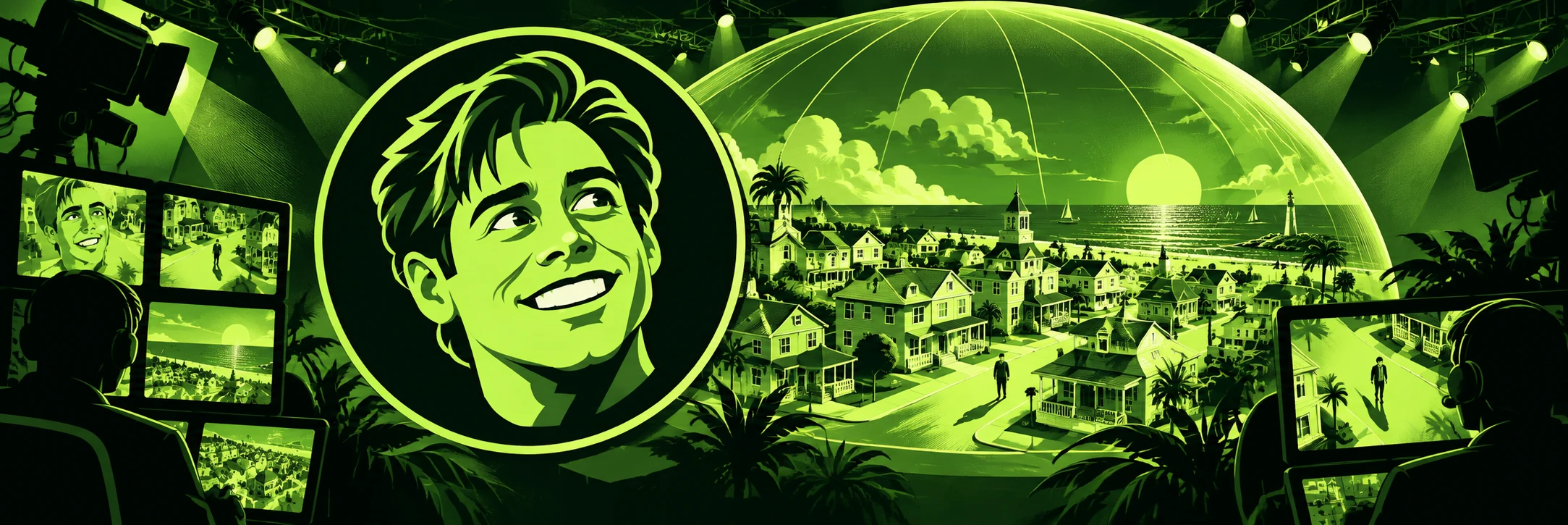
A token address lands on Truman’s phone
Someone sends Truman a token address. In Truman World’s public log, the character replies that he does not understand the code and asks for a clear message. The contrast captures the project: outside, a community follows an asset on BNB; inside, a character tries to make sense of messages entering his everyday life. When we visited, the camera had stopped, but conversations and events remained visible. The show therefore has two stages: the character’s world and the audience trying to redirect his story. [1]
At 11:48 a.m. Paris time on September 20, 2026, $TRUMAN reached a market-cap peak of $3.52 million, according to the observation supplied to the newsroom. That figure measures neither Truman World’s revenue nor its audience. It places a market acceleration around an experiment whose relationship with the token changed in less than a day. This is where the story becomes interesting: the creator initially said he did not have a token, before announcing that trading fees would help keep his world running. [3] [9]
The audience steps into the control room
On September 19 at 6:39 p.m. Paris time, Will, known on X as Will (Exploring AI), introduced Truman World. He proposed a livestream inside a persistent universe: Truman does not know he is in a simulation, while visitors can influence his surroundings. The name, surveillance and gap between the protagonist’s knowledge and the audience’s perspective make the reference to The Truman Show immediately recognisable. Here, the premise becomes a participatory fiction powered by artificial intelligence. [2]
One rule matters: visitors act around Truman rather than controlling him directly. Changing a situation, introducing an object or altering circumstances sets the scene; the character’s reaction then belongs to the system. In principle, this makes the viewer a partial director, with uncertainty forming part of the attraction. [2]
Will describes agents with memories, changing relationships and a world governed by spatial and causal continuity. These are the creator’s stated features, not findings from a technical audit. Nevertheless, the project poses a more concrete question than the spectacle of generated images alone: will an intervention leave a lasting enough trace to change what happens next? [2]
A phone, constraints and impatient spectators
Early interactions reveal a gap between visitors’ imagination and the proposed world’s limits. Will notes that many people are trying to text Truman. He explains that the character cannot receive messages without his phone. This apparently mundane detail becomes a narrative rule: an event should not happen merely because someone requested it. It needs a plausible route into the character’s world. [4]
That constraint separates an unfolding story from a succession of instantly executed commands. It can create waiting, frustration or surprise. It also asks people to observe before intervening. The misunderstood contract address is a revealing episode: market language enters the setting, but the character does not automatically treat it as the centre of his existence. [1] [4]
Collective participation also raises moderation questions. Will subsequently announces filters for problematic content, including sexual material, and an end to automatic retries when a prompt is rejected. The announcement describes a system adjustment; it does not establish that all abusive interventions have disappeared. In an open fiction, these decisions shape the atmosphere: what visitors can impose on the world affects what others are willing to watch. [6]
Keeping the camera running without requiring a wallet
At launch, Will describes an initial eight-hour broadcast window and a paid mechanism for extending camera time, initially priced at five dollars per additional minute. The distinction between the broadcast and the world is central: he says the simulation continues when the video stops. The expense therefore keeps a window open onto the experiment, rather than being presented as a prerequisite for every event to exist. [2]
The first adjustment follows an obstacle much less spectacular than AI: some visitors do not have a crypto wallet. Will makes prompts available without USDC payments for the rest of the livestream. Free participation lets curious newcomers experiment without making a transaction. Under the arrangements observed, buying $TRUMAN is therefore not a prerequisite for taking part. [5]
He later announces more than 3,000 unique visitors and seven additional hours of broadcasting. His subsequent recap mentions more than 4,000 visitors. These are the creator’s figures, without independent verification. They primarily document how he presents the project’s beginnings: an experiment quickly opened to the public and adjusted in response to feedback. [7] [9]
September 20: trading fees enter the picture
The timeline helps avoid a shortcut. When someone asks for the contract at launch, Will replies that he does not have one. This does not establish who deployed $TRUMAN or when it was created. It does, however, prevent an unqualified account of a show designed from the outset as an asset’s official showcase. [3]
At 11:05 a.m. Paris time on September 20, Will posts a FlapGift request containing the exact BNB contract covered here: 0xabffa443547b34ab6c3b3173d26e233900527777. At 11:23 a.m., he explains his change of position. He thanks @XIGUA0903 for encouraging him to claim the fees, then cites a conversation with @eth_cedric: use that revenue to cover livestream costs and make Truman World free. [8] [9]
Will announces his intention to claim $Truman’s fees and dedicate future fee revenue to running the project. The public link between the experiment and this contract is now explicit. Its scope needs precision: a request and a commitment are documented; the amounts actually received, their allocation and their ability to cover expenses have not been verified here. The peak supplied to the newsroom follows the announcement by twenty-five minutes. The timing is notable, but it does not by itself establish what caused the rise. [8] [9]
What the token brings to the story
The $TRUMAN narrative now rests on a proposed cycle: attention around the world attracts a community, token activity could generate fees, and those receipts would help extend the show. The strength of that cycle depends on costs and revenues not yet documented in the sources reviewed. A $3.52 million market capitalisation is not a reserve available to pay for generated footage.
In his recap, Will also highlights a follow from Marc Andreessen. That is a sign of attention he reports, not an announcement of investment or partnership. The editorial task is to keep these distinctions clear: a self-reported audience, a prominent follower, a commitment to allocate fees and a secondary market are different things. [9]
Will promises another livestream within twenty-four hours while saying the world continues to run. What follows will reveal what survives the initial curiosity: characters whose adventures people actually follow, interventions that enrich the story, and funding transparent enough to explain how the camera stays on. For now, $TRUMAN has found its most distinctive premise: making the cost of the show part of the show itself. [9]
Written by Jérôme L.
Flap gives trading taxes a second job

The vault announced on 18 September links automated purchases to perpetual markets. Its appeal lies in the flow of funds—and so do its unanswered questions.
At 14:05 Paris time on 18 September, Flap announces a perpetual vault powered by MYX Finance. The platform’s vocabulary expands: taxes collected from trades are now meant to help open another market. Alongside the spot token, the project wants perpetual contracts and an additional income stream for holders. MYX’s account responds to the announcement. That documents a launch presented together, rather than the results of its use. [11] [12]
The starting point is familiar to users of taxed tokens. A fraction of trading is collected. In Flap’s description, that tax enters the vault, which automatically buys the token. The purchased units are then deployed as liquidity to open a perpetual market on MYX. The process therefore goes beyond a buyback: it puts the tokens to work in trading infrastructure. That second step distinguishes the announcement from a simple programme supporting the price. [11]
The team describes two layers of income for spot holders: trading taxes and revenue from the perpetual market, including fees and funding. It is an appealing formulation, allowing a holder to remain on the spot side while participating in derivatives activity. But the announcement does not provide a distribution history with which to measure the promise. It describes a circuit, rather than a return already observed over a substantial period. [11]
That distinction matters because flows do not arise merely from a vault’s existence. Transactions must generate fees, positions must give a derivatives market activity and usable liquidity must allow participants to enter and leave. Perpetual funding is not a fixed coupon: its operation depends on the market and positions. Counting it in advance as stable income would erase precisely what the new product still needs to demonstrate.
Flap also emphasises permissionless markets from day one, without a listing committee. The argument addresses creators whose communities are waiting for another venue. It turns an external procedure into a feature available at a project’s birth. A distinction remains: being able to open a market guarantees neither users nor depth in its order books or reserves. Access is a property of the design; activity will be an outcome. [11]
Replies introduce two more practical questions. On 19 September, OddlySpecific asks what happens to Flap when volume collapses. The next day, wukongtaojin asks how to claim perpetual-market revenue. These comments do not establish a malfunction. They show where public explanations need to become concrete: where does money come from when activity slows, and what does a holder do to receive it? [13] [14]
The first question concerns the economic engine. A tax can organise redistribution, but it remains tied to the activity producing it. The second concerns everyday use: a promise of two revenue layers is difficult to assess if the path from market trades to an individual balance remains abstract. Terms, observable distributions and quieter periods will deserve as much attention as launch day.
In our previous issue, Flap appeared through its support for projects and announced buybacks around stock memes. This week’s change is architectural. The vault tries to put the same story to work in two arenas, spot and derivatives. Asking which character attracts attention is no longer enough. The question becomes what happens to taxes after collection, and whether their circulation creates an activity that survives the first wave of attention.
Written by Jérôme L.
Stonks Season, on the eve of the verdict
A provisional ranking, two reward pools and a snapshot date: behind the $400,000 are two approaches to rewarding holders.
The ranking is still moving. On the evening of 20 September, DappBay shows the contenders for Stonks Season’s second week, but the winner-announcement boxes remain pending. The holder snapshot is scheduled for 21 September. Writing a winners’ list now would turn a provisional screen into a final result. The more interesting story on the eve of that date is what the competition measures—and which behaviour it wants to extend. [15] [16] [17]
The announcement published on 17 September highlights $400,000 in rewards. The dashboard divides them into two pools paid in U: $250,000 for the week-two HODLER Airdrop and $150,000 for the HODLER Duo Airdrop. The first targets holders of the three memes that finish on top. The second looks back to the first week’s winners. One campaign total therefore covers two stories: joining the new ranking and keeping an older position. [15] [16]
For the first pool, the displayed conditions require at least $100 in one of the three winning memes and a place among that token’s top 1,500 holders at the 21 September snapshot. For the second, the dashboard targets the top 3,000 holders of week-one winners, provided they have retained at least 80% of their winning meme holdings since the 11 September snapshot. The current price is not enough: a wallet’s past enters eligibility for this second mechanism. [16]
The reading at around 21:40 Paris time on 20 September puts the token whose contract starts 0x87ae2670 and ends 76a47777 in first place. The dashboard assigns it a $27.48 million market capitalisation, a 368.90% increase, $15.32 million in volume and 27,090 additional holders. Second-placed 0xb077ada3…a53a7777 shows a $1.86 million capitalisation and $12 million in volume. CZ, third at that moment, is identified by 0x923cbbe4…35447777 and a $1.29 million capitalisation. Those contracts distinguish the projects despite potentially similar names and tickers. [16]
The most instructive contrast appears further down. 4Stock is ninth with $33.11 million in displayed volume, more than any of the top three in this reading. Rank therefore cannot be read as a simple volume sort. The table also presents a score, token age, market-cap change and holder growth. Without reconstructing a formula that this screen alone cannot establish, one observation is already possible: a large volume figure in isolation does not explain the whole ranking. [16]
Memestock, one of the first week’s podium names, is seventh at this point. That is not yet a verdict on its second campaign; it is a position at a particular moment. The displayed week-two rule also excludes tokens already spot-listed on Tier-0 centralised exchanges. That condition must be read separately from the score. It defines the competition’s scope without, by itself, explaining every candidate’s presence or absence. [16]
The dashboard advertises a refresh every five minutes and a validation lag of five to ten minutes. These details explain why two nearby readings may not match exactly. The 21 September snapshot will give the numbers a different status: it will fix the holders considered under the rules, followed by the winner announcement. Sunday’s reading remains a photograph of a race. [16]
The continuity with our previous issue is clear. Niu Lai, MarsCoin and memestock shaped the first verdict; week two is already organising the return of holders and the arrival of new candidates. The competition does more than reward a burst of attention. Through its Duo pool, it tries to extend holding beyond the first podium. Whether communities preserve that continuity after snapshots and distribution announcements remains to be seen.
Written by Jérôme L.
Tokenized stocks need tools
A $20,000 hackathon invites developers to build around tokenized stocks. One reply brings the discussion back to prices that can actually be executed.
On 16 September, BNB Chain and Binance Wallet open a hackathon devoted to tokenized stocks. The announced prize pool is $20,000 and the building period runs until 11 October. Alongside meme competitions and their snapshots, this timetable establishes another rhythm: several weeks to deliver a usable agent, dashboard or portfolio tool. The winner is not yet a ticker; the requested work is a product. [18] [22]
The launch thread names three sets of building blocks: bStocks, Ondo and xStocks. It lists agents, trading tools, bots, dashboards, MCP servers and SDKs. This is not an adoption announcement for every future project. It defines technical ground on which developers are invited to connect data, actions and interfaces. The competition concerns potential uses of tokenized assets, rather than simply their presentation. [19]
The suggested ideas are concrete enough to outline several audiences. A pricing or arbitrage tool examines differences between markets; a periodic-purchase programme automates a discipline; rebalancing restores a portfolio to chosen proportions. Agents around company earnings and thematic baskets instead try to turn information into a reading journey or prepared decisions. The announcement also includes the way into a product: improving onboarding remains a building problem in its own right. [20]
The thread details the available components: Binance Web3 API, Agentic Wallet, Wallet Skills and BNB Agent Studio. Two $2,000 prizes are associated with outstanding work using the Agentic Wallet / Wallet Skills and BNB Agent Studio stacks. They belong to the announced pool, rather than adding another $4,000 to it. For a participant, that division matters: it ties some rewards to specific tools and therefore to design choices. [21]
A reply posted on 17 September by @XristouGiwtis supplies a useful counterpoint. The author wants projects to show what is actually executable while US markets are closed: quote age, available size and expected slippage. They want these details shown before an order. This is a contribution to the debate, rather than an official hackathon rule. Yet it asks a more demanding question than whether an interface is available twenty-four hours a day. [23]
A displayed price and a transaction of the same size are not the same thing. An interface can remain accessible while the reference market is closed; that does not guarantee identical depth or a constant gap with that market. A tool which clearly exposes how fresh a data point is and the size to which it applies therefore adds something different from a chart that simply keeps moving. That distinction makes the building work worth following.
Comparisons with this week’s memes should not erase the categories. A token parodying a company, an instrument linked to a share and software helping people trade it do not carry the same rights or perform the same function. The language of stocks travels between them; that shared vocabulary is precisely a reason to specify the product being discussed. Here, the call for projects names infrastructure and uses, rather than another mascot contest.
11 October provides the next date for this story. Until then, the most revealing evidence will be demonstrations: what an agent can do, what it asks the user to approve and what a dashboard can explain before a transaction. After market caps and holder rewards, BNB is opening a building programme whose quality will also be judged by the clarity of a screen and the precision of execution.
Written by Jérôme L.
The sources, a click away.
Numbered references in the articles point to this list. External links open in a new tab.
- Truman World / interface and public log, read 20 September
- Will / Truman World launch, 19 September
- Will / initial response to a contract request: Don't have one
- Will / how Truman's phone works
- Will / interventions opened without USDC payment
- Will / announced filtering of problematic interventions
- Will / first stream extension and claimed visitor numbers
- Will / BNB contract in FlapGift request, 20 September at 11:05 Paris
- Will / first stream recap and announced fee allocation, 20 September at 11:23 Paris
- DexScreener / TRUMAN-BNB, contract identity
- Flap / Perpetual Vault, 18 September
- MYX Finance / response to Flap
- OddlySpecific / question on lower volumes
- wukongtaojin / revenue claim question
- BNB Chain / Stonks Season week 2
- DappBay / live Stonks Season dashboard
- BNB Chain / 19 September reminder
- BNB Chain / tokenized-stocks hackathon
- BNB Chain / eligible building blocks
- BNB Chain / project ideas
- BNB Chain / developer tools and prizes
- BNB Chain / hackathon event page
- @XristouGiwtis / execution outside market hours
Make this issue yours.
The same edition, wherever you want to read.