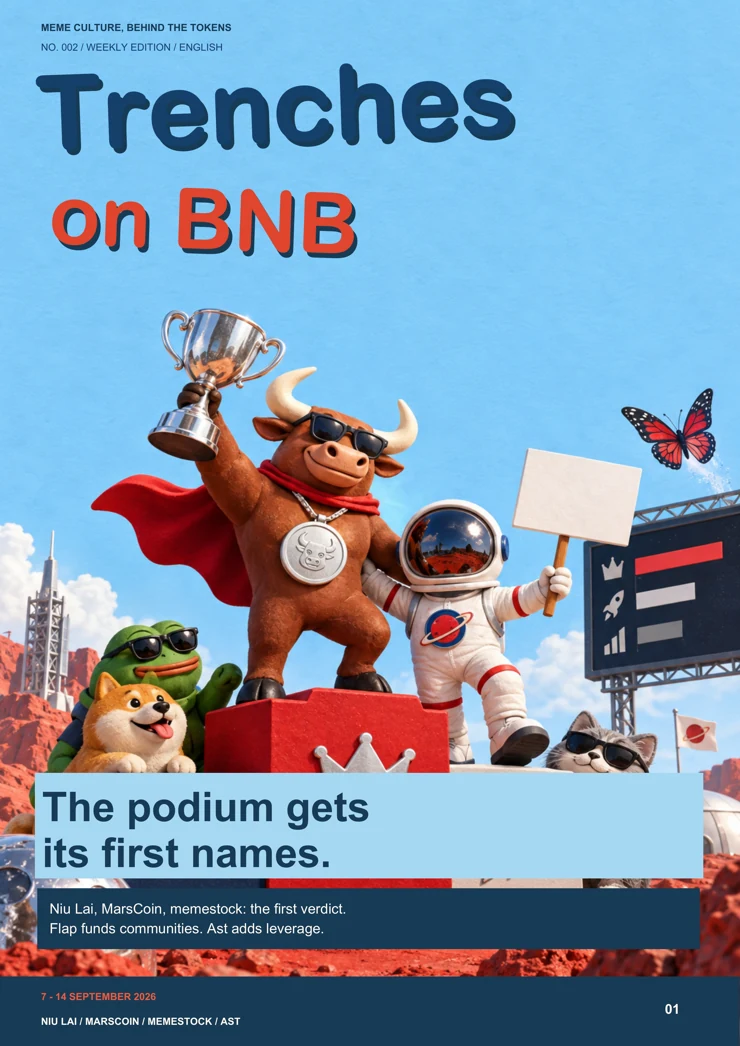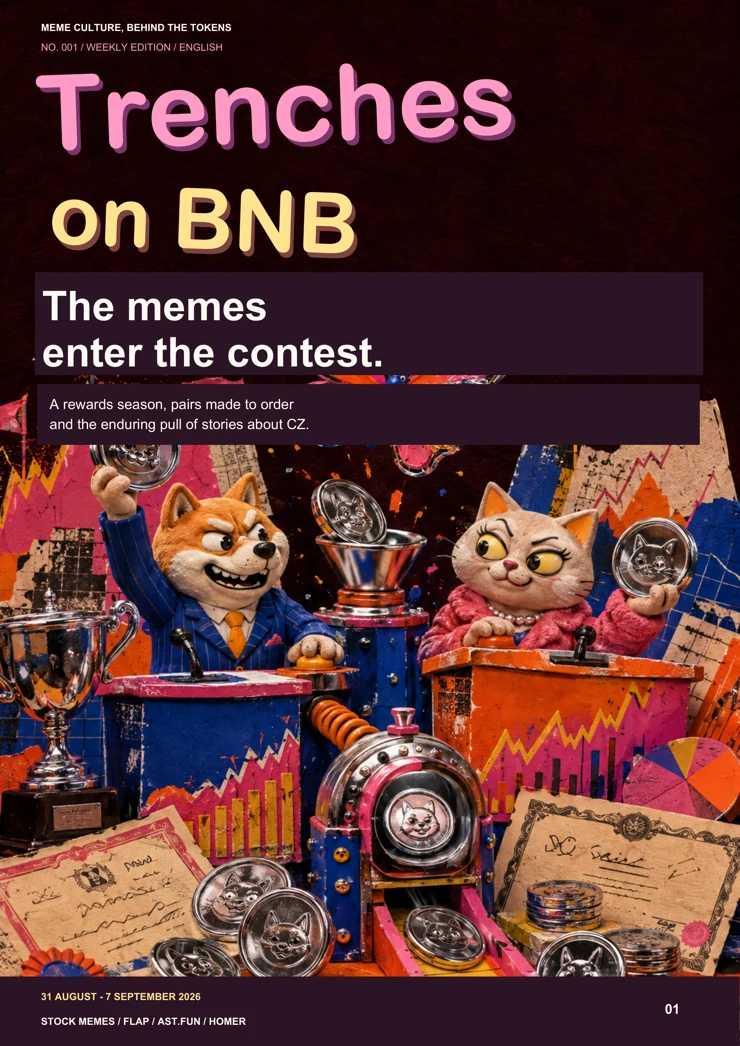
This time, there is a programme.
BNB Chain gives stock memes a calendar and a prize pool. Platforms are positioning themselves around the new competition.
On 4 September, BNB Chain announces a $4 million Stonks Szn campaign. Three days later, ast.fun explains how to launch a meme to take part. In between, Flap expands the choice of quote assets. The week's story is no longer only about the next character to go viral. It is about the tools and incentives organising its circulation.
The new structure does not displace old habits. HOMER keeps drawing on a story about Binance's founders. The project seeks amplification, points to media coverage and urges communities to share its tale. A market in mechanisms coexists with a market in recognition.
Our selection follows both threads. Platform announcements provide dated facts; their promises still need checking in the products. Familiar names offer a cultural entry point, but establish no affiliation. That combination gives this week on BNB its particular character.
 The Trenches On editorial team
Meme season gets a rulebook.
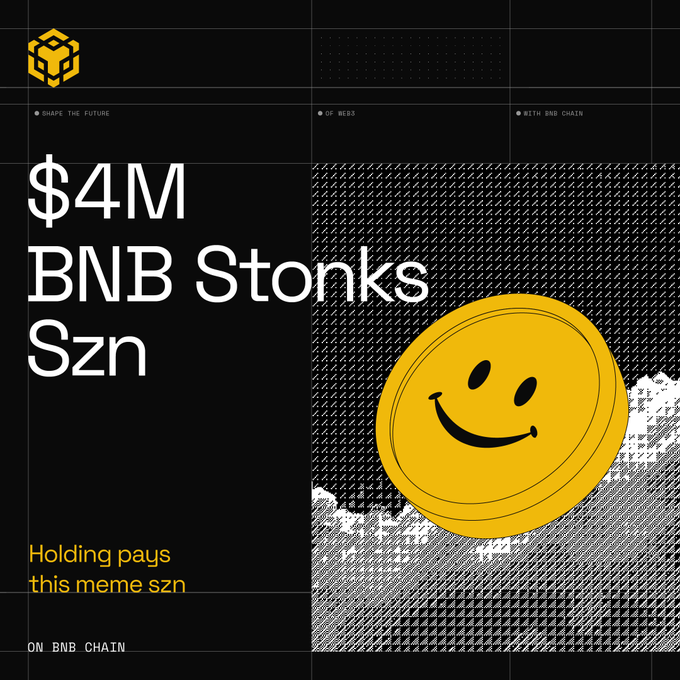
With Stonks Szn, BNB Chain turns a conversation about stock pairs into an organised competition.
On 4 September, BNB Chain announces $4 million for a campaign running over several weeks. The opening round has a stated $400,000 allocation. Eligible projects are memes paired with bStocks; rewards are aimed at their holder communities. [1]
The contest's design matters as much as its size. The network plans to rank memes, then airdrop rewards to the communities of the top three. Announced criteria combine market capitalisation, trading activity and holders, with checks that include liquidity and artificial trading. Projects have several reasons to keep their communities active.
For holders, the campaign introduces a HODLer Index, described as combining the amount held with holding duration. Past exits may count against it. A clarification posted that day corrects a practical detail: holding at least $100 of a single selected meme is enough to meet that eligibility threshold. The 7 September reminder repeats this wording. [2] [3]
Meeting the threshold does not promise a payment. The announcement explicitly says a HODLer Index does not guarantee an airdrop. It also gives a competition period of 4-12 September while scheduling results for the 11th. Those formulations need clarification before being treated as an operational calendar. [1]
For this issue, the question is what those rules do to the narrative. A community can now talk about its ranking, collective staying power and next milestone, alongside the token itself. Rules give attention continuity. They can also encourage participants to read every burst of activity as progress.
The campaign confirms that stock memes are a theme the network has chosen to promote. It does not individually validate every participant. The programme supplies a stage; each token stepping onto it retains its own mechanisms and unknowns.
$4m announced for the season; $400,000 for week one.
Choose a pair. Write the mechanics.

Flap widens the field: creators can choose a quote asset just as they choose a mascot.
![Artwork from Flap's 6 September announcement. [7]](../assets/flap-art.jpg)
On the evening of 6 September, Flap announces custom-quote-asset launches on BNB Chain. Creators are invited to enter the address of the asset they want to use. RWAs, major crypto assets or familiar memes: the catalogue is no longer presented as a closed list. [7]
The post then lays out the customisation pitch. Pair selection sits alongside different mechanisms: creator wallets, distributions, token burns and liquidity provision. For the project, the aim is to let creators compose their own token economy. For future holders, it also means that two launches on the same platform can tell very different financial stories.
The next day, BNB Chain amplifies the announcement. That establishes its presence in the network's communications. It does not establish that every asset creators select is authentic, liquid or suitable for every mechanism. [8]
Flap prepares the ground with an explanatory character: Ben. In a 6 September post, it describes a creator whose meme can be paired with stocks and whose trading fees would purchase distributions for holders. This is a promotional illustration of the model, not a BEN token we have identified and investigated. [9]
The image works because it compresses several technical decisions into a simple story. But greater creator freedom shifts some of the work to the person reading a launch: which asset backs the pair, how are flows divided, and what remains when trading slows?
The development is therefore about more than launching faster. It multiplies the possible combinations. This week on BNB, Flap is selling a set of parts for building a promise rather than a ready-made mascot. That is fertile ground for ideas, and for misunderstandings.
Customisation makes launches less interchangeable.
Thirty seconds to take the stage.
ast.fun connects its creation flow to Stonks Szn. The network's campaign becomes a product pitch.
On 7 September, ast.fun promises a stock-meme launch in about 30 seconds. It names NVIDIA, SpaceX, GameStop and Nasdaq-100 among the available references, then explains that the meme launches through Four.meme and is paired with a bStock. The announcement explicitly presents this as an entry point into Stonks Szn. [4]
The calendar is part of the product. BNB Chain announced its campaign three days earlier; ast.fun now offers a way to join. Creators are invited not only to imagine a character, but to choose a financial reference and enter a conversation already organised around a ranking.
Another post that day couples stock selection with leverage. It makes a compelling headline, but the exact asset and terms still need examining. Naming a company or an index is not enough to establish holder rights, the quality of an exposure or how its leverage works. [5]
The main announcement also shows a 60% allocation to holders of the underlying asset and 40% to ast.fun's vault. Taken alone, the post does not explain the basis of that split clearly enough to turn it into expected income. We therefore do not present it as a yield promise. [4]
Distribution also happens through language. On 6 September, ast.fun announces support for Traditional Chinese, Japanese and Vietnamese. It is less spectacular than a campaign's prize pool, but tells another competitive story: making the same flow usable by more communities. [6]
Those are the announcement's two moves: simplify entry and widen the audience. The advertised 30 seconds describe an interface ambition. They do not measure the time needed to understand the token someone creates, or later encounters in the market.
The interface may be fast. Understanding the product takes longer.
A nickname goes a long way.

HOMER draws on a behind-the-scenes Binance story. This week shows how older news keeps feeding a token's promotion.
![Artwork posted by @HomerBSC on 3 September. [10]](../assets/homer-art.jpg)
On 3 September, the Homer account compresses its thesis into a few lines: before he was CZ, Binance's founder was supposedly 'Homer'. The post ties that identity to BNB and claims an original status for the meme. Its artwork borrows from The Simpsons. [10]
The starting point predates our reporting window. On 27 August, CoinDesk published an article about Binance's cofounders using the aliases Homer and Marge in internal meetings and communications. It reports information attributed to people familiar with the matter and mentions memecoins appearing around the story. It is not a recommendation to buy HOMER. [12]
On 5 September, a post by Spartan turns that coverage into a promotional argument, stressing the publication's and journalist's reputation. The shift is familiar but revealing: reporting about an anecdote becomes, in holders' conversation, supposed evidence of the token's importance. [11]
The project's identity needs to stay precise. Several assets use the name HOMER. The pair data consulted connect HOMER CZ on BNB Smart Chain to @HomerBSC, distinguishing this story from its namesakes. That identifies a project; it demonstrates no relationship with Binance, CZ or the characters' rights holders. [13]
The narrative works because familiar references are close at hand. The audience recognises a crypto figure and a television character. Promoters do not need to invent an entire world: they offer a way to reread an existing one, then ask communities to share it.
HOMER is a counterpoint to Stonks Szn. A campaign organises attention through rules; an anecdote extends it through retelling. Even amid increasingly elaborate financial mechanisms, memes still live through stories people want to tell.
Reporting an anecdote is not recommending a token.
The sources, a click away.
Numbered references in the articles point to this list. External links open in a new tab.
- BNB Chain: Stonks Szn campaign
- BNB Chain: threshold clarification
- BNB Chain: week-one reminder
- ast.fun: launches and Stonks Szn
- ast.fun: leverage post
- ast.fun: additional languages
- Flap: custom quote assets
- BNB Chain: Flap announcement repost
- Flap: the Ben illustration
- Homer: the CZ narrative
- Spartan: promotional HOMER post
- CoinDesk: origin of the Homer/Marge story
- DEX Screener: HOMER CZ / BSC
Make this issue yours.
The same edition, wherever you want to read.