
 RUNNERS / SOLANA
CRAWL: web spiders want to feed a crypto AI
A viral animation becomes a network of readers, a queen to train and trading fees to turn into computing power. On Solana, CRAWLNET reaches a reported $3.78M ATH on October 4 at 05:58 Paris time.
A spider leaves its Wikipedia page
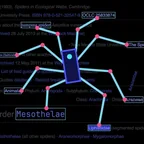
On October 1, Slava Rybin, @rybinfx, posts an animation titled Web spiders. Against a dark page filled with references, a small geometric creature attaches its legs to words and links. Coloured lines trace its movement through the text. Rybin’s profile describes him as a systems artist; the post carries JavaScript and CSS hashtags. Before becoming a token narrative, the spider is a way of making navigation through a webpage visible and almost animal-like. [1]
On October 4 at 00:06:32 Paris time, Matthew, @matthewabides, quotes that video and proposes a change of scale: multiply the crawlers, send them through the crypto web and train a language model on their reading. He says he has built the system. At 00:09:07 he adds BXoHJddsWJLHtAopeiSbKUSELsu8hSFMs8baGMDkpump. That explicit connection ties his thread to CRAWLNET on Solana; it does not identify Rybin as the token’s creator or supporter. [2] [3]
The mascot becomes a reading room
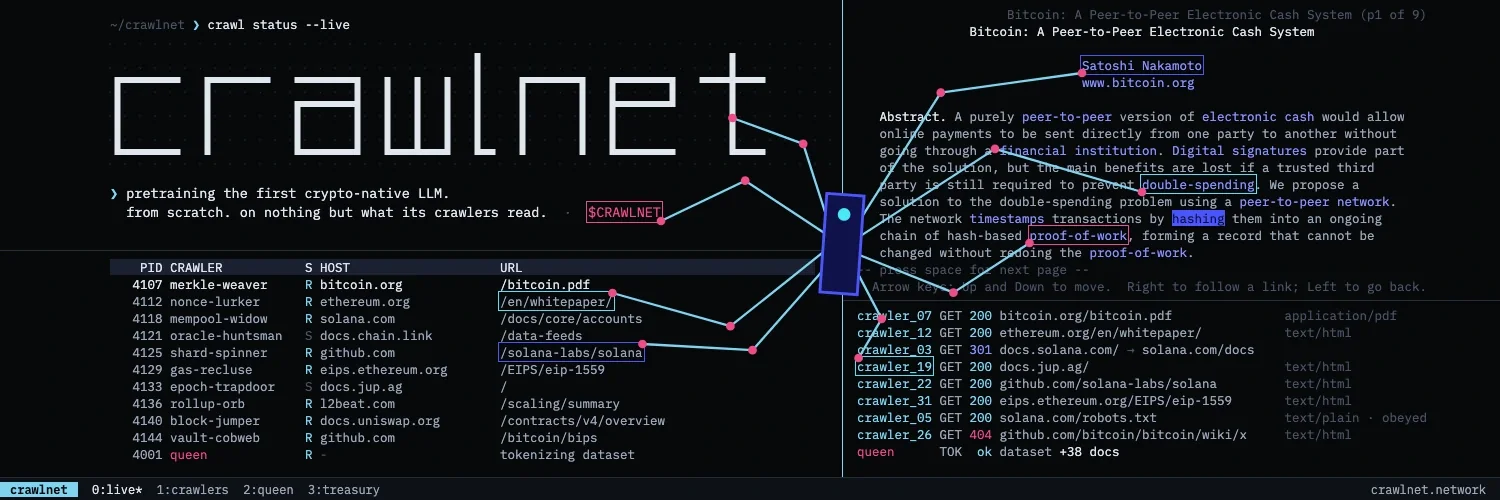
CRAWLNET keeps the spider’s visual appeal but gives it a job. Its banner places a blue-purple rectangular body, cyan legs and pink joints beside an extract from the Bitcoin whitepaper. A process list on the left names collectors; log lines on the right display reads. The visitor encounters the visual language of a computer terminal rather than a smiling mascot. The image turns an invisible operation into activity people can watch. [17]
The site extends that choice through live, crawlers, queen, treasury and spawn sections. Queen is the model the reading is intended to feed. The proposition connects three usually separate things: crypto project documents, the construction of a dataset and an AI experiment funded by a memecoin’s creator fees. Our reading is that the appeal goes beyond the promised outcome: each collection also provides a small public episode in the story. [4]
Reading is not yet learning
In his thread, Matthew describes each collector as a headless Chromium browser guided by a DeepSeek agent. He says it also reads PDFs and discards pages unrelated to crypto or web3. The manual specifies the next steps: canonicalise pages, remove duplicates, filter for relevance and turn text into training units. It groups targets into chapters including whitepapers, documentation, forums and GitHub. These are mechanisms described by the project rather than an audit of their execution. [5] [8]
The distinction between collector and Queen matters. DeepSeek is presented as the navigation guide; Queen is meant to be pretrained from random initialisation on the collected corpus. Matthew announces a first version with 42 million parameters requiring at least 20 million unique tokens, followed by a ladder reaching 1.68 billion parameters. Tokens here means text units for AI, not CRAWL units bought on Solana. Those sizes are announced targets. [6]
The reference to nanochat supplies a real technical context. Andrej Karpathy’s repository brings together tokenisation, pretraining, finetuning, evaluation and inference for models accessible to experimentation. Drawing on it establishes neither Karpathy’s involvement in CRAWLNET nor performance equivalent to the models cited. A growing collection and a model that answers well remain separate outcomes to demonstrate. [7]
Fees, GPUs and shares of the collection
The manual describes a division of Pump.fun creator fees: 80% would pay for browsers, the models used in collection and GPU training runs; 20% would fund a pool for crawler owners. To participate, a visitor must burn CRAWL to create a collector tied to their wallet. The mechanism turns the character into an identifiable contribution and promises payment for its activity. Simply holding the token is not presented as sufficient to receive a share. [8] [10]
The terms have changed between sources. The launch thread specifies one million CRAWL burned per collector and a distribution every twenty-four hours. The manual reviewed on October 4 describes twelve-hour rounds closing at 00:00 and 12:00 UTC, with at least twenty-five new pages contributed during a round to qualify. At 09:44 the @crawlnetwork account announces five new collectors and a cost of 200,000 CRAWL each. These rules therefore need to be read with their dates rather than turning the first announcement into a permanent condition. [8] [9] [16]
SOL distributions and the treasury ledger are features announced by the platform. The sources examined here do not independently verify every payment or the complete allocation of fees. Their narrative significance is narrower: readers are invited to finance computing hours while following the contribution of machines carrying their names. [10]
In the replies, the experiment meets competition
At 00:22:04, leyten raises the possibility of a memecoin-funded model and encourages Matthew. This is a participant’s assessment, not proof that CRAWLNET is the first to do it. A minute earlier, Jud, @judthedev, was already comparing the project with another site he considers worse. Without a competing contract in that reply, it cannot establish a shared identity; it shows that priority enters the conversation immediately. [11] [12]
Criticism also addresses the proposed work. At 03:06:43, Anderson, @ItsGoharr, questions the quality of the collected material. The remark points to a real issue for the project: a crypto-only corpus can contain technical documentation, promotion and self-interested narratives. The announced filtering must therefore do more than add up pages. At 03:00:32, 0xTantei had asked Matthew what distinguishes this project from SWARM, quoting an older message about a Robinhood token. That question about continuity does not prove abandonment; it shows that participants also assess an author’s track record. [13] [14]
At 05:58, the peak still precedes the announced first training run
The ATH supplied to the editorial team for this contract is a $3.78 million market cap on October 4 at 05:58 Paris time. DEX Screener dates the Pump.fun pair to 00:07:49 and the tracked PumpSwap pair to 00:08:10. These reference points document markets; they do not measure how much each post contributed to the rise. [17]
At 08:28:30, after that peak, the Crawlnet account announces that Queen v1 has met its data threshold: 20.7 million unique tokens from 8,255 pages. The post presents pretraining as the next step. The market-cap maximum should therefore not be read as validation of a model already completed at that time. Publishing weights on Hugging Face is also part of the announced programme. [2] [15]
During our review, the public view remained in a reconnecting state and did not let us check those counters live or inspect a Queen answer. CRAWLNET nevertheless already has a distinct story: a spider from an animation becomes a team of readers, then a learning experiment funded by its market. The next step will be to compare the data, published weights and model answers to see what that reading has actually produced. [4] [18]
Sources
Sources consulted on 4 October 2026. Figures reflect the cited snapshots and are not updated live.
- Slava Rybin — animation Web spiders, 1er octobre
- Matthew — présentation de Crawlnet, 4 octobre à 00:06 (Paris)
- Matthew — contrat exact de CRAWL, 4 octobre à 00:09 (Paris)
- CRAWLNET — site et interface publique
- Matthew — collecte, Chromium et DeepSeek
- Matthew — échelle de modèles et besoins en données
- Andrej Karpathy — dépôt officiel nanochat
- CRAWLNET — manuel de collecte et économie
- Matthew — lancement des crawlers et partage des frais
- CRAWLNET — trésorerie et distributions annoncées
- leyten — réaction sur le financement du modèle par un memecoin
- Jud — comparaison avec un autre site, réponse à Matthew
- Anderson — critique de la qualité des données collectées
- 0xTantei — question sur la continuité après SWARM
- Crawlnet — seuil de données v1 annoncé, 4 octobre à 08:28 (Paris)
- Crawlnet — nouveaux crawlers et coût annoncé, 4 octobre à 09:44 (Paris)
- DEX Screener — CRAWL / SOL sur PumpSwap, identité et visuels
- CRAWLNET — interface Queen