
 RUNNERS / SOLANA
PHP: a researcher finds his work trading as memecoins
A green skull, a cybersecurity write-up and a list of lookalikes. With PHP-UP-2026, traders do more than borrow a name: they invite the researcher into their economy.
One screenshot, several PHPs
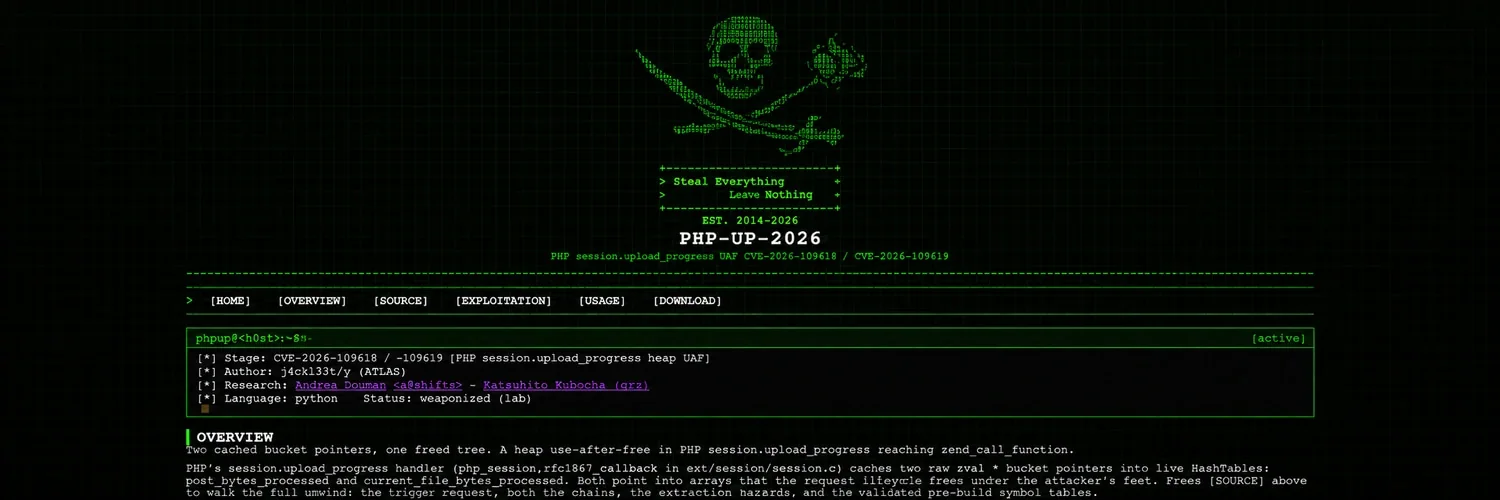
On October 21, Jλckλι, @J4ck3LSyN, posts a search screenshot. The query is “php-up-2026”; the interface shows 45 results in its coins category. Several visible rows carry the same name and green skull, but different addresses. At the top is an abbreviated contract beginning Cbkg5w7V and ending pump. His cybersecurity write-up now has tradable doubles. [1]
That number belongs to a screenshot, not a verified census of 45 clones. Yet the image shows the shift clearly: a research title has become a label that multiple token creators can reuse. Following this story requires the full address, not just the letters PHP. The DEX Screener listing for the contract examined here does link to J4ck3LSyN’s write-up and X account. [1] [10]
The terminal becomes a flag
The PHP-UP-2026 write-up concerns security problems in the PHP programming language. Its presentation is immediately recognisable: black background, green text, a skull and crossed swords, a terminal-style interface. The token banner borrows that visual vocabulary. Even before understanding the technical subject, readers have an image to recognise. [3] [10]
The news did not originate in the trenches. On October 21, PHP released fixes for two critical vulnerabilities allowing unauthenticated remote code execution. A joint statement published by ENISA urged organisations to apply the updates. The token therefore borrows its name from a real security emergency; neither advisory endorses it. [2] [9]
The distinction between the texts matters. The personal write-up carries an October 21 correction that rejects its initial exploit chain and describes a narrower issue. PHP’s official advisory still identifies a critical remote-code-execution risk. The blog’s conclusions should not be generalised to all the vulnerabilities or replace the software project’s guidance. The token narrative is circulating while the technical account is being corrected. [2] [3]
What if the fees paid for the research?
Under the screenshot, replies already suggest a different next chapter. Shakespeare, @prottlegang11, asks for a Solana wallet to receive donations. Alphaval, @alpha_vl, imagines fees funding further research, companies paying to fix problems and a portion returning to holders. This sketches a model in a reply; it does not document a functioning arrangement. [4] [5]
Fred, @Fred__42069, jokes about how easily the researcher could become a KOL, a market influencer. The compliment concerns attracting attention more than writing code. The same author can be read as a technical source by one audience and a prospective promoter by another. [6]
This is PHP’s most revealing turn. Participants are not simply borrowing a name without its author: some try to give him a place in the economic arrangement they imagine around it. Those invitations prove neither that he created this contract nor that he controls its supply or that any revenue sharing has actually occurred.
Two audiences in the same thread
On October 22, Jλckλι quotes his screenshot and posts a Pump.fun link, framing the gesture as a joke. The connection is now public on his own account. It documents his participation in the crypto conversation, without by itself identifying the contract’s creator or establishing an official relationship with the PHP team. [7]
Not every reply resembles a trader’s celebration. ねこち, @cgmali9, reproaches him for overnight maintenance work that this person attributes to his actions. That is an accusation in a thread, not established responsibility. Its presence nevertheless shows that spectators are judging different things: some discuss funding or visibility, others the consequences of disclosure. [8]
At the October 22 observation, Degen Flow also shares the exact contract while advertising a multiple on his own call. We do not treat that return as a verified result. The post illustrates a third way of telling PHP’s story: the technical news recedes behind the promotional record of someone claiming to have spotted it. [11]
The green skull brings together perspectives that remain distinct. The defining scene is still the screenshot in which a researcher finds his subject in a list of coins. Replies immediately try to turn that recognition into an ongoing relationship. Whether it produces anything beyond a link, proposed funding and another name in traders’ performance posts remains an open question.
Runner facts
PHP — PHP-UP-2026 · Solana. Contract: Cbkg5w7V7W2J2sUmecnyN825CbvwvXwasfhduVtNpump. Reference pair: PHP/SOL on PumpSwap. [10]
ATH reported to the editorial team: $2.14 million market capitalization on October 22, 2026 at 07:09, Paris time. This high comes from the supplied observation and was not independently recalculated.
Sources
Sources consulted on 22 October 2026. Figures reflect the cited snapshots and are not updated live.
- Jλckλι — capture des tokens PHP-UP-2026, 21 octobre
- PHP — avis officiel de sécurité du 21 octobre 2026
- J4ck3LSyN — dossier PHP-UP-2026 et conclusions corrigées
- Shakespeare — proposition de dons sur Solana
- Alphaval — proposition de financement par les frais
- Fred — réaction sur le rôle de promoteur
- Jλckλι — lien Pump.fun, 22 octobre
- ねこち — réaction critique dans le fil du 22 octobre
- ENISA — déclaration commune sur les vulnérabilités PHP
- DEX Screener — contrat, paire Solana et visuels PHP-UP-2026
- Degen Flow — promotion du token avec son contrat exact