
 RUNNERS / SOLANA
HOOKED: a fishhook in the rules of the market
On Solana, Hooked turns trading conditions into rules embedded in tokens. Stock-market hours, sell caps, fixes and buybacks shape a launchpad story whose supplied ATH reaches $11.91M on October 2, 2026 at 20:03 Paris time.
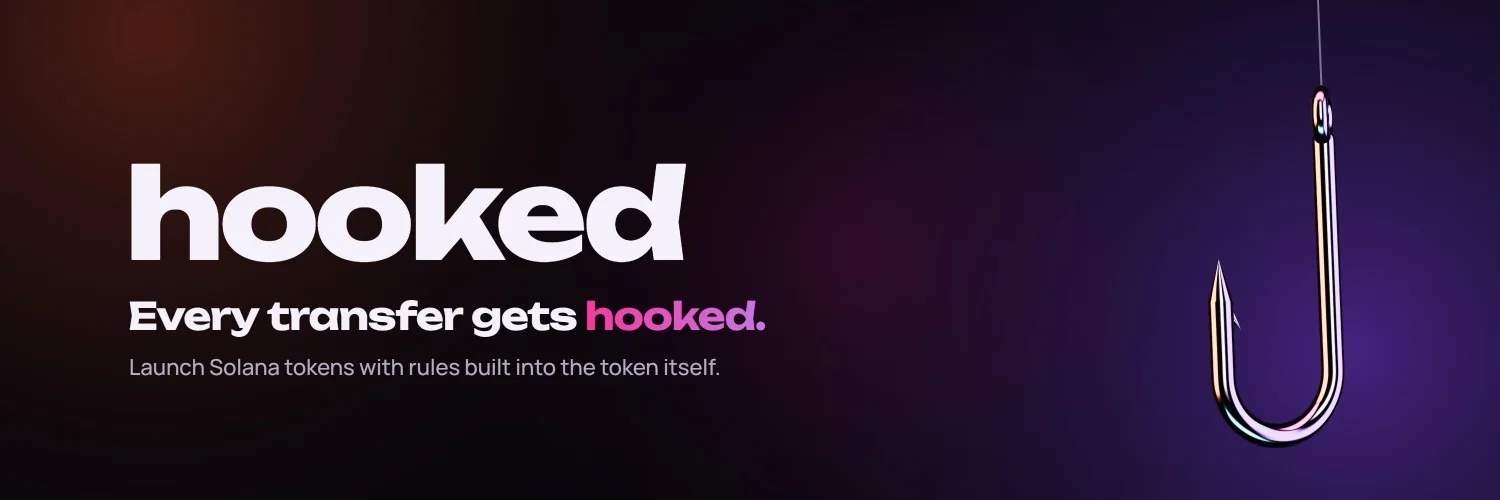
A fishhook instead of a mascot
A chrome fishhook hangs against black, rust and violet. The banner sets hooked in large white letters, with a pink word catching the eye in its promise that every transfer passes through a hook. The image works on two levels: a fisherman’s hook and a programmer’s hook, an instruction intercepting an action. HOOKED chooses that double meaning over a memecoin animal. Its founding scene is a market operation that can be refused. [2] [11]
On September 28 at 22:03:08 Paris time, @Hoookedpad announced its launch on Meteora and published C1mBfBoDkwWfd6uTFZp62ARHLjeVp3bDpCDMfMZtPngE. The first Meteora pair in our DEX Screener capture is dated 22:05:16. The proximity gives the public start a precise marker; it does not date the entire development process. Four days later, the supplied peak reached $11.91M on October 2 at 20:03. [1] [11]
A rule enforced by the token
The project presents itself as a launchpad for choosing the conditions under which a token circulates. Who can receive it? How much can leave in one sale? Which application can buyers use? The page groups rules around these questions, using tabs rather than an abstract pitch. An allowlist, a wallet limit or an unlocking schedule becomes an ingredient in a launch. [2] [3]
The underlying building block exists in Solana: Token-2022’s Transfer Hook extension invokes a custom program during transfers. It allows additional checks, including checks on recipients or fees. The documentation confirms the technical principle; it does not certify Hooked’s particular programs. The claimed innovation is turning these possibilities into a product where creators choose their settings. [4]
A sale that is too large makes the distinction easy to understand. According to Hooked’s documentation, the program examines the transfer and can fail the entire transaction if the amount exceeds its limit. It does not wait for a bot to correct the market afterward. This promise concerns tokens launched with those rules: the HOOKED name alone does not establish that every protection applies to the platform token itself. [3]
From nonstop markets to Wall Street hours
On October 1 at 18:10, the official account proposed an unusual feature for a world accustomed to continuous trading: a rule following the US session, Monday to Friday from 9:30am to 4pm New York time. The documentation includes options to leave sales open outside the session and observe holidays. It gives programmable tokens an immediately visible meaning: even the market’s timetable can become a token property. [5] [3]
At 18:58, Hooked said it had applied for verification with FOMO. An application remains an application, without proving approval or a partnership. At 23:13, another announcement described sliding caps: a sale permitted up to 1% of supply at launch could be capped at 0.5% at a $100,000 market cap, then 0.1% at $1M. These are configuration examples, not a description of sales of HOOKED. [6] [8]
The additions change the narrative’s engine. Restrictions are more than a defense against fast early buyers; they become material for inventing behavior. The documentation even describes linked tokens, one unlocking the other when a threshold is reached. Our reading is that Hooked turns the rules of the game into something a community can discuss. [3]
The community meets the closed doors
The exchanges also expose friction. On October 1 at 20:22, replying to @spil8x and @fomo, the team attributed an incident to a token named usdc, which it said had been flagged by OKX. It announced it would whitelist the pool to restore buying and selling and considered blocking certain names in future. This is Hooked’s published explanation, not an independent diagnosis from OKX. The scene nevertheless shows how rules also depend on the routes applications take. [7]
At 23:55, a reply to @fomofyx explained that a few buys from the creator wallet were needed for FOMO to recognize a Meteora pool. On October 2 at 04:34, the account announced that Pump App only was working and that existing tokens had received a fix automatically. Under that message, @blugati reported launches failing to appear; Hooked replied that it was fixed. @Shinobeetrader meanwhile asked for agentic launches. Users were already discussing access, display issues and future functionality beyond the chart. [12] [9]
Fees give the hook an economic role
The link between platform activity and HOOKED runs through buybacks. The documentation specifies a 1% fee on each trade on a Hooked bonding curve. Of that revenue, 85% is intended to buy HOOKED on the market and burn the acquired tokens; 15% funds development. The cycle is scheduled every ten minutes. The percentages matter: 85% of fees, not 85% of traded volume. [3]
The website displays a buyback dashboard with transaction links. That makes the narrative observable, but its counters are not an independent audit. Burning tokens does not promise income distributions to holders either. The engine remains usage: launches, trading and fees actually generated. A platform that attracts conversation but little activity does not feed the circuit in the same way. [3]
On October 2 at 01:57, Stitch (@stitchdegen) published an extended reading of the project. He examined buybacks, distinguished protocol fees from HOOKED pool fees and asked for greater clarity on creator-wallet flows. His central tension was durability: launched tokens need to keep living after their initial start. The post documents a critical discussion without, by itself, establishing the financial aggregates it cites. [10]
Do the rules outlive the launch?
The documentation separates two choices. A graduating curve is meant to migrate to a regular Meteora pool with the hook removed; a permanent curve keeps its rule. A protection advertised at launch therefore does not automatically become an everlasting protection. For certain rules tied to FOMO or Pump, access to a compatible application directly affects the ability to trade. The Social trading rule even warns that if both applications stop trading the token, holders could be unable to sell. [3]
The trust chapter also states that Hooked’s deployment authority can still upgrade the programs. Some configurations grant the creator exemptions. Those qualifications matter more than a slogan promising no intermediary: transfer controls are recorded on-chain, while upgrades, exemptions and compatible routes remain human choices. [3]
The supplied $11.91M peak on October 2 at 20:03 places the attention this proposition attracted. The announcements reviewed do not allow the rise to be attributed to one feature or one amplifier. The story to follow lies in a more interesting tension: creators want to invent markets with rules, and users still want to be able to exit them. Hooked has given that tension a fishhook, an interface and a token.
Sources
Sources consulted on 2 October 2026. Figures reflect the cited snapshots and are not updated live.
- Hooked — annonce de lancement avec le contrat, 28 septembre à 22 h 03 (Paris)
- Hooked — site officiel, règles et identité graphique
- Hooked — documentation : courbes, frais, exceptions et autorités
- Solana — documentation officielle de l’extension Transfer Hook
- Hooked — horaires boursiers, 1er octobre à 18 h 10 (Paris)
- Hooked — demande de vérification FOMO, 1er octobre à 18 h 58 (Paris)
- Hooked — incident du token nommé usdc et ouverture du pool, 1er octobre à 20 h 22 (Paris)
- Hooked — plafonds glissants, 1er octobre à 23 h 13 (Paris)
- Hooked — correctif Pump App only et échanges communautaires, 2 octobre à 4 h 34 (Paris)
- Stitch — analyse du produit, des revenus et de la transparence, 2 octobre à 1 h 57 (Paris)
- DEX Screener — Hooked / SOL sur Meteora, contrat et repères de création
- Hooked — réponse sur l’amorçage d’un pool FOMO, 1er octobre à 23 h 55 (Paris)