
 RUNNERS / BNB
Q币: the penguin bringing QQ memories back
From telephone top-ups to nights of gaming, Q币 brings a piece of the Chinese internet to BNB. Flap’s addition of wTCENTx provides the context; former users provide the stories. Reported ATH: $1.36M on September 29, 2026 at 07:25 Paris time.
A phone number returning to memory
At 08:48 on September 29, 电次, @karasonekamilia, does not begin with a chart. He recalls secretly buying Q Coins by phone as a child. He says he still remembers the numbers to dial, mentions a monthly limit and ends with the punishment he received when adults discovered it. Alongside this anecdote, he places a BNB address. A personal memory has become a way of discussing a token launched that morning. [1]
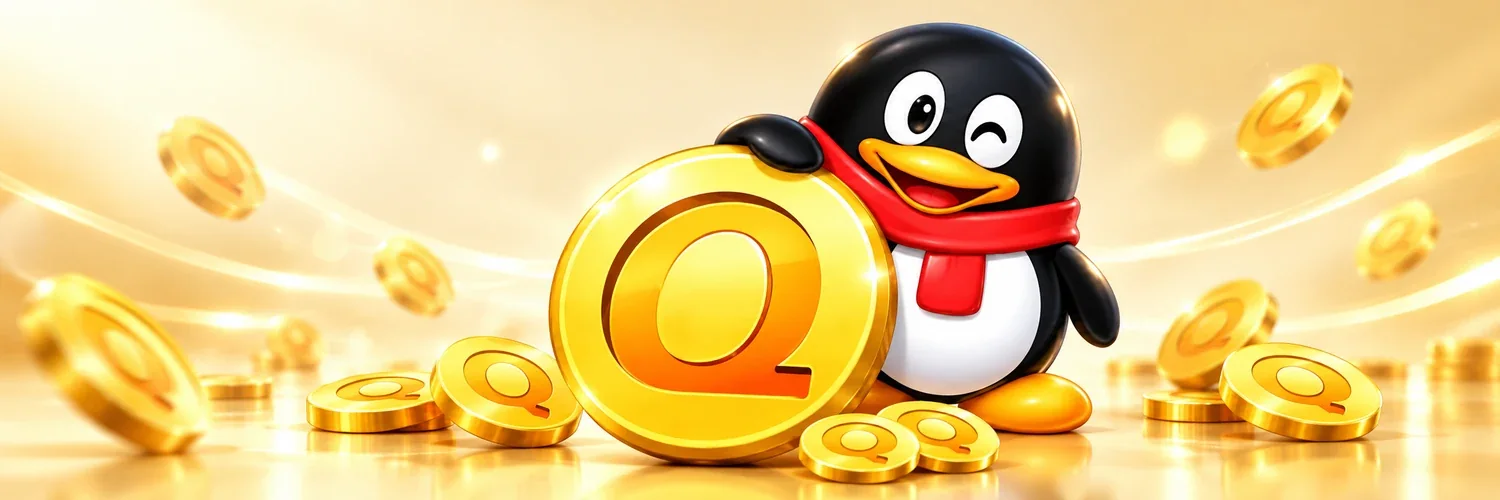
Q币, which can be read as ‘Q coin’, finds its hook here: an old virtual currency reappears in a new conversation. A black-and-white penguin, a red scarf and a large golden coin are enough to evoke QQ. The contract examined adopts this name and imagery; the sources consulted do not establish that it is a product launched or endorsed by Tencent.
Before the memecoin: top-ups and games
The reference has a documented past. A financial document published by Tencent in 2012 already lists retailers and distributors buying its prepaid Q-Coin cards among the company’s customers. This establishes a digital-services economy predating the BNB token by many years. It does not describe the contract that appeared in September 2026. [3]
Tencent’s official top-up centre still displays this environment: game credits, QQ membership, video services, reading and subscriptions identified by coloured diamonds. Those uses matter more to understanding the meme than an abstract definition of virtual currency. They evoke purchases, accounts and small markers of distinction associated with life online. [2]
The artwork’s golden coin plays on that familiarity. The Q covers almost its entire face; the penguin rests a flipper on it and winks, with two smaller coins at its feet. The illustration suggests a top-up and a reward. Our reading is that this identity avoids a lengthy introduction: it first asks whether the viewer recognises something from their own past.
07:03: Tencent enters Flap’s vocabulary
The immediate context comes from an announcement by Flap. In a message displayed as edited at 07:03 Paris time on September 29, @flapdotsh presents wTCENTx as newly available on the platform. The text recalls Tencent’s social, gaming, payments and cloud businesses. It announces a new pairing possibility; it does not present Q币 as an official Tencent creation. [4]
The requested contract’s DEX Screener listing makes the connection tangible. It identifies Q币 on BNB and a PancakeSwap pair with an asset named ‘Wrapped Tencent xStock’, symbol wTCENTx. Its creation timestamp is 07:01:28. That information describes a pair tracked by the aggregator, rather than establishing the complete deployment history on its own. [5]
Two layers consequently overlap in the posts: the addition of a quote asset associated with Tencent’s name, followed by the choice of a meme immediately evoking the company. This helps explain why participants are discussing QQ that morning. It establishes neither equivalence between the memecoin and QQ credits nor entitlement to Tencent shares through holding Q币.
An entire generation’s first coin?
At 07:10, No.17, @CryptoHtdi, posts the exact contract and suggests Q币 was the first coin his reader ever bought. He adds that Q Coins existed before Bitcoin. The line turns a consumer experience into cultural precedence: people who topped up accounts might recognise a familiar word in a market that has become much more complicated. The ‘first purchase’ claim is a rhetorical invitation, not a survey of every user. [6]
At 07:14, CourageZz, @Lucky766650286, explicitly connects the idea to Flap. Who does not know QQ, he effectively asks, and who has never bought Q Coins? He presents Q币 as the most suitable meme for the new pair and compares it favourably with another figure, a frog. This post directly connects the tracked contract to a narrative thesis, minutes before the supplied peak. [7]
At 07:16, @dong7da7 extends the wordplay: he says he has gone all-in on Q币 because he actually owns Q Coins. The line relies on two meanings colliding under the same name. It works precisely because the assets differ: the memory of an old QQ balance becomes a joking justification for commitment to the new token. [8]
After the peak, memories become content
The ATH supplied to the editorial team is $1.36 million in market capitalisation on September 29, 2026 at 07:25 Paris time. The posts at 07:10, 07:14 and 07:16 precede that reference. They document the narrative’s circulation without establishing each message’s contribution to the rise.
At 07:26, No.17 revives another familiar format: a message promising one hundred Q Coins to anyone forwarding the contract to five groups, supposedly for Ma Huateng’s birthday. We read it as an adaptation of a chain message, not a Tencent promotion or verification of that birthday. Nostalgia now works through the method of sharing as much as through the picture. [9]
At 08:40, diu, @handlemint, recalls nights in the QQ games lobby and lists poker, mahjong, matching games and dou dizhu. At 08:48 comes 电次’s account of telephone top-ups. These contributions follow the ATH and give the theme texture: specific games, habits and anecdotes replace the simple claim that everyone knows the name. [10] [1]
Shared memories, competing tokens
Familiarity does not automatically gather everyone around one contract. At 08:06, @WangchaiTom, whose account carries a parody label, argues for 欢乐豆 over Q币. In his view, those game tokens are more widely recognised, including among younger and older people. He attaches a different contract. The argument remains his, but shows that competition also concerns which memory is considered most universal. [11]
At 08:18, @luckying1122 complains precisely about fragmentation between BSC projects. Earlier, at 07:29, @KarianeVries criticises the recycling of old memes and challenges the idea that a Tencent reference is enough to give the launch value. These reactions do not substantiate any allegations they contain; they show a less unanimous reception than nostalgic slogans might suggest. [12] [13]
The sources assembled do not identify the contract’s creator with certainty. The observable thread is one of community relays: a new pair, a familiar name, wordplay, then competition between fragments of the same digital past. Q币 has found an entrance into that memory. Its distinctive identity will have to develop within a world that many other tokens can also evoke.
Sources
Sources consulted on 29 September 2026. Figures reflect the cited snapshots and are not updated live.
- 电次 — souvenir des recharges téléphoniques, 29 septembre à 08 h 48 (Paris)
- Tencent — centre officiel de recharge, jeux et abonnements
- Tencent — document financier de 2012, cartes prépayées Q-Coin
- Flap — annonce de wTCENTx, message affiché modifié à 07 h 03 le 29 septembre (Paris)
- DEX Screener — Q币 / wTCENTx, contrat et paire PancakeSwap
- No.17 — le premier coin acheté, 29 septembre à 07 h 10 (Paris)
- CourageZz — le rapprochement entre la paire Tencent et Q币, 07 h 14 (Paris)
- 被蜗牛追杀中 — jeu sur la possession de Q Coins, 07 h 16 (Paris)
- No.17 — détournement du message à transférer dans cinq groupes, 07 h 26 (Paris)
- diu — souvenirs du hall de jeux QQ, 08 h 40 (Paris)
- 汪一一一歌 — comparaison avec 欢乐豆 et contrat distinct, 08 h 06 (Paris)
- BW冰糖橙 — critique de la dispersion entre projets, 08 h 18 (Paris)
- KarianeVries — critique du recyclage des anciens memes, 07 h 29 (Paris)