
 RUNNERS / SOLANA
GoCollect: crates in the city, cards at the end of a walk
On Solana, COLLECT connects trading fees to a hunt for tokenised physical cards. Early finds, empty crates and player accounts give the launch a life outdoors. Reported ATH: $3.55M on September 26 at 01:06 Paris time.
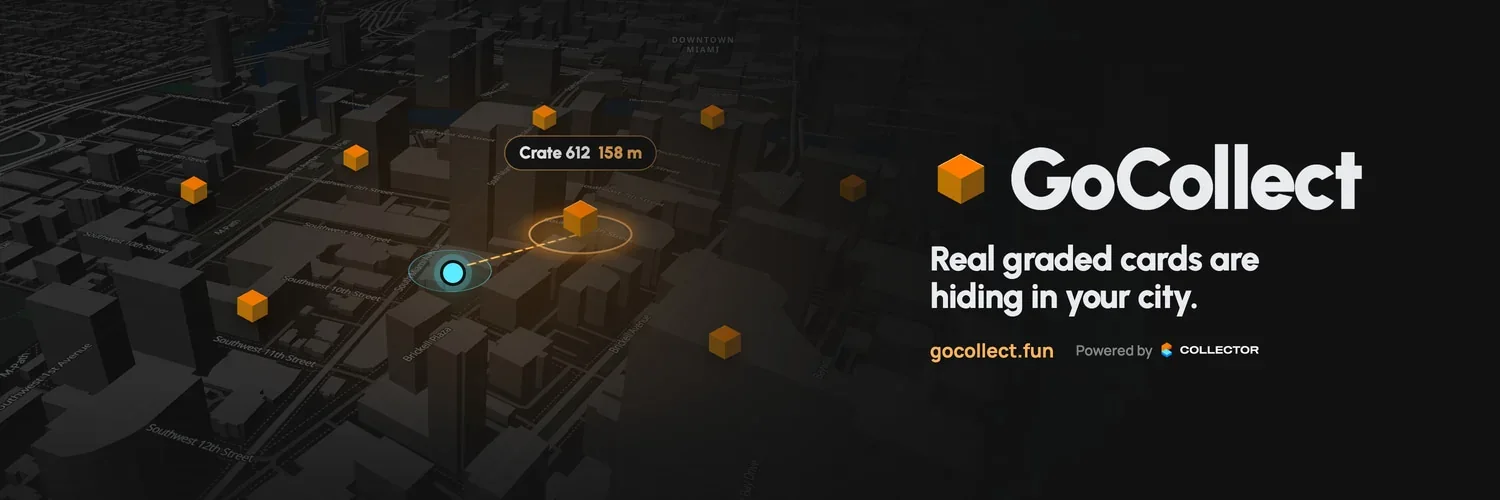
An orange crate down the street
On GoCollect’s banner, a dark city is dotted with orange cubes. A blue marker approaches a crate; a label still shows 158 metres. The scene does not require familiarity with a meme character or an inside joke. It suggests movement: leave the chart, look at a map, walk. The logo repeats that cube, an object waiting to be opened. [8]
Behind COLLECT is the promise of finding trading cards while walking. They appear in a digital wallet, but are described as backed by physical copies held by Collector Crypt. This meeting of location-based hunting and collecting gives participants a story they can extend through their own finds. The peak supplied to the editorial team is a $3.55 million market capitalisation on September 26 at 01:06 Paris time. [1]
The launch invites people outside
On September 25 at 02:57, @gocollectfun publishes its announcement with a video lasting approximately one minute. The journey involves a few steps: connect a Solana wallet, allow location and approach a crate. Opening becomes possible within roughly forty metres; the project says a winning card reaches the wallet within a minute. A first crate is supposed to appear where the player is standing. [2]
The game runs in a phone browser. On desktop, a map and QR code invite visitors to continue on mobile. Documentation images show Brickell in Miami, a Mega Absol ex card graded CGC 10 Pristine and an empty crate. That last screen matters as much as the prize: an opening does not always produce an item. The advertised limit is the same twenty-five crates per day for everyone. [1]
The website and X account both display nDZknLvfFRp5rgUHdzTrQsmSY5NKzoavqdLjSHVpump. DexScreener identifies it as GoCollect, symbol COLLECT, on Solana. That is the blockchain corresponding to the address examined here. Matching the three sources helps distinguish the game’s name from an unrelated asset or from CARDS, Collector Crypt’s token mentioned in its communications. [1] [2] [8]
A digital card, a stored object
The project divides prizes by insured value: below $30 for common items, $30–75 for uncommon, $75–300 for rare and $300 or more for grails. Behind those categories are identifiable cards, with characters, sets and grading scores. Rarity takes a form familiar to collectors, extending beyond a colour inside an application. [1]
Collector Crypt describes insured storage, authentication and linking cards to profiles or wallets, together with a marketplace. GoCollect says winning items can be sold there or redeemed for the physical card to be shipped. This describes the intended process; we have neither made a redemption nor verified a delivery. Receiving the digital collectible and receiving the physical object remain separate stages. [1] [4]
Trading fees stock the crates
According to the documentation, COLLECT trades on pump.fun with a 3% creator fee allocated entirely to prizes. The advertised split assigns 90% of those receipts to affordable cards and 10% to pieces worth at least $300. The vault corresponds to the treasury wallet, publicly linked on Collector Crypt. Funding the game is therefore explicitly tied to token activity. [1]
That connection explains the commercial argument: more trading should enable more prize purchases. It also creates a concrete dependency. High game attendance alone does not demonstrate that inventory is replenished at the same pace. Players open crates; transactions finance their contents. Following the project requires considering both movements together, instead of treating every new player as revenue.
In the September 26 snapshot, the statistics page advertised a 98.6% chance of an empty crate. Displayed probabilities change with inventory, so this is not a permanent rule. It nevertheless indicates how much the experience depends on waiting and repetition, even when social posts primarily showcase the finest cards. [3]
Pseudonyms behind the finds
The public dashboard goes beyond aggregate numbers. Yeezus appears with a One Piece Roronoa Zoro card, graded PSA 10 and valued at $850. Another row shows Monkey D. Luffy at the same amount; Lugia and Latias feature further down. These names give players a shared vocabulary even if they do not follow the same tokens. They are platform-listed finds and advertised valuations; the editorial team has not checked every transfer. [3]
Not every account is about a grail. At 06:57 on September 26, @cryptoovicky, introducing himself as Vicky, describes a harder search than expected, muddy roads and a broken slipper. He also says he has not slept since the previous night. This public testimony has not been verified on location, but it illustrates another way of discussing the game: through effort and fatigue instead of a card’s price alone. [7]
Here the community’s voice starts to diverge from the product demonstration. The walk imagined by the website meets actual routes, constraints and unequal outcomes. Collecting supplies images to share; searching for crates also produces its own anecdotes.
Fast numbers need dates
At 17:26 on September 25, the account announces 13,597 users and 6,327 people currently playing, in a report presented as covering its first fourteen hours. On September 26, another post claims $100,000 in cards won, 2,548 cards pulled and 25,389 collectors. These are team-reported figures, not an independent measurement of the audience. [5] [6]
The statistics page subsequently reviewed displayed 25,621 collectors, 164,492 opened crates and 2,562 prizes with a combined stated value of $103,366. It also listed 1,251 cards remaining in the vault. These successive snapshots must not be added together: they describe counters at different moments. The cards’ stated value does not represent proceeds actually realised through resale either. [3]
For draws, the website describes publishing a fingerprint before each hour and revealing the corresponding seed afterwards. It displays information intended to allow results to be checked and advertises detection of simulated locations, teleportation and driving speeds. These mechanisms are documented by the project; their presence does not constitute a full audit of their effectiveness. [1] [3]
After the peak, the next walk
The $3.55M ATH at 01:06 remains the reference supplied to the editorial team, without a transaction-by-transaction reconstruction. Twenty-two hours and nine minutes separate the September 25 announcement at 02:57 from that peak. Figures published on the morning of September 26 document the launch continuing, rather than the exact situation at the ATH.
GoCollect has a tangible narrative: a recognisable card, a crate to look for and a find to describe. Its continuation will be visible in replenished prizes, physical redemptions and the willingness to return after several empty crates. The token already has its reported peak; the game still has to turn those first walks into a habit.
Sources
Sources consulted on 26 September 2026. Figures reflect the cited snapshots and are not updated live.
- GoCollect — règles et financement des récompenses
- GoCollect — annonce du 25 septembre à 2 h 57 (Paris)
- GoCollect — statistiques et trouvailles, relevé du 26 septembre
- Collector Crypt — conservation, authentification et marché
- GoCollect — bilan après quatorze heures, 25 septembre à 17 h 26
- GoCollect — annonce des 100 000 dollars de cartes, 26 septembre
- Vicky, @cryptoovicky — récit de recherche des caisses, 26 septembre à 6 h 57
- DexScreener — identité du token, paires et visuels