
 RUNNERS / SOLANA
Stamp: burn on Solana, keep a record on Zcash
A pixel stamp, a certificate of destruction and privacy that remains to be built. Stamp connects Solana traders with expectations around Zcash, with a reported $14.63M peak on September 21 at 01:59 Paris time.
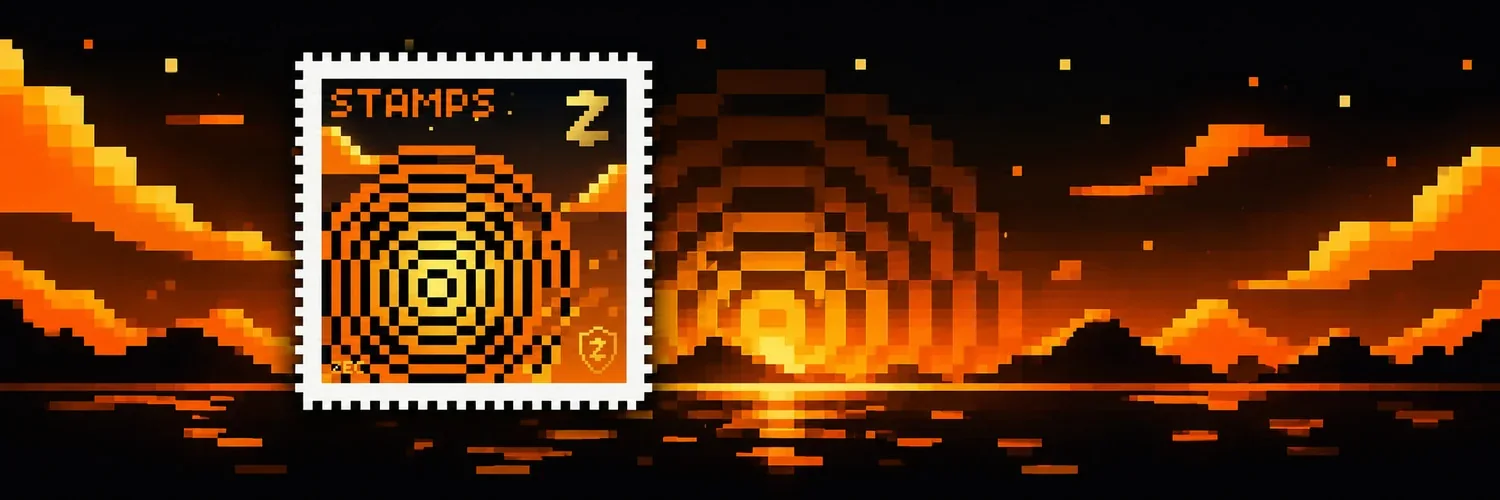
A stamp obtained by giving something up
A white perforated border, orange rings and a fiery horizon: Stamp looks like something you might collect. Behind that small picture lies a less familiar action. Users are asked to destroy tokens on Solana to receive an inscription on Zcash, a receipt recording the quantity surrendered. The project turns an irreversible act into an object to keep. [1] [11]
That contrast makes this runner distinctive. Stamp does not begin with a viral animal or a remixed video: it turns anticipation of a technical development into a collecting story. Its peak supplied to our editorial team is $14.63 million in market capitalisation, reached on September 21, 2026 at 01:59 Paris time. A few hours earlier, replies on X were already debating what the certificate could actually represent.
September 20: explaining the passage between two chains
At 20:38, @Zip227 outlines its idea: SPL tokens and NFTs would provide an intermediate solution while the project waits for Zcash to accommodate the assets it envisages. The explanation connects an available action — burning — with a future possibility — converting the certificate into an asset on Zcash. The narrative takes shape in that gap. [2]
A reader arriving from Solana recognises a contract and a market. Someone following Zcash recognises a vocabulary: shielded assets, inscriptions and network upgrades. Stamp brings those conversations together without making them identical. The address EKtmPPLaCbEEKiwoHHtV7TsRsmPXs5CMGtQtZFSiinsc appears in the project’s presentation and The Watchers’ examination, allowing readers to follow the same token through similar names. [3] [11]
At 21:17, verification becomes a point of reference
The Watchers then publishes a detailed examination. The account says it matched a burn of 1,000,000 Stamp on Solana with an inscription on Zcash mainnet, checking the amount, destruction signature and recipient. It supplies the exact contract, a Solscan transaction and a Zcash identifier. It also reports 89 successful tests, explicitly noting that this is not a security audit. We are reporting that work, not claiming to have independently reproduced it in full. [3]
The post matters because it offers two readings at once. It supports the existence of a working example while stressing that the receipt remains public, the two transactions are separate, and conversion into a shielded asset is still in the future. In Nick O’Neill’s thread, Steveler.eth links to the examination and compares the mechanism with Ordinals. Verification becomes an explanation participants can pass to one another. [3] [6]
In the replies, enthusiasm meets a straightforward question
Templar tags @zooko to ask whether this is a major technological breakthrough. That invitation is neither a response nor an endorsement from Zooko. At 22:32, Nick O’Neill raises a more specific objection: which NFT protocol is the project referring to, when several approaches coexist? These are two ways into the same subject: seeking recognition or asking for a definition. [4] [12]
Mamba brings the discussion back to use. In this participant’s view, certificates will acquire value only if a market develops around them. The next day, parobus asks what Zcash assets are for. These exchanges prevent the community from being reduced to a string of encouragements. Some want to know whether the code works; others ask why anyone would want to keep what it produces. Burning answers the first step, not every subsequent one. [5] [13]
A name borrowed from the protocol, not an affiliation
ZIP 227 is an official proposal concerning the issuance of Zcash Shielded Assets. The document consulted is marked Draft and describes a consensus change. That does not make the Solana token Stamp a native asset under that specification. The project’s website explicitly states that it is independent, with no affiliation or endorsement from the Zcash Foundation or Electric Coin Co. [1] [7]
The public repository describes a watcher that detects burns, a service that writes certificates and a ledger that validates them. It distinguishes conversion from backing: destroyed tokens do not remain in a deposit somewhere. Privacy belongs to a later stage; the current process uses a transparent Zcash address. “Shielded” in the name therefore expresses an ambition, rather than a demonstrated property of the present receipt. [8]
The certificate, and details that still need careful reading
On the website consulted on September 24, the interface specifies a minimum burn of 1,000,000 Stamp. A numbered certificate presents destruction as an archival object. The table displays one burn of that amount, while a separate counter announces 172 tokens launched. Those figures measure different activities: creating a token does not establish that a holder has completed the journey to a certificate. [1]
The documentation also preserves traces of development. Its progress journal describes a rehearsal on both mainnets using 1,500,000 units of a separate test token. Some general statements still refer to testnet. Examples must therefore be read in context, without confusing a rehearsal with the Stamp burn identified by The Watchers. The documentation is useful, but it is not a perfectly synchronised historical record. [3] [8] [9]
Another revealing detail: the website says there is no organised market for the certificates yet. The value of the token traded on Solana and that of a receipt kept on Zcash are therefore not interchangeable. The stamp’s appearance gives the project a tangible shape; it does not, by itself, create demand from collectors. [1] [5]
After the peak, a roadmap expands the story
At 03:36 on September 24, the roadmap adds several areas of work: making burns more visible, developing buybacks and destruction funded by launchpad activity, and preparing migration to native assets if Zcash enables them. Its phases are team objectives. They neither set Zcash’s activation timetable nor demonstrate that every announced mechanism has been delivered. [10]
That publication comes after the supplied ATH. It illuminates what the project wants to become, without retrospectively explaining every purchase preceding the peak. The $14.63M figure remains our supplied reference point, not an independently reconstructed historical maximum. Stamp’s story ultimately rests on a fragile transition: making a public receipt into a desirable collectible, and perhaps later into a private asset. Between those stages, participants are already asking for evidence, uses and a reason to keep the stamp.
Sources
Sources consulted on 24 September 2026. Figures reflect the cited snapshots and are not updated live.
- Stamp — site, certificat et avertissement sur l’indépendance du projet, consulté le 24 septembre
- Zip227 — présentation du mécanisme, 20 septembre à 20 h 38 (Paris)
- The Watchers — examen du burn et de l’inscription, 20 septembre à 21 h 17
- Nick O’Neill — question sur les standards NFT, 20 septembre à 22 h 32
- Mamba — discussion sur la valeur et le marché des certificats
- Steveler.eth — rapprochement avec les Ordinals et relais de The Watchers
- ZIP 227 — proposition officielle d’émission des Zcash Shielded Assets
- BasedDEV101 — dépôt public ZcashMEME et description du mécanisme
- ZcashMEME — journal des essais, dont une répétition mainnet avec un token de test
- Stamp — roadmap du 24 septembre à 3 h 36
- DexScreener — contrat, marchés et visuels de Stamp
- Templar — question adressée à Zooko dans le fil du 20 septembre
- parobus — question sur l’utilité des actifs Zcash, 21 septembre