
 RUNNERS / ROBINHOOD
QUANTA: behind the “Meteora of Robinhood”, a community asks for substance
An electric-green interface, liquidity pools and public answers about the token’s role: Quanta Pools brings an infrastructure narrative to Robinhood Chain. Its reported ATH reached a $1.38 million market cap on September 24 at 02:15 Paris time, during a night of demonstrations and questions.
By 21:17, the shorthand has already landed
Under the Quanta Pools announcement, PopeCalls sums up the project in a few words: “Basically meteora of RH”. It is 21:17 in Paris on September 23. Fifteen minutes after the official post announcing mainnet availability, a reader has already supplied its most shareable comparison. There is no animal to recognise or catchphrase to remix: a familiar platform has been transplanted into the imagination of another blockchain. [2] [3]
The comparison begins with Quanta itself, which describes the project as its version of Meteora for Robinhood Chain. That gives traders a reference point; it establishes neither a partnership with Meteora nor equivalence between the products. The distance between an appealing comparison and a service that still needs to prove itself is what makes QUANTA’s first hours interesting. [2]
At 02:15 on September 24, the peak reported to the editorial team reaches a $1.38 million market capitalisation. That figure and time are this article’s reference point; the exact peak has not been independently verified. Subsequent announcements belong to the next part of the story and cannot retrospectively explain its initial trigger.
Green waves instead of a mascot
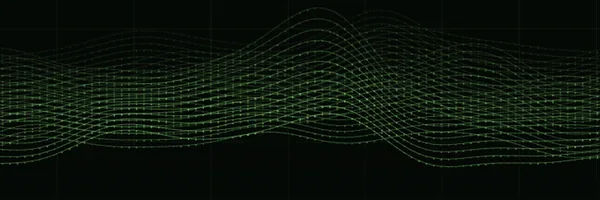
The website welcomes visitors into an almost entirely black setting. Green dots form undulating sheets; a grid and technical labels surround a promise of liquidity for Robinhood Chain. The token’s banner repeats those waves. The eye is directed towards flows, connections and markets rather than a character. [1] [12]
This identity accompanies a project presenting itself as independent infrastructure. The contract supplied to the editorial team appears on the website, in the X announcement and in DexScreener’s listed markets: 0x1da81ca017949efbe07972776580d04592ba9b63. That cross-check ties these sources to the same QUANTA. The site also states that the project is not affiliated with, sponsored by or endorsed by Robinhood. [1] [2] [12]
Our reading is that the narrative shifts attention: after the tokens people trade come the tools intended to make those trades possible. For participants, backing QUANTA becomes a bet on its place in the ecosystem. That is an interpretation of its positioning, not a measurement of adoption.
How liquidity providers change the story
The intended audience extends beyond people buying a token. Quanta addresses liquidity providers, or LPs: people depositing assets into pools used for swaps. Its announcement brings together DLMM, DAMM, position management and dynamic fees. Meteora’s documentation helps explain the reference: its terminal offers functions including creating and tracking positions, claiming fees and rebalancing liquidity. It does not validate Quanta’s implementation. [2] [13]
On its own website, Quanta describes a router intended to compare several liquidity sources: internal pools, Pons markets and external Uniswap v4 liquidity. Its stated ambition is to bring those paths into one interface, with slippage, deadline and Pons token-lifecycle checks. For users, the promise is less movement between separate tools. [1]
The project also distinguishes volatile launch tokens, tokenised stocks and future approved real-world assets. The last category is presented as a future extension. Including these assets in an architecture does not mean a corresponding catalogue of markets is already available. The difference between the proposed scope and the observable offering runs throughout the presentation. [1]
Readers start looking behind the interface
The conversation is not entirely enthusiastic. At 21:08, gootshed claims the counters then displayed do not match the API responses he is examining. That is a participant’s published criticism, not a finding we reproduced at that time. It nevertheless shows that some readers are already looking behind the presentation. [5]
During our September 24 visit, the application initially displays an unavailable indexer before synchronising and showing two discovered pools and three registered assets. That loading sequence matters: a temporary zero would have produced a misleading snapshot. The depth chart is described as illustrative, so we do not treat it as evidence of millions of dollars deposited. [4]
These observations neither settle the earlier discussion nor constitute an audit. They provide a more precise picture of the visible development stage: an accessible interface, data that loads and functions whose operation needs to be assessed separately. A technical badge or an attractive curve cannot, by itself, answer every user question.
At 02:51, the next worksite is Telegram
After the reported peak, Quanta says its Telegram liquidity terminal is approximately 40% built. The proposed functions describe a practical routine: discovering pools, comparing DLMM and DAMM, tracking fees, finding positions, adjusting ranges and rebalancing deposits. The account explicitly describes a product still under construction. [6]
The appeal of this format lies in an existing habit: discussions and alerts already circulate in messaging apps. The developer wants position monitoring and management closer to those conversations. Our interpretation is that this promise concerns user convenience as much as technology. The completion percentage remains the developer’s statement; it cannot establish that the terminal is a finished service.
“What’s the role of the token?” changes the conversation
SpeedRacer asks what QUANTA does: buybacks, burns, an airdrop? He wants a post explaining the tokenomics. At 04:26, the account replies that 95% of protocol fees will be used for QUANTA buybacks and burns. The reader thanks the account and expresses interest. In this short exchange, the discussion moves from the product to how its token might benefit. [7]
The subsequent answers matter just as much. Asked whether the mechanism is automatic or manual, Quanta says at 04:31 that automation is still being worked on. When Daniel.HL asks which wallet will perform the operations, the account replies at 04:48 that it is setting up the system and promises an update. [8] [9]
This is therefore an announced allocation of protocol fees, not 95% of trading volume, nor evidence in those posts of buybacks already executed. These details also arrive more than two hours after the reported ATH. They add to the project’s economic narrative without establishing the cause of that earlier peak.
A demonstration with a trace to follow
At 06:11, Quanta publishes a DAMM v2 swap demonstration through its SmartRouter and supplies a transaction link. This time, readers can leave the X thread to check a specific record: Blockscout marks the transaction successful on September 24 at 05:52:42 Paris time. It originates from the address presented as the deployer and interacts with the contract identified by the website as SmartRouter. [1] [10] [11]
The visible transfers show WETH passing into USDG through contracts on the announced route. That is a specific execution trace, more informative than a demonstration button alone. Its significance remains that of one operation: it does not measure protocol traffic, the depth of all its pools or the reliability of every promised feature. [11]
The next chapter will be written through use
QUANTA enters the Runners section with a story different from a mascot going viral. Its raw material combines a familiar comparison, product images, questions addressed to a developer and early evidence readers can inspect. The community is not merely repeating a name: it asks what revenue might reach the token and what already works.
The reported $1.38 million peak brings that sequence into view. The next meaningful developments will be repeated usage, positions actually managed and verifiable implementation of the announced mechanisms. The nickname “Meteora of Robinhood” offered an opening in the conversation. What follows depends on what users can do with the product, then tell one another about.
Sources
Sources consulted on 24 September 2026. Figures reflect the cited snapshots and are not updated live.
- Quanta Pools — site officiel, architecture et contrat du token
- Quanta Pools — annonce mainnet, 23 septembre à 21 h 02 (Paris)
- PopeCalls — comparaison avec Meteora, 23 septembre à 21 h 17
- Quanta Pools — application publique, relevé du 24 septembre
- gootshed — interrogation sur les données de l’interface, 23 septembre à 21 h 08
- Quanta Pools — terminal Telegram annoncé à 40 %, 24 septembre à 2 h 51
- Quanta Pools — réponse à SpeedRacer sur les frais du protocole, 24 septembre à 4 h 26
- Quanta Pools — automatisation encore en développement, 24 septembre à 4 h 31
- Quanta Pools — réponse à Daniel.HL sur le portefeuille de rachat, 24 septembre à 4 h 48
- Quanta Pools — démonstration DAMM v2 et SmartRouter, 24 septembre à 6 h 11
- Blockscout — transaction de démonstration réussie le 24 septembre à 5 h 52 min 42 s
- DexScreener — contrat, marchés et visuels de QUANTA, relevé du 24 septembre
- Meteora — documentation officielle du terminal de liquidité DLMM