
 RUNNERS / BNB
$TRUMAN, the audience takes control of the show
An AI character, a persistent world and viewers intervening in the story: Truman World finds a community and a potential funding model on BNB. On September 20, $TRUMAN reaches a $3.52 million market capitalisation.
A token address lands on Truman’s phone
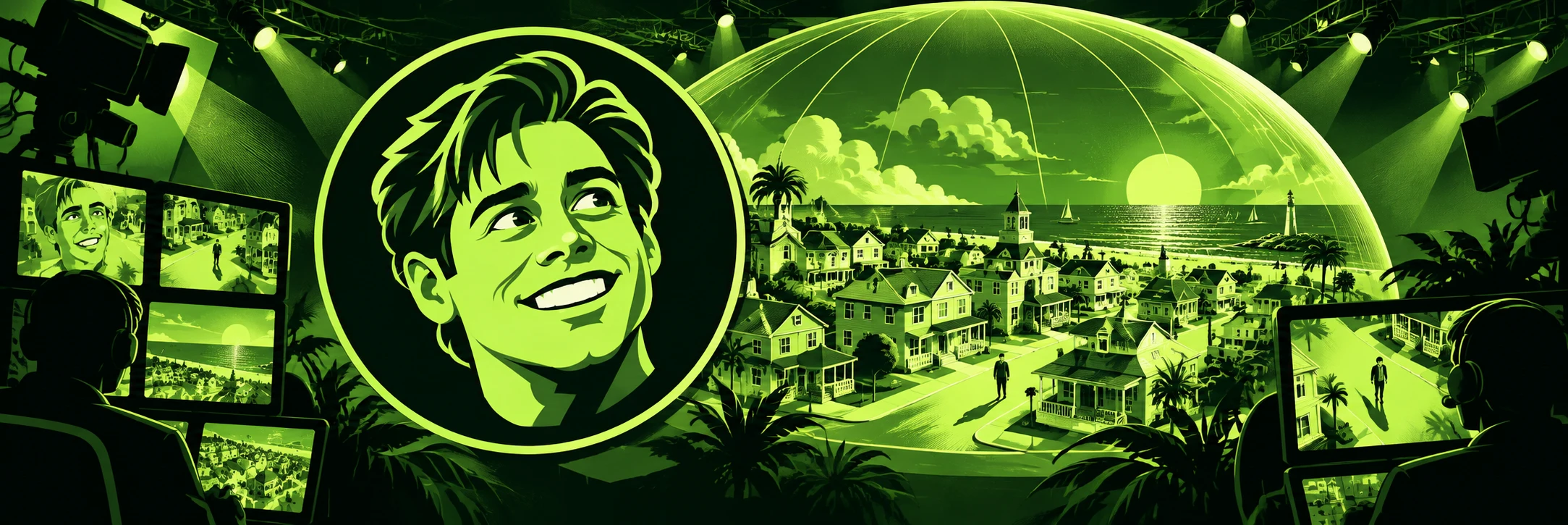
Someone sends Truman a token address. In Truman World’s public log, the character replies that he does not understand the code and asks for a clear message. The contrast captures the project: outside, a community follows an asset on BNB; inside, a character tries to make sense of messages entering his everyday life. When we visited, the camera had stopped, but conversations and events remained visible. The show therefore has two stages: the character’s world and the audience trying to redirect his story. [1]
At 11:48 a.m. Paris time on September 20, 2026, $TRUMAN reached a market-cap peak of $3.52 million, according to the observation supplied to the newsroom. That figure measures neither Truman World’s revenue nor its audience. It places a market acceleration around an experiment whose relationship with the token changed in less than a day. This is where the story becomes interesting: the creator initially said he did not have a token, before announcing that trading fees would help keep his world running. [3] [9]
The audience steps into the control room
On September 19 at 6:39 p.m. Paris time, Will, known on X as Will (Exploring AI), introduced Truman World. He proposed a livestream inside a persistent universe: Truman does not know he is in a simulation, while visitors can influence his surroundings. The name, surveillance and gap between the protagonist’s knowledge and the audience’s perspective make the reference to The Truman Show immediately recognisable. Here, the premise becomes a participatory fiction powered by artificial intelligence. [2]
One rule matters: visitors act around Truman rather than controlling him directly. Changing a situation, introducing an object or altering circumstances sets the scene; the character’s reaction then belongs to the system. In principle, this makes the viewer a partial director, with uncertainty forming part of the attraction. [2]
Will describes agents with memories, changing relationships and a world governed by spatial and causal continuity. These are the creator’s stated features, not findings from a technical audit. Nevertheless, the project poses a more concrete question than the spectacle of generated images alone: will an intervention leave a lasting enough trace to change what happens next? [2]
A phone, constraints and impatient spectators
Early interactions reveal a gap between visitors’ imagination and the proposed world’s limits. Will notes that many people are trying to text Truman. He explains that the character cannot receive messages without his phone. This apparently mundane detail becomes a narrative rule: an event should not happen merely because someone requested it. It needs a plausible route into the character’s world. [4]
That constraint separates an unfolding story from a succession of instantly executed commands. It can create waiting, frustration or surprise. It also asks people to observe before intervening. The misunderstood contract address is a revealing episode: market language enters the setting, but the character does not automatically treat it as the centre of his existence. [1] [4]
Collective participation also raises moderation questions. Will subsequently announces filters for problematic content, including sexual material, and an end to automatic retries when a prompt is rejected. The announcement describes a system adjustment; it does not establish that all abusive interventions have disappeared. In an open fiction, these decisions shape the atmosphere: what visitors can impose on the world affects what others are willing to watch. [6]
Keeping the camera running without requiring a wallet
At launch, Will describes an initial eight-hour broadcast window and a paid mechanism for extending camera time, initially priced at five dollars per additional minute. The distinction between the broadcast and the world is central: he says the simulation continues when the video stops. The expense therefore keeps a window open onto the experiment, rather than being presented as a prerequisite for every event to exist. [2]
The first adjustment follows an obstacle much less spectacular than AI: some visitors do not have a crypto wallet. Will makes prompts available without USDC payments for the rest of the livestream. Free participation lets curious newcomers experiment without making a transaction. Under the arrangements observed, buying $TRUMAN is therefore not a prerequisite for taking part. [5]
He later announces more than 3,000 unique visitors and seven additional hours of broadcasting. His subsequent recap mentions more than 4,000 visitors. These are the creator’s figures, without independent verification. They primarily document how he presents the project’s beginnings: an experiment quickly opened to the public and adjusted in response to feedback. [7] [9]
September 20: trading fees enter the picture
The timeline helps avoid a shortcut. When someone asks for the contract at launch, Will replies that he does not have one. This does not establish who deployed $TRUMAN or when it was created. It does, however, prevent an unqualified account of a show designed from the outset as an asset’s official showcase. [3]
At 11:05 a.m. Paris time on September 20, Will posts a FlapGift request containing the exact BNB contract covered here: 0xabffa443547b34ab6c3b3173d26e233900527777. At 11:23 a.m., he explains his change of position. He thanks @XIGUA0903 for encouraging him to claim the fees, then cites a conversation with @eth_cedric: use that revenue to cover livestream costs and make Truman World free. [8] [9]
Will announces his intention to claim $Truman’s fees and dedicate future fee revenue to running the project. The public link between the experiment and this contract is now explicit. Its scope needs precision: a request and a commitment are documented; the amounts actually received, their allocation and their ability to cover expenses have not been verified here. The peak supplied to the newsroom follows the announcement by twenty-five minutes. The timing is notable, but it does not by itself establish what caused the rise. [8] [9]
What the token brings to the story
The $TRUMAN narrative now rests on a proposed cycle: attention around the world attracts a community, token activity could generate fees, and those receipts would help extend the show. The strength of that cycle depends on costs and revenues not yet documented in the sources reviewed. A $3.52 million market capitalisation is not a reserve available to pay for generated footage.
In his recap, Will also highlights a follow from Marc Andreessen. That is a sign of attention he reports, not an announcement of investment or partnership. The editorial task is to keep these distinctions clear: a self-reported audience, a prominent follower, a commitment to allocate fees and a secondary market are different things. [9]
Will promises another livestream within twenty-four hours while saying the world continues to run. What follows will reveal what survives the initial curiosity: characters whose adventures people actually follow, interventions that enrich the story, and funding transparent enough to explain how the camera stays on. For now, $TRUMAN has found its most distinctive premise: making the cost of the show part of the show itself. [9]
Sources
Sources consulted on 20 September 2026. Figures reflect the cited snapshots and are not updated live.
- Truman World — interface et journal public, consultés le 20 septembre 2026
- Will — lancement de Truman World, 19 septembre 2026
- Will — réponse initiale à une demande de contrat : « Don’t have one »
- Will — fonctionnement du téléphone de Truman
- Will — ouverture des interventions sans paiement en USDC
- Will — filtrage annoncé des interventions problématiques
- Will — première prolongation du direct et visiteurs annoncés
- Will — contrat BNB dans la demande FlapGift, 20 septembre à 11 h 05 (Paris)
- Will — bilan du premier direct et affectation annoncée des frais, 20 septembre à 11 h 23 (Paris)
- DexScreener — fiche TRUMAN / BNB, identification du contrat